
← Pharmaceutical Organic Chemistry practicals | Pharm.D. Year 1 Practicals
Stereo Model Study: Acetylene (Ethyne)
1. Aim
To use a stereo model to identify the linear arrangement of acetylene, also called ethyne, and contrast it with tetrahedral and planar examples. Acetylene is the fourth named PCI section III model topic. The actual observations must be recorded here. [1]
2. Requirements
An instructor-approved triple-bond model or preassembled display, observation sheet, reference card, teaching supervisor, and any room-required protective equipment. No acetylene gas, flame, or reaction apparatus is used. Kit specifications and assessment criteria are specified in your college lab manual and instructor's method sheet. [2]
3. Theory
Acetylene has two carbons connected by a triple bond, and each carbon has one attached hydrogen. In the idealized model, each carbon has two directions of bonding and a linear arrangement, so the angle along the carbon-carbon axis is 180 degrees. This differs from the three-direction planar environment in ethylene and the four-direction tetrahedral environment in methane. A ball-and-stick kit may use a special connector to indicate multiple bonding, but its connector thickness or shape is a teaching convention, not a literal picture of electron density. [2]
4. Procedure
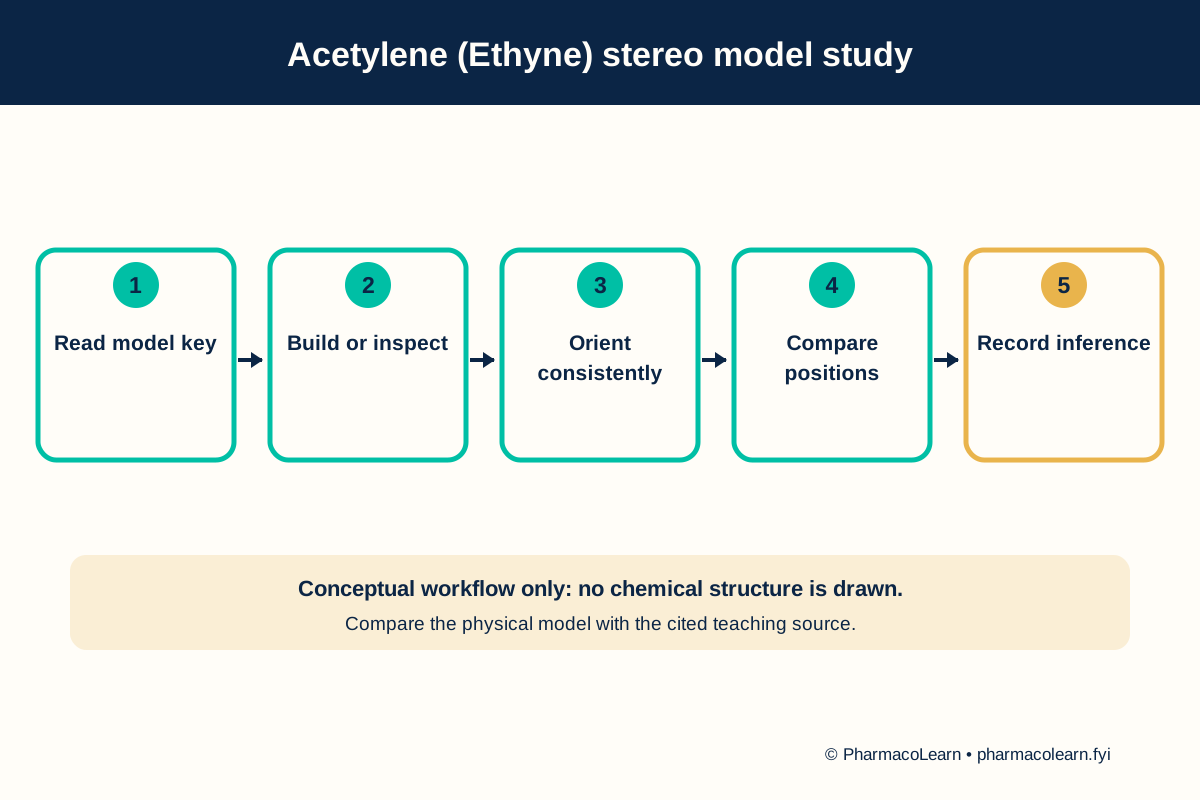
- Select the kit pieces indicated for a triple-bond example or inspect a preassembled model.
- Identify the two carbon positions and the terminal positions without handling a gas sample.
- View the model from two perpendicular directions and record whether the atom positions remain in one straight line.
- Compare its arrangement with the planar ethylene model and tetrahedral methane model.
- Use the instructor reference card to note the idealized linear angle.
- Record any limitation of the kit, such as bulky connectors that obscure alignment.
- State the supported geometry and return the model parts.
5. Calculation, graph, or images as appropriate
| Model observation | Actual teaching record |
|---|---|
| Number of directions at each carbon | Record here |
| Overall alignment | Record here |
| Idealized angle | Record here |
| Model limitation | Record here |
Pre-assumed observations for explanation only: a correct model places the terminal positions and two carbons along one line, corresponding to a 180-degree idealized angle. This is a geometric model observation, not a gas measurement. Actual kit findings must be recorded here. This section records shape or orientation rather than a synthesis yield. No reagent-volume or product-mass calculation is required.
6. Result
Report the named geometry or stereochemical relationship only after comparing the actual model with the cited reference and the instructor's labels. The submitted model result must be recorded here. Safety note: No acetylene gas or ignition source belongs in this teaching exercise. Use the model under ordinary laboratory supervision and keep small parts contained.
7. References
- Pharmacy Council of India, Pharm.D. Regulations, 2008.
- OpenStax, Carbon and Molecular Geometry.
- Colorado State University, Molecular Shapes.
Back to Pharmaceutical Organic Chemistry practicals | Pharm.D. Year 1 Practicals · All Pharm D Practicals · Pharm D
Theory notes: Pharmaceutical Organic Chemistry