
← Pharmaceutical Inorganic Chemistry Practicals
Swelling Power of Bentonite
1. Aim
To measure the settled volume produced by an assigned bentonite sample under a verified swelling-power method. The controlling monograph and minimum criterion are to be recorded from the assigned current monograph or approved college method in the student record.
2. Requirements
Assigned bentonite, approved wetting medium, graduated cylinder, balance, timer, suitable water, stirring or addition tools, eye protection, and dust control. Exact sample mass, medium composition, addition schedule, standing time, and reading convention are specified in your college lab manual and instructor's method sheet.
3. Theory
Bentonite is a swelling clay. When hydrated, its particles absorb water and form an expanded sediment. The measured settled or swollen volume depends on sample mass, medium, how the powder is added, trapped air, and standing time. A classroom manual describes a surfactant-containing medium, but that recipe and its acceptance limit must not be treated as universal for every bentonite grade. The assay records a volume under a named method, not an inherent constant of all bentonites.
4. Procedure
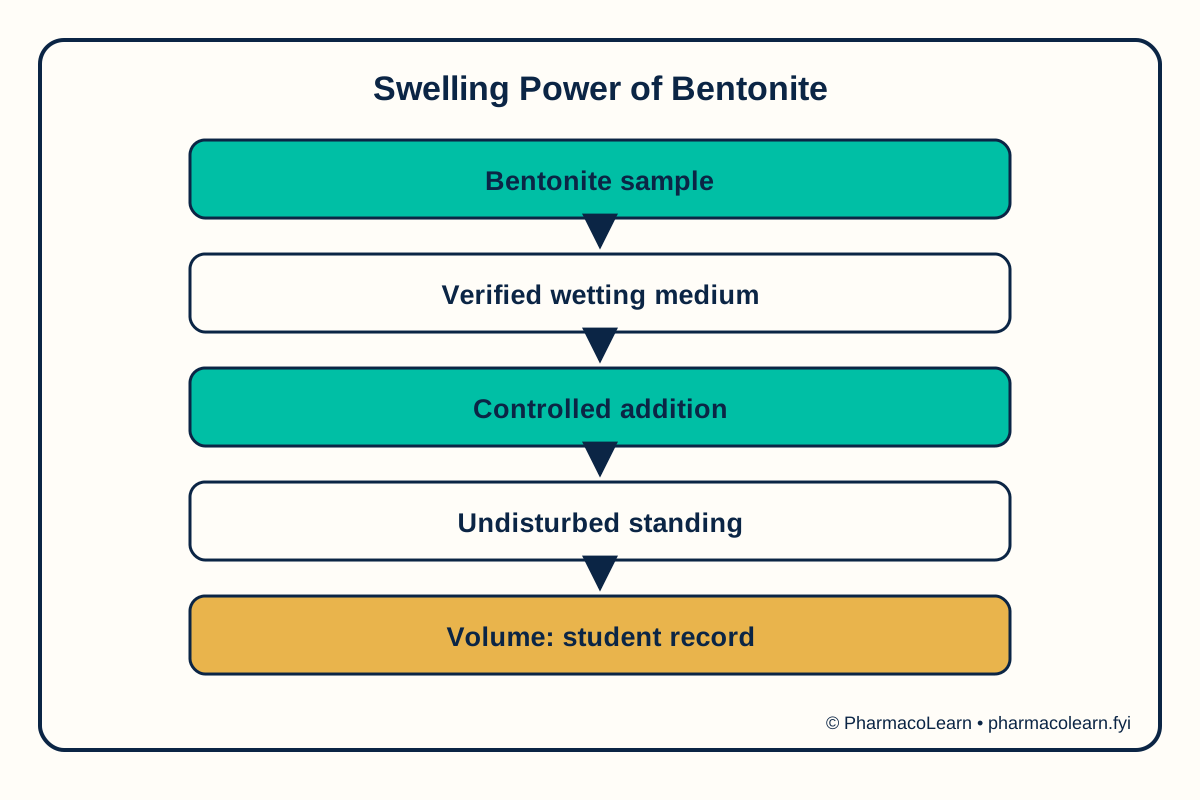
- Confirm the assigned bentonite monograph, wetting medium, sample mass, addition schedule, standing time, and reading rule; record missing details as unresolved and consult the approved local method.
- Prepare a clean graduated cylinder and record the starting medium and cylinder reading.
- Add the specified sample portions as the approved method directs, avoiding loss of powder and large trapped-air pockets.
- Allow the cylinder to stand undisturbed for the verified time.
- Read the swollen sediment boundary at eye level, repeat if prescribed, and compare the actual volume with the verified criterion.
5. Calculation, graph, or images as appropriate
| Observation | Actual teaching record |
|---|---|
| Bentonite grade and batch | Record here |
| Sample mass | Record here |
| Medium identity and volume | Record here |
| Addition schedule | Record here |
| Standing time | Record here |
| Swollen sediment volume and decision | Record here |
Assumed values for practice only: assume an assumed sample mass of 2.00 g and an assumed final swollen volume of 26.0 mL. These invented inputs are a calculation example, not a universal recipe or result.
- The illustrative swelling index is assumed 26.0 mL ÷ assumed 2.00 g = 13.0 mL/g.
- If the verified method reports only settled volume, report the observed millilitres instead; do not substitute the index.
- Record actual swelling power here when readings are available. The pass status is determined by the qualified reviewer against the assigned current monograph or approved method and recorded in the student record. This page decides nothing: it does not pass, fail, identify, or release any sample.
6. Result
Record the actual result here only when the method and measurements are confirmed. The product decision is made by the qualified reviewer against the assigned current monograph or approved method and recorded in the student record. This page decides nothing: it does not pass, fail, identify, or release any sample. Safety note: Avoid inhaling fine bentonite dust and use a supervised teaching-lab setup. Clean spills promptly to prevent slippery floors.
7. References
- Pharmacy Council of India, Pharm.D. Regulations, 2008.
- IQ City Institute of Pharmaceutical Sciences, Swelling Power in Bentonite.
Back to Pharmaceutical Inorganic Chemistry Practicals · All Pharm D Practicals · Pharm D
Theory notes: Pharmaceutical Inorganic Chemistry