
← Pharmaceutical Inorganic Chemistry Practicals
Identity Test for Potassium Chloride
1. Aim
To verify the prescribed potassium and chloride identity responses of an assigned potassium chloride sample. The current monograph and full acceptance conditions are to be recorded from the assigned current monograph or approved college method in the student record.
2. Requirements
Assigned potassium chloride, water, approved chloride reagent and acid medium, prescribed potassium confirmation setup, matched controls, test tubes, protective equipment, and silver-containing waste vessel if silver reagent is used. Exact volumes and concentrations are specified in your college lab manual and instructor's method sheet.
3. Theory
Potassium chloride dissolves to provide potassium and chloride ions. Chloride can be confirmed by a controlled precipitation reaction, while potassium requires a separate prescribed ion test. A flame colour alone can be masked by sodium contamination, and a white chloride precipitate alone can arise from many chloride salts. Both independent responses and the monograph controls are therefore needed. Appearance and solubility support the record but do not replace identity tests.
4. Procedure
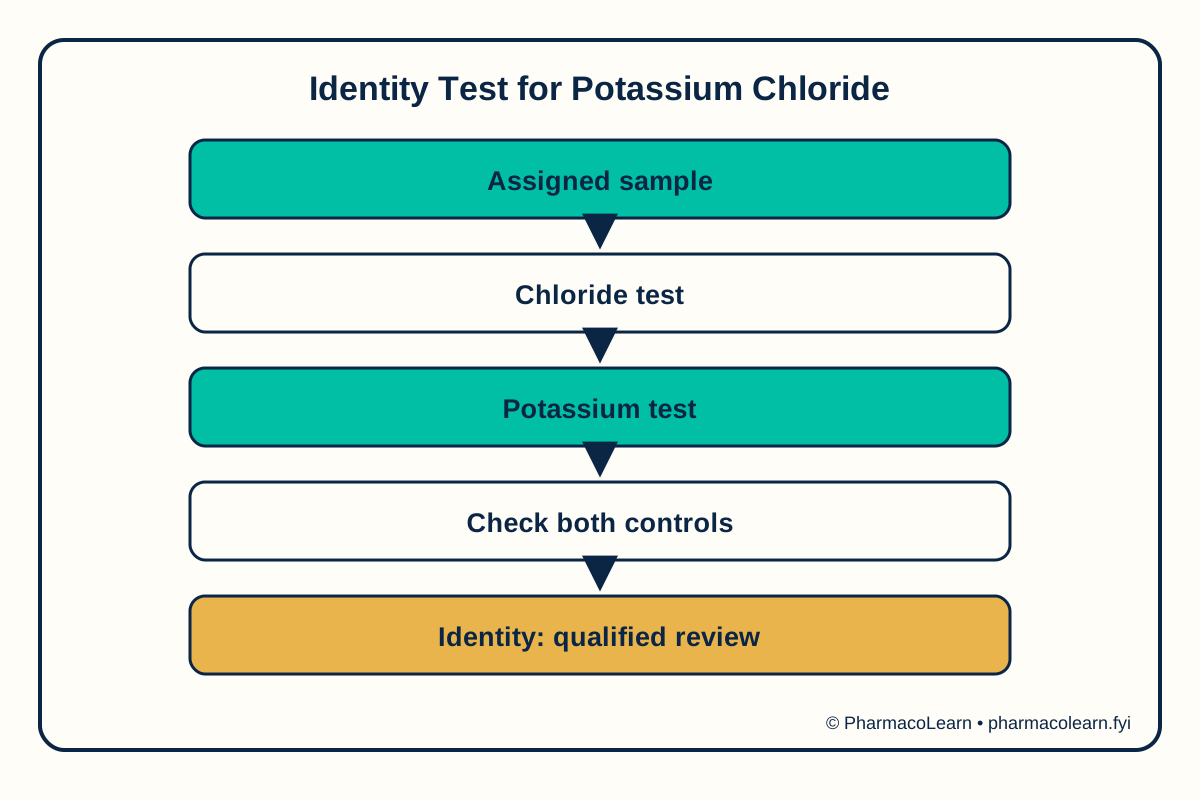
- Identify the material monograph and its required potassium and chloride procedures; resolve details with the approved local method.
- Prepare a labelled sample solution and matching blank or reference as directed.
- Use the verified chloride test on one portion and record precipitate or other response.
- Use the prescribed potassium test on a separate portion, controlling sodium interference if the method requires it.
- Compare each response with the approved positive and negative controls, then state an identity decision only after both tests are valid.
5. Calculation, graph, or images as appropriate
| Observation | Actual teaching record |
|---|---|
| Sample label and appearance | Record here |
| Chloride method and control | Record here |
| Chloride response | Record here |
| Potassium method and control | Record here |
| Potassium response | Record here |
| Identity conclusion | Record here |
No concentration is inferred from these qualitative reactions. Assumed observations for practice only: an assumed chloride test gives its prescribed response and an assumed potassium test agrees with its positive control. These invented responses do not establish the identity of a real sample. The actual identity decision is made by the qualified reviewer against the assigned current monograph or approved method and recorded in the student record. This page decides nothing: it does not pass, fail, identify, or release any sample.
6. Result
Record the actual result here only when the method and measurements are confirmed. The product decision is made by the qualified reviewer against the assigned current monograph or approved method and recorded in the student record. This page decides nothing: it does not pass, fail, identify, or release any sample. Safety note: Silver reagent can stain or irritate; flames, if used by the approved potassium method, require instructor control. Never taste the sample.
7. References
- Pharmacy Council of India, Pharm.D. Regulations, 2008.
- United States Pharmacopeia, Potassium Chloride monograph preview.
- Truman State University, Inorganic Qualitative Analysis.
Back to Pharmaceutical Inorganic Chemistry Practicals · All Pharm D Practicals · Pharm D
Theory notes: Pharmaceutical Inorganic Chemistry