
← Pharmaceutical Inorganic Chemistry Practicals
Acid Neutralising Capacity of Aluminium Hydroxide Gel
1. Aim
To calculate the acid consumed by an assigned aluminium hydroxide gel sample using a validated excess-acid back titration. The product-specific criterion is to be recorded from the assigned current monograph or approved college method in the student record.
2. Requirements
Assigned gel, standardized hydrochloric acid and sodium hydroxide, verified indicator or pH endpoint, timed mixing setup, burettes, pipettes, flask, balance or volumetric measure, and protective equipment. Exact concentrations, acid excess, contact time, temperature, and reporting unit are specified in your college lab manual and instructor's method sheet.
3. Theory
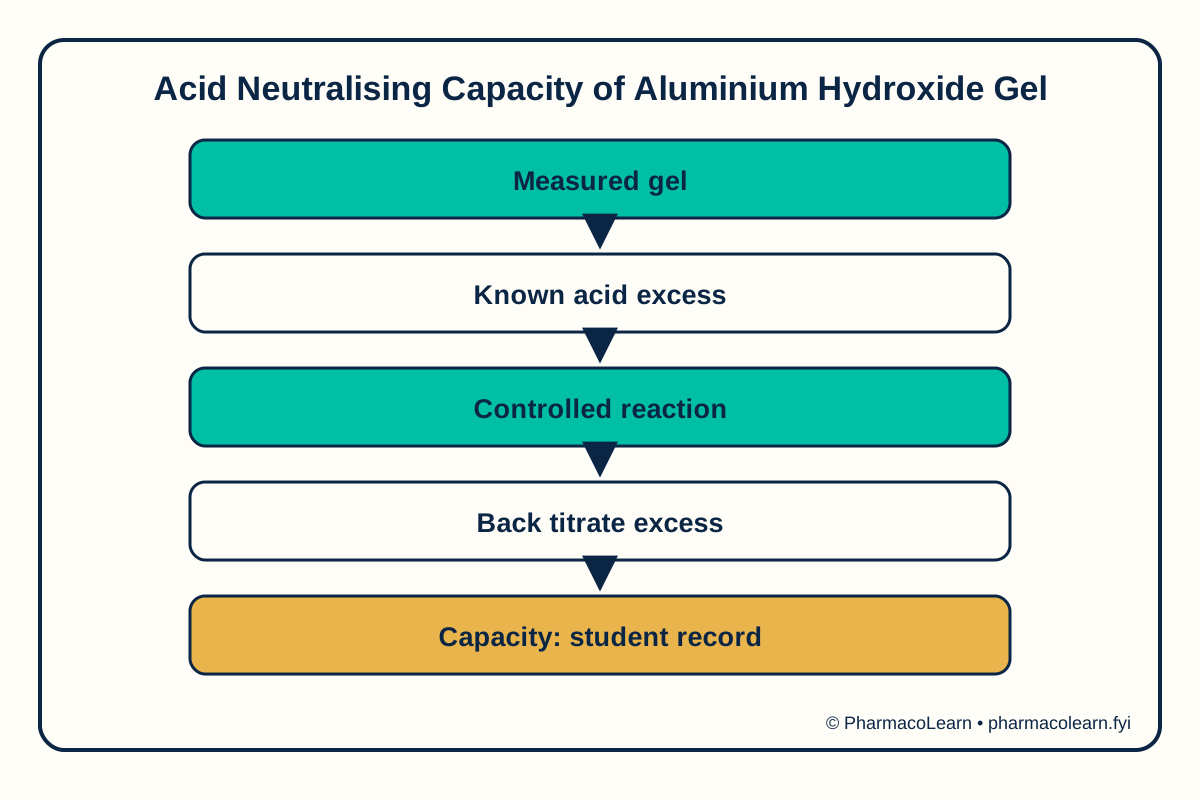
An accurately measured excess of strong acid reacts with basic material in the gel. The remaining acid is back titrated with standard base. Acid consumed equals acid added minus acid remaining, after appropriate blank correction. Aluminium hydroxide gel may vary in composition and water content, so capacity should be reported on the verified mass or volume basis rather than assuming pure Al(OH)3. Endpoint and contact conditions affect the result.
4. Procedure
- Verify sample type, acid and base standardization, blank, contact conditions, endpoint, and monograph unit; resolve these points with the approved local method.
- Measure or weigh the assigned gel and record its actual amount.
- Add a known excess of standardized acid under the prescribed mixing and contact conditions.
- Back titrate remaining acid with standardized base to the validated endpoint; run the required blank.
- Calculate millimoles of acid consumed on the specified sample basis and compare with the verified criterion.
5. Calculation, graph, or images as appropriate
| Observation | Actual teaching record |
|---|---|
| Gel mass or volume | Record here |
| Acid standardized molarity and volume | Record here |
| Base standardized molarity and titre | Record here |
| Blank and contact conditions | Record here |
| Acid consumed | Record here |
| Capacity per verified sample unit | Record here |
Assumed values for practice only: assumed acid addition 50.00 mL at assumed 0.1000 mol/L, assumed base titre 20.00 mL at assumed 0.1000 mol/L, and assumed gel mass 1.000 g. Assume zero blank correction solely for this teaching example. None are measured values or reagent instructions.
- Assumed acid added = 0.05000 × 0.1000 = 5.000 mmol.
- Assumed acid remaining = 0.02000 × 0.1000 = 2.000 mmol.
- Illustrative acid consumed = 5.000 minus 2.000 = 3.000 mmol; illustrative capacity = 3.000 ÷ assumed 1.000 g = 3.000 mmol/g.
- Record the actual result here. Pass status is determined by the qualified reviewer against the assigned current monograph or approved method and recorded in the student record. This page decides nothing: it does not pass, fail, identify, or release any sample.
6. Result
Record the actual result here only when the method and measurements are confirmed. The product decision is made by the qualified reviewer against the assigned current monograph or approved method and recorded in the student record. This page decides nothing: it does not pass, fail, identify, or release any sample. Safety note: Acid and base are corrosive. Handle the gel as a laboratory sample and do not use the teaching result to advise a patient.
7. References
- Pharmacy Council of India, Pharm.D. Regulations, 2008.
- IQ City Institute of Pharmaceutical Sciences, Acid Neutralising Capacity of Aluminium Hydroxide Gel.
Back to Pharmaceutical Inorganic Chemistry Practicals · All Pharm D Practicals · Pharm D
Theory notes: Pharmaceutical Inorganic Chemistry