
← Pharmaceutical Inorganic Chemistry Practicals
Test for Ammonium Salts in Potash Alum
1. Aim
To check an assigned potash alum sample for ammonium contamination using the current monograph-approved test. The method and acceptance criterion are to be recorded from the assigned current monograph or approved college method in the student record.
2. Requirements
Assigned potash alum, ammonia-free water, validated ammonium reference and blank, instructor-approved test reagent or detector, test tubes, fume hood if needed, and labelled waste vessel. Exact sample preparation, reagent, volume, timing, and limit are to be recorded from the assigned current monograph or approved college method in the student record.
3. Theory
Potash alum contains potassium, aluminium, and sulphate; an ammonium salt may be an unwanted substitution or impurity. A suitable assay differentiates ammonium from the expected ions and compares the sample with an approved reference or stated limit. Nessler chemistry is used in some historical ammonium tests but introduces mercury waste and must not be adopted without the controlling monograph. A positive ammonia odour is neither safe nor sufficiently specific as a release test.
4. Procedure
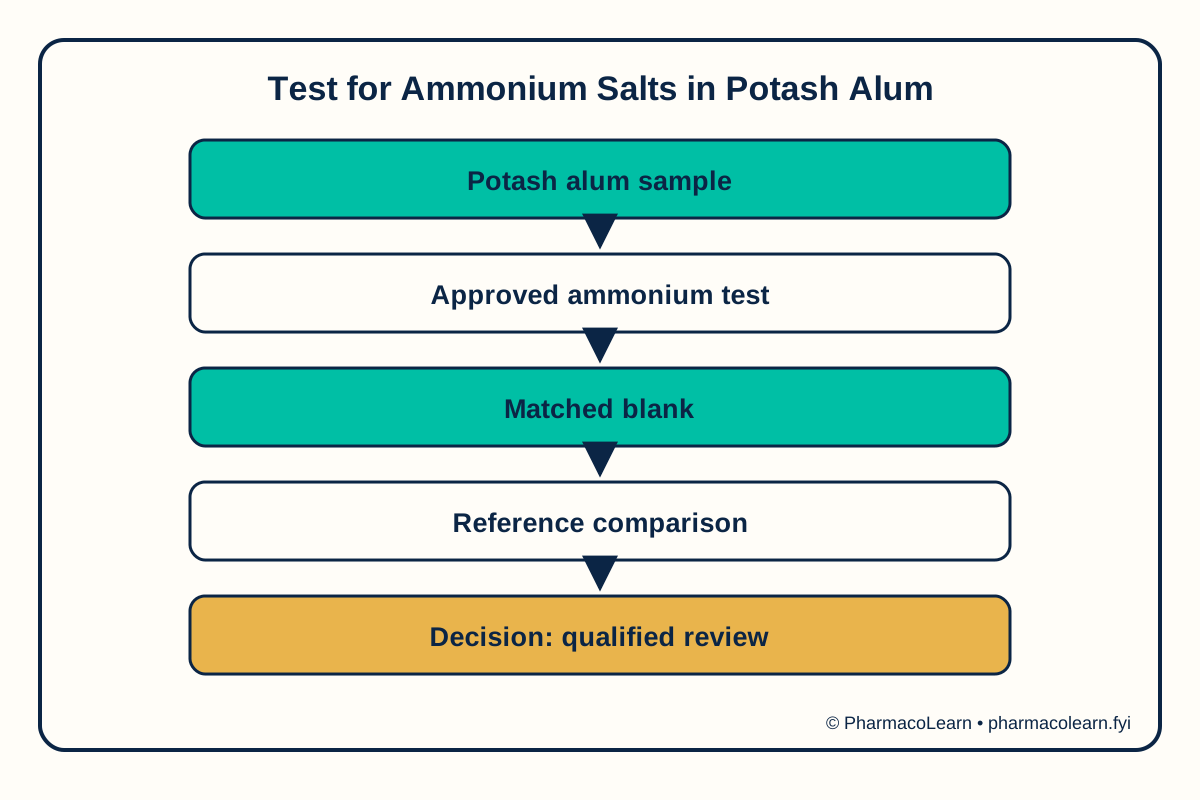
- Identify the current potash alum monograph and its required ammonium test or modern approved alternative; obtain missing details from the approved local method.
- Prepare a clean blank, ammonium reference, and sample according to that method.
- Have trained staff dispense the approved reagent or detector, especially if mercury chemistry is involved.
- Develop and compare the sample and reference under matched timing and viewing conditions.
- Record the actual observation and decide pass, fail, or inconclusive only against the verified criterion.
5. Calculation, graph, or images as appropriate
| Observation | Actual teaching record |
|---|---|
| Alum identity and batch | Record here |
| Approved ammonium method | Record here |
| Blank response | Record here |
| Reference response | Record here |
| Sample response | Record here |
| Actual criterion and decision | Record here |
This is a limit or identity comparison, not an invented concentration calculation. Assumed observations for practice only: an assumed blank is negative, an assumed reference responds, and an assumed sample appears weaker than the reference. These invented observations do not prove compliance. The real result must be recorded here.
6. Result
Record the actual result here only when the method and measurements are confirmed. The product decision is made by the qualified reviewer against the assigned current monograph or approved method and recorded in the student record. This page decides nothing: it does not pass, fail, identify, or release any sample. Safety note: Do not sniff vapour. If a mercury-containing reagent is mandated, use a supervised hood and collect dedicated mercury waste. A mercury-free validated method is preferred where the monograph permits it.
7. References
- Pharmacy Council of India, Pharm.D. Regulations, 2008.
- Government of India Directorate of Forensic Science Services, Chemistry Manual.
Back to Pharmaceutical Inorganic Chemistry Practicals · All Pharm D Practicals · Pharm D
Theory notes: Pharmaceutical Inorganic Chemistry