
← Pharmaceutical Inorganic Chemistry Practicals
Preparation of Calcium Lactate
1. Aim
To prepare calcium lactate from verified calcium and lactic-acid sources in a supervised teaching exercise. Product hydrate, reagent quantities, and identity checks are to be recorded from the assigned current monograph or approved college method in the student record.
2. Requirements
Approved lactic acid and calcium source, suitable water, controlled mixing vessel, filtration and crystallization or drying equipment, balance, protective equipment, and waste vessel. Calcium source, lactic-acid strength, stoichiometric amounts, temperatures, and final hydrate are to be recorded from the assigned current monograph or approved college method in the student record.
3. Theory
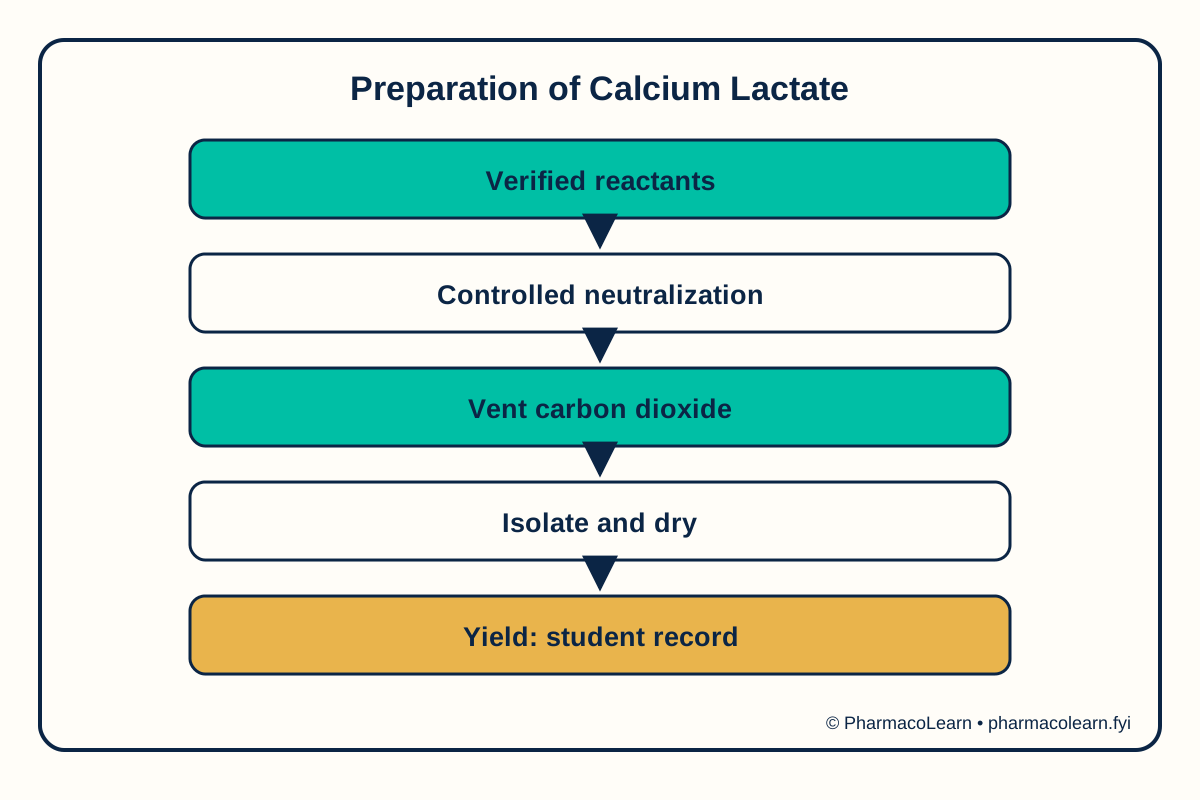
Calcium carbonate can neutralize lactic acid to form calcium lactate, water, and carbon dioxide. The product is separated and crystallized or dried according to the approved process. The gas evolution must not occur in a sealed vessel. Calcium lactate can exist in different hydration states, so theoretical yield and product mass comparison require the exact target formula and verified drying condition. A government process description supports the overall neutralization and isolation sequence, not a student-scale recipe.
4. Procedure
- Confirm the approved calcium source, lactic-acid assay, target calcium lactate hydrate, and controlled method; missing details are to be recorded from the assigned current monograph or approved college method in the student record.
- Measure the assigned reagents only after instructor verification of their actual concentrations and amounts.
- Carry out controlled neutralization in a vented vessel, watching for the prescribed completion sign.
- Filter or clarify the mixture and crystallize or dry the product by the verified process.
- Weigh the dry product, perform the required identity or purity checks, and calculate yield using the confirmed hydrate.
5. Calculation, graph, or images as appropriate
| Observation | Actual teaching record |
|---|---|
| Calcium source and amount | Record here |
| Lactic-acid strength and amount | Record here |
| Reaction and gas observations | Record here |
| Product drying conditions | Record here |
| Dry product mass | Record here |
| Identity and percentage yield | Record here |
Assumed values for practice only: assume a worksheet supplies an assumed theoretical yield of 5.00 g for its verified calcium lactate hydrate and an assumed dry product mass of 3.75 g. These invented masses are not preparation instructions or actual observations.
- Illustrative yield = assumed 3.75 g ÷ assumed 5.00 g × 100 = 75.0%.
- Actual yield and calcium-lactate formula must be recorded here until the starting materials, reagent assays, product hydrate, and weighed mass are confirmed.
6. Result
The actual result and decision must be recorded here until the method and measured record are confirmed. Safety note: Neutralization releases carbon dioxide and can foam. Use an open, supervised vessel, eye protection, and controlled mixing. The student preparation is not a medicine.
7. References
- Pharmacy Council of India, Pharm.D. Regulations, 2008.
- Government of India Environment Clearance Annexure, Calcium Lactate Process.
- Subba Rao, Practical Pharmaceutical Inorganic Chemistry, contents preview.
Back to Pharmaceutical Inorganic Chemistry Practicals · All Pharm D Practicals · Pharm D
Theory notes: Pharmaceutical Inorganic Chemistry