
← Pharmaceutical Inorganic Chemistry Practicals
Preparation of Magnesium Sulphate
1. Aim
To prepare and isolate crystalline magnesium sulphate from a verified magnesium source by a supervised teaching method. The product hydrate, starting quantities, and identity criteria are to be recorded from the assigned current monograph or approved college method in the student record.
2. Requirements
Assigned magnesium carbonate or the approved magnesium source, prescribed sulphuric acid, suitable water, warm vessel, stirrer, filter setup, crystallization dish, balance, protective equipment, and magnesium-containing waste vessel. Exact acid strength, mass, temperature, and drying conditions are to be recorded from the assigned current monograph or approved college method in the student record.
3. Theory
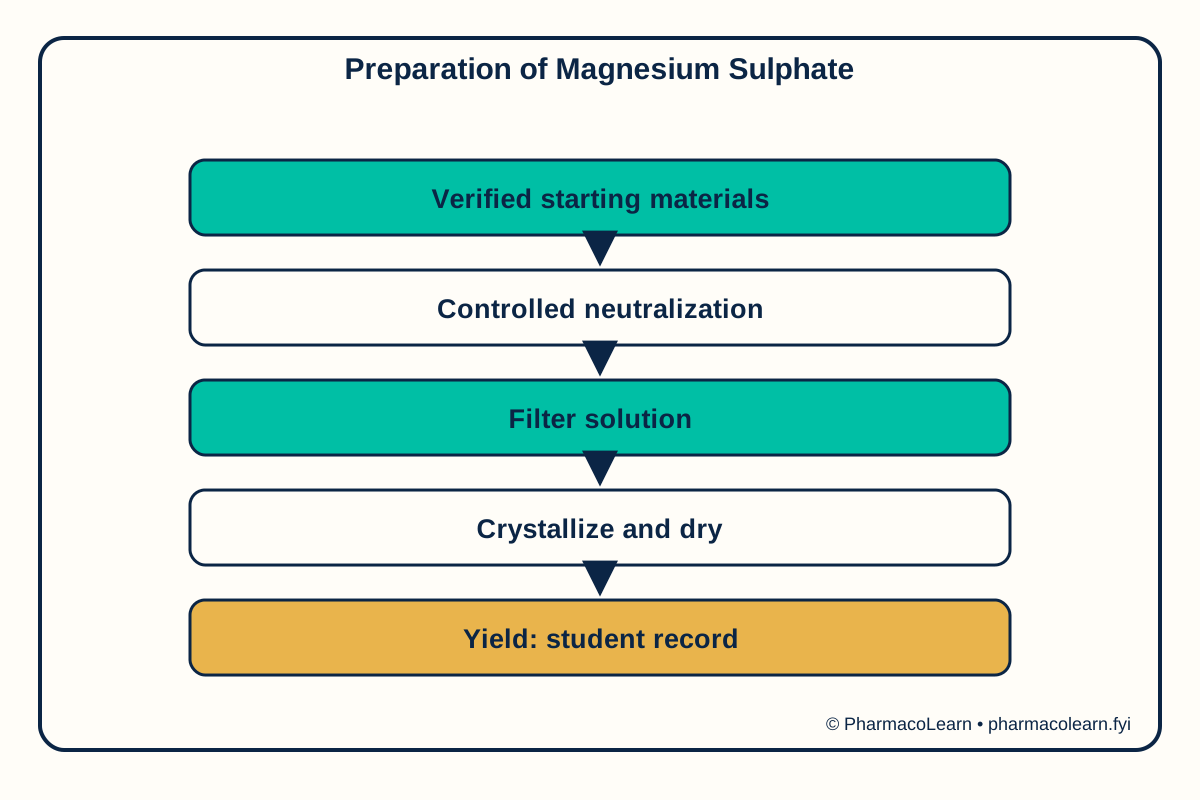
Magnesium carbonate reacts with sulphuric acid to form magnesium sulphate, water, and carbon dioxide. A controlled excess of starting solid can help avoid excess acid, but the actual endpoint and separation method belong to the verified protocol. Clarifying the solution and cooling an appropriately concentrated filtrate can produce crystals. Magnesium sulphate may crystallize with water of hydration; theoretical yield calculated for anhydrous material cannot be compared directly with a hydrated crystal mass. The source manual describes the route but its reported formula mass is anhydrous, so this page explicitly checks the hydrate before yield calculation.
4. Procedure
- Confirm the specified magnesium source, acid strength, stoichiometry, target hydrate, and drying method. Missing conditions are to be recorded from the assigned current monograph or approved college method in the student record.
- In a vented vessel under teaching-lab supervision, combine the approved acid and magnesium source according to the verified sequence.
- Observe the reaction without sealing the vessel. Filter the clarified solution as the method directs.
- Concentrate and cool the filtrate under the approved conditions to form crystals.
- Collect, dry, and weigh the product. Record crystal appearance and any required identity or purity tests.
- Calculate theoretical and percentage yield using the verified reactant assay and target hydrate.
5. Calculation, graph, or images as appropriate
| Observation | Actual teaching record |
|---|---|
| Magnesium source and mass | Record here |
| Acid identity and amount | Record here |
| Reaction observation | Record here |
| Target hydrate | Record here |
| Dry crystal mass | Record here |
| Verified theoretical and percentage yield | Record here |
Assumed values for practice only: assume a worksheet has already established an assumed theoretical yield of 5.00 g for a verified target hydrate, and assume the isolated dry mass is assumed 4.10 g. These invented values are not actual observations or reagent instructions.
- Illustrative yield = assumed 4.10 g ÷ assumed 5.00 g × 100 = 82.0%.
- The actual theoretical yield, hydrate identity, and purity must be recorded here until reagent masses and product checks are known.
6. Result
The actual result and any identification or yield conclusion must be recorded here until the teaching method and observed record are confirmed. Safety note: Sulphuric acid is corrosive and the reaction releases carbon dioxide. Use a vented vessel, eye protection, instructor supervision, and safe hot-glass handling. The product is not for use as medicine.
7. References
- Pharmacy Council of India, Pharm.D. Regulations, 2008.
- East Point College of Pharmacy, Pharmaceutical Inorganic Chemistry Manual.
Back to Pharmaceutical Inorganic Chemistry Practicals · All Pharm D Practicals · Pharm D
Theory notes: Pharmaceutical Inorganic Chemistry