
← Pharmaceutical Inorganic Chemistry Practicals
Estimation of a Sodium Hydroxide and Sodium Carbonate Mixture
1. Aim
To resolve sodium hydroxide and sodium carbonate in a supplied mixed-alkali solution by two endpoint titration. Record the sample mass and dilution here.
2. Requirements
Assigned mixed-alkali solution, standardized hydrochloric acid, phenolphthalein and methyl-orange or validated potentiometric endpoint, suitable water, burette, pipette, flasks, and eye protection. Exact aliquot, acid concentration, endpoint and sample basis are specified in your college lab manual and instructor's method sheet.
3. Theory
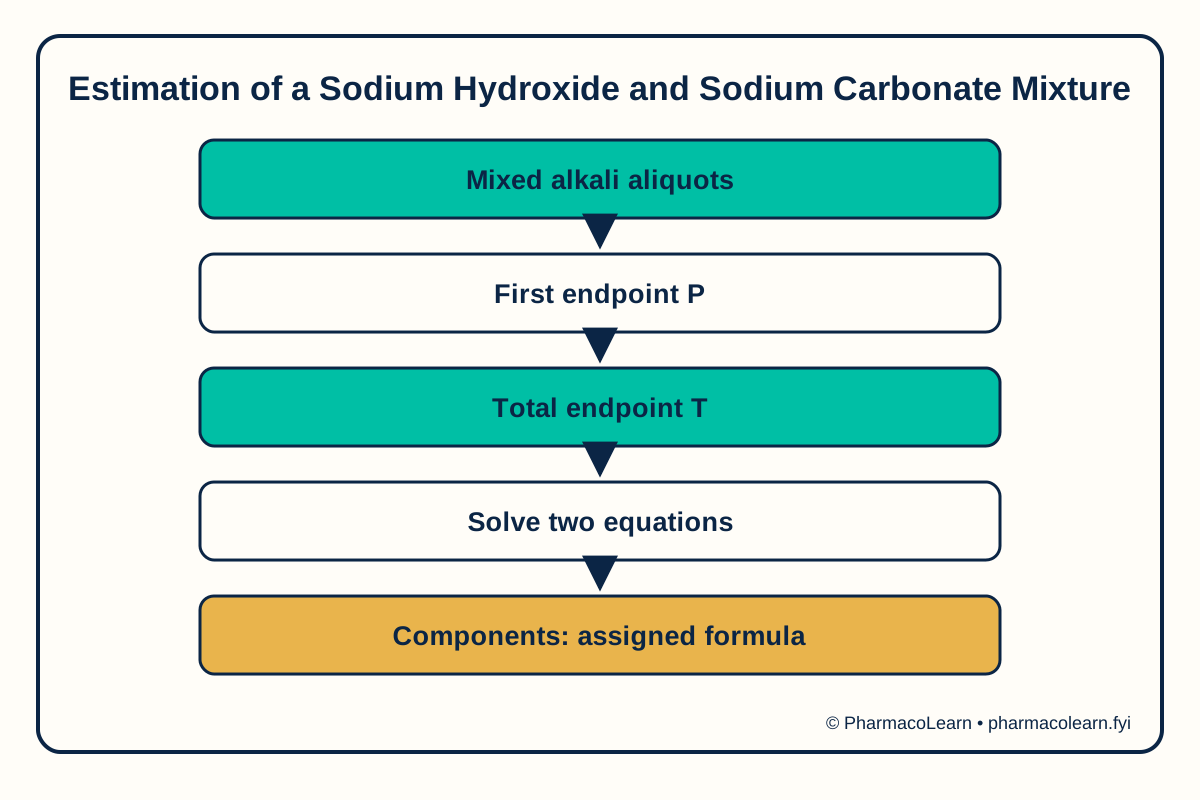
At the phenolphthalein endpoint, acid has neutralized all hydroxide and converted carbonate to bicarbonate. The later methyl-orange endpoint accounts for the second proton of carbonate. For equal sample aliquots, let P be acid volume to the first endpoint and T the total volume to the second endpoint. With one molar acid, carbonate moles equal C(T−P), and hydroxide moles equal C(2P−T), where volumes are in litres. Valid data require T between P and 2P. Endpoint drift and atmospheric carbon dioxide can disturb the separation.
4. Procedure
- Verify the acid standardization and the two endpoint definitions; resolve protocol details with the approved local method.
- Pipette equal fresh aliquots of the supplied mixture into two flasks or use an approved sequential method.
- Titrate one aliquot to the phenolphthalein endpoint and record P.
- Titrate a matched aliquot to the methyl-orange endpoint and record total T, or continue as the method directs.
- Repeat to concordance and calculate both components from the two equations, applying the verified dilution.
5. Calculation, graph, or images as appropriate
| Observation | Actual teaching record |
|---|---|
| Mixture mass and dilution | Record here |
| Aliquot volume | Record here |
| Acid standardized molarity | Record here |
| Phenolphthalein titre P | Record here |
| Total methyl-orange titre T | Record here |
| Calculated component masses | Record here |
Assumed values for practice only: assumed acid concentration 0.1000 mol/L, assumed first-endpoint volume P = 15.00 mL, and assumed total second-endpoint volume T = 20.00 mL for equal aliquots. These are invented values only.
- Illustrative carbonate amount = 0.1000 × (0.02000−0.01500) = 0.000500 mol.
- Illustrative hydroxide amount = 0.1000 × (2 × 0.01500−0.02000) = 0.001000 mol.
- Illustrative Na2CO3 mass = 0.000500 × 105.99 = 53.00 mg, and illustrative NaOH mass = 0.001000 × 40.00 = 40.00 mg, each in the assumed aliquot.
- Actual composition and percentage must be recorded here.
6. Result
Record the actual result here only when the stated conditions and observations are confirmed. The monograph decision is made by the qualified reviewer against the assigned current monograph or approved method and recorded in the student record. This page decides nothing: it does not pass, fail, identify, or release any sample. Safety note: Hydrochloric acid and sodium hydroxide are corrosive. Work under teaching-lab supervision and rinse splashes under the institutional protocol.
7. References
- Pharmacy Council of India, Pharm.D. Regulations, 2008.
- NPTEL, Titration of a Carbonate and Hydroxide Mixture.
- Guru Ghasidas Vishwavidyalaya, Chemistry Laboratory Manual.
Back to Pharmaceutical Inorganic Chemistry Practicals · All Pharm D Practicals · Pharm D
Theory notes: Pharmaceutical Inorganic Chemistry