
← Pharmaceutical Inorganic Chemistry Practicals
Assay of Antimony Potassium Tartrate by Iodimetry
1. Aim
To interpret an iodimetric assay of antimony potassium tartrate, the chosen PCI option for the sodium antimony gluconate or antimony potassium tartrate entry. Product formula, hydrate, and current monograph are to be recorded from the assigned current monograph or approved college method in the student record.
2. Requirements
Instructor-supplied antimony potassium tartrate assay dataset or controlled sample, standardized iodine titrant, verified alkaline tartrate or borate medium and starch endpoint, burette, balance, flask, eye protection, and designated antimony waste. Exact quantities and method version are specified in your college lab manual and instructor's method sheet.
3. Theory
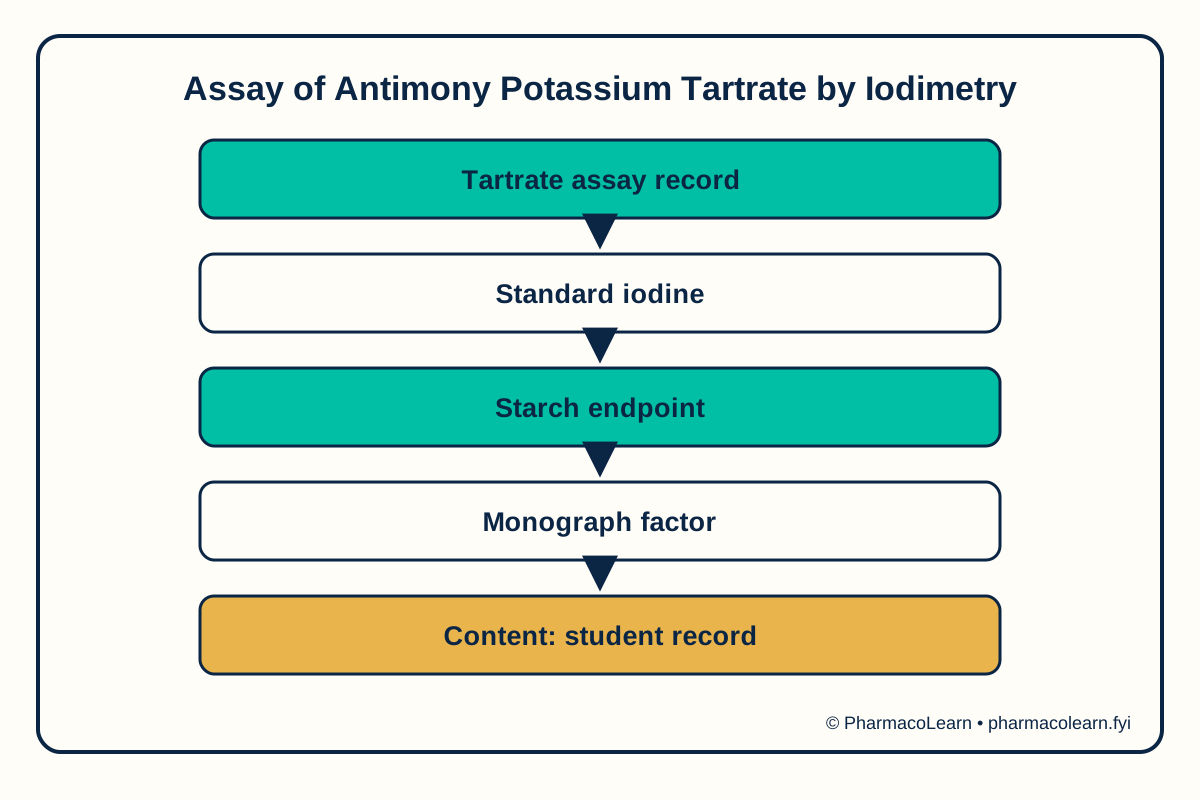
Antimony(III) is oxidized to antimony(V) while iodine is reduced to iodide. Starch detects persistent excess iodine at the endpoint. For the official antimony potassium tartrate trihydrate basis, a 0.1 N iodine titre has a monograph factor of 16.70 mg per mL; this factor depends on the named formula and titrant normality. This page chooses the tartrate branch because an identifiable iodimetric method is available. It is not an assay of sodium antimony gluconate.
4. Procedure
- Verify that the assigned material is antimony potassium tartrate, not sodium antimony gluconate, and obtain the controlling monograph.
- For teaching, provide a verified assay dataset or let trained staff handle the toxic material under the approved protocol.
- Record actual sample mass, iodine standardization, endpoint reagent, and any blank.
- If a physical assay is authorized, titrate in the validated medium to the persistent starch endpoint and record burette readings.
- Calculate mass with the verified titrant factor and compare with the monograph only after confirming hydrate and sample basis.
5. Calculation, graph, or images as appropriate
| Observation | Actual teaching record |
|---|---|
| Chosen antimony compound and hydrate | Record here |
| Sample mass | Record here |
| Iodine standardization | Record here |
| Initial/final readings | Record here |
| Corrected titre | Record here |
| Calculated content and percentage | Record here |
Assumed values for practice only: assumed iodine titre 10.00 mL, assumed iodine strength 0.1000 N, assumed no blank correction, and assumed antimony potassium tartrate trihydrate as the reporting form. All are invented inputs, not actual assay data.
- The cited monograph factor for 0.1 N iodine is 16.70 mg of the trihydrate per mL.
- Illustrative mass = assumed 10.00 mL × 16.70 mg/mL = 167.0 mg in the assumed aliquot.
- If the actual titrant strength differs, scale the factor by actual N ÷ 0.1000 N. Actual percentage and acceptance are to be recorded from the assigned current monograph or approved college method in the student record.
6. Result
Record the actual result here only when the stated conditions and observations are confirmed. The monograph decision is made by the qualified reviewer against the assigned current monograph or approved method and recorded in the student record. This page decides nothing: it does not pass, fail, identify, or release any sample. Safety note: Soluble antimony compounds are toxic. This is a supervised or document-based teaching exercise; collect all antimony waste. Never infer patient suitability from an illustrative assay.
7. References
- Pharmacy Council of India, Pharm.D. Regulations, 2008.
- United States Pharmacopeia, Antimony Potassium Tartrate monograph.
- Annamalai University, Pharmaceutical Chemistry I.
Back to Pharmaceutical Inorganic Chemistry Practicals · All Pharm D Practicals · Pharm D
Theory notes: Pharmaceutical Inorganic Chemistry