
← Pharmaceutical Inorganic Chemistry Practicals
Estimation of a Boric Acid and Borax Mixture
1. Aim
To distinguish borax from boric acid in an assigned mixture using a validated two-stage acid and mannitol-assisted base titration. The precise borax hydrate and calculation convention are to be recorded from the assigned current monograph or approved college method in the student record.
2. Requirements
Assigned boric acid and borax mixture, standardized acid and base, verified mannitol reagent, prescribed indicators or pH meter, water, pipette, burettes, flask, balance, and eye protection. Reagent amounts, endpoints, hydrate, and blank are to be recorded from the assigned current monograph or approved college method in the student record.
3. Theory
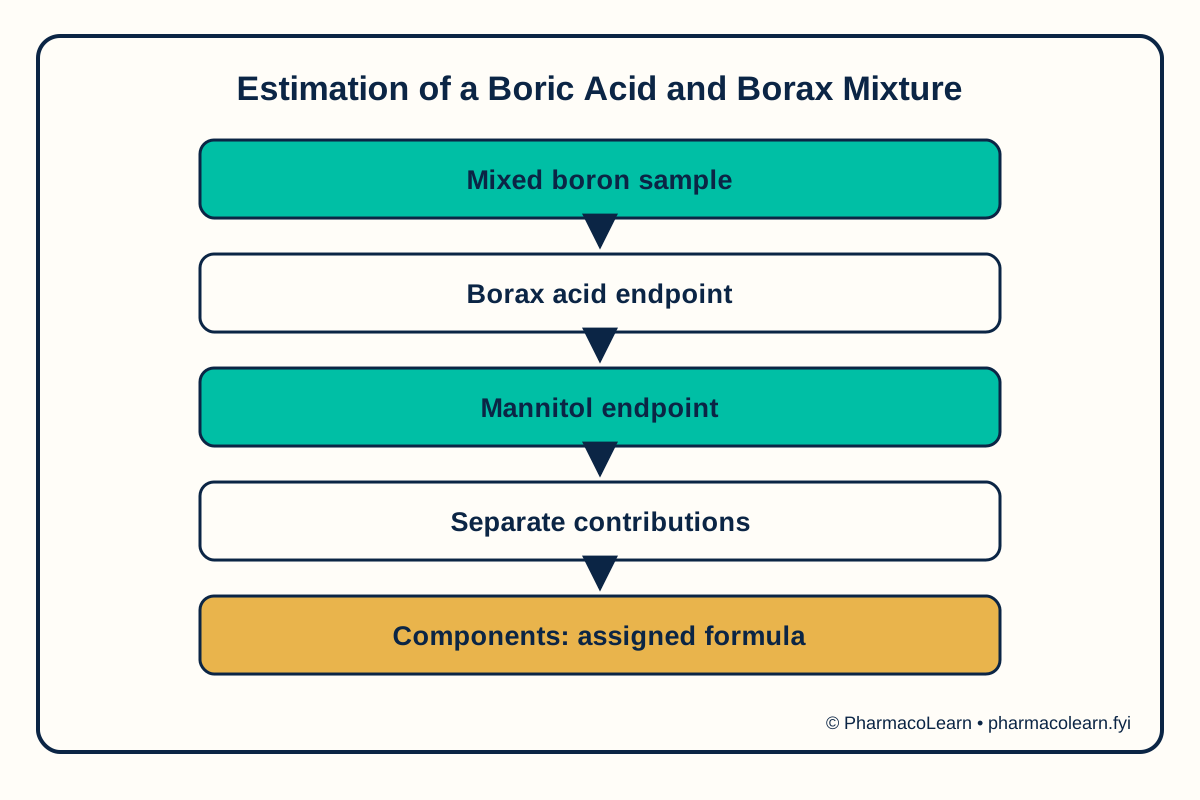
Borax consumes strong acid as its borate converts to boric acid. Boric acid alone is too weak for a sharp ordinary base titration, but mannitol forms a more titratable complex. A first acid endpoint can quantify borax under a verified model; a second mannitol-assisted base endpoint measures the total boric-acid equivalents after conversion. Subtracting the borax-derived contribution yields original boric acid. This subtraction depends on the method’s exact endpoint convention and borax hydrate. A standalone mannitol titre cannot identify both components.
4. Procedure
- Confirm the controlling protocol, borax hydrate, endpoint pH or indicator colours, acid and base standardization, and blank; unresolved items are to be recorded from the assigned current monograph or approved college method in the student record.
- Prepare and measure a fresh aliquot of the mixed sample.
- Titrate to the first verified acid endpoint and record the acid titre associated with borax.
- Add the prescribed mannitol under the validated conditions and titrate with base to the second endpoint.
- Repeat and use the protocol’s stoichiometric equations to separate original boric acid from borax-derived boric acid.
5. Calculation, graph, or images as appropriate
| Observation | Actual teaching record |
|---|---|
| Borax hydrate and sample mass | Record here |
| Sample dilution and aliquot | Record here |
| Acid concentration and titre | Record here |
| Base concentration and titre | Record here |
| Mannitol blank and endpoint | Record here |
| Boric acid and borax results | Record here |
Assumed values for practice only: assume a teaching worksheet supplies an assumed first-endpoint acid amount of 0.001000 mol and an assumed total boric-acid equivalent after conversion of 0.004500 mol. These are invented intermediate quantities, not measured titres or laboratory instructions.
- For the verified borax-to-boric-acid conversion, one borax formula unit yields four boric-acid units. The first-endpoint acid-to-borax mapping must follow your college lab manual and instructor's method sheet for the selected method.
- If that method verifies assumed borax amount 0.000500 mol, its contribution would be 4 × 0.000500 = 0.002000 mol boric-acid equivalents.
- The illustrative original boric-acid amount would be assumed 0.004500 minus assumed 0.002000 = 0.002500 mol. This example is conditional on the verified mapping; actual component masses must be recorded here.
6. Result
Record the actual result here only when the stated conditions and observations are confirmed. The monograph decision is made by the qualified reviewer against the assigned current monograph or approved method and recorded in the student record. This page decides nothing: it does not pass, fail, identify, or release any sample. Safety note: Boric acid, borax, acid, and base require controlled handling. Use teaching-lab supervision and the institution’s boron waste guidance. Do not use the example for formulation release.
7. References
- Pharmacy Council of India, Pharm.D. Regulations, 2008.
- Purdue University, Electrometric Titration of Boric Acid.
- University of California Radiation Laboratory, Titration of Boric Acid in Aqueous Solution.
Back to Pharmaceutical Inorganic Chemistry Practicals · All Pharm D Practicals · Pharm D
Theory notes: Pharmaceutical Inorganic Chemistry