
← Pharmaceutical Inorganic Chemistry Practicals
Estimation of an Oxalic Acid and Sodium Oxalate Mixture
1. Aim
To separate oxalic acid and sodium oxalate in a supplied mixture using an acid-base measurement of free acid and a redox measurement of total oxalate. Hydrate forms and sample basis are to be recorded from the assigned current monograph or approved college method in the student record.
2. Requirements
Assigned mixture, standardized sodium hydroxide, standardized potassium permanganate, prescribed sulphuric-acid medium, validated endpoint indicators, pipettes, burettes, flasks, water, balance, and waste vessels. Exact reagent amounts, warming conditions, and hydrate forms are to be recorded from the assigned current monograph or approved college method in the student record.
3. Theory
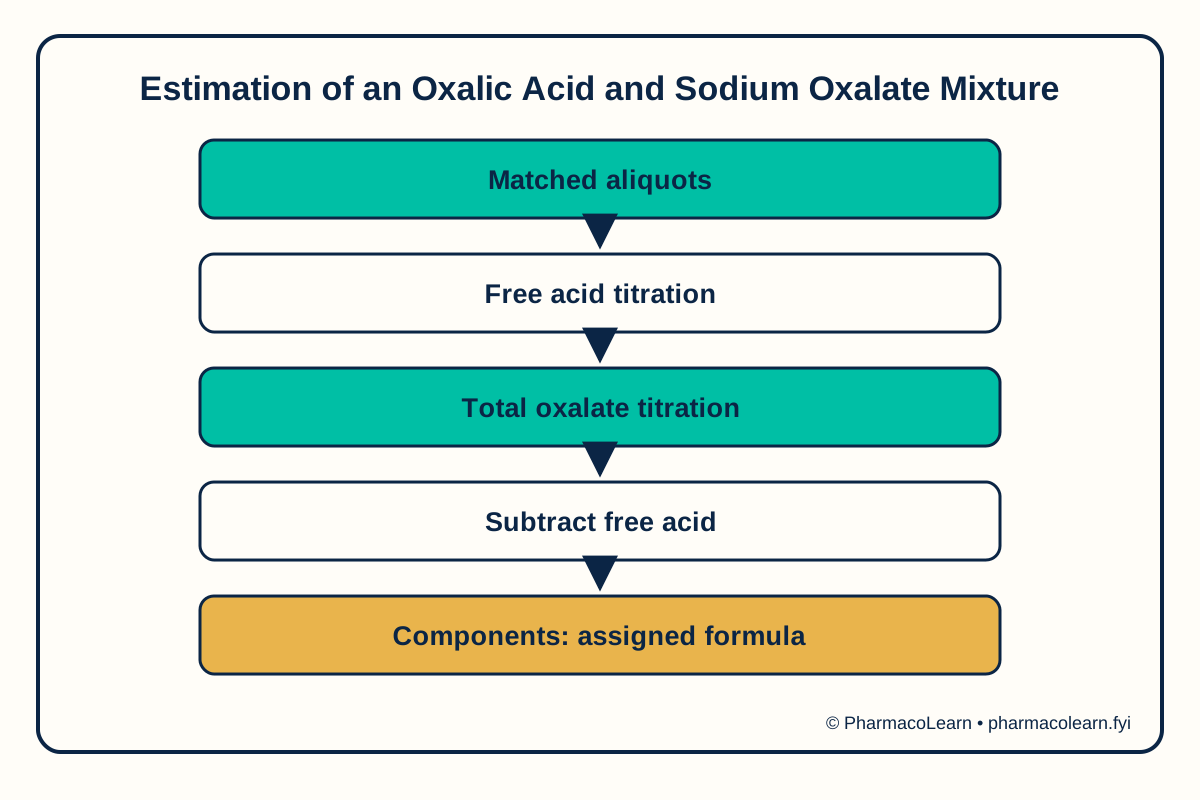
The acid-base aliquot measures only the free oxalic acid, because sodium oxalate is already a salt. A separate acidic permanganate titration measures total oxalate from both components through the 5 oxalate to 2 permanganate mole ratio. Subtracting oxalic-acid oxalate from total oxalate gives sodium oxalate. Oxalic acid may be supplied as a hydrate, so mass conversion must use the verified form. The redox and acid-base aliquots must represent equal sample volumes before subtraction.
4. Procedure
- Verify sample identity, hydrate forms, standardized titrants, aliquot matching, and approved redox conditions; missing items are to be recorded from the assigned current monograph or approved college method in the student record.
- Prepare one mixed-sample solution and take equal aliquots.
- Titrate the first aliquot with standardized base to the validated acid-base endpoint; calculate free oxalic acid using two OH− per acid molecule.
- Acidify the second aliquot with the approved sulphuric-acid medium and titrate total oxalate with standardized permanganate under the prescribed temperature conditions.
- Calculate total oxalate from the 5:2 relation, subtract free-acid oxalate, and report the two components on verified formula bases.
5. Calculation, graph, or images as appropriate
| Observation | Actual teaching record |
|---|---|
| Mixture mass and dilution | Record here |
| Matched aliquots | Record here |
| NaOH standardized molarity and titre | Record here |
| Permanganate standardized molarity and titre | Record here |
| Free acid moles | Record here |
| Sodium oxalate moles | Record here |
Assumed values for practice only: assumed NaOH titre 10.00 mL at assumed 0.1000 mol/L, and assumed permanganate titre 8.00 mL at assumed 0.0500 mol/L, for equal aliquots. These invented values are not observations or instructions.
- Assumed free oxalic acid = (0.01000 × 0.1000) ÷ 2 = 0.000500 mol.
- Assumed total oxalate = (0.00800 × 0.0500) × 5 ÷ 2 = 0.001000 mol.
- Illustrative sodium oxalate = 0.001000 minus 0.000500 = 0.000500 mol in the assumed aliquot.
- Record component masses and percentages here only after actual readings, dilution, and hydrate forms are confirmed.
6. Result
Record the actual result here only when the stated conditions and observations are confirmed. The monograph decision is made by the qualified reviewer against the assigned current monograph or approved method and recorded in the student record. This page decides nothing: it does not pass, fail, identify, or release any sample. Safety note: Oxalic acid is harmful if swallowed; permanganate is an oxidizer and the acid medium is corrosive. Conduct only under supervised teaching-lab controls.
7. References
- Pharmacy Council of India, Pharm.D. Regulations, 2008.
- Umm Al-Qura University, Practical Analytical Chemistry I.
- University of British Columbia, Permanganate Titration.
Back to Pharmaceutical Inorganic Chemistry Practicals · All Pharm D Practicals · Pharm D
Theory notes: Pharmaceutical Inorganic Chemistry