
← Pharmaceutical Inorganic Chemistry Practicals
Assay of Sodium Chloride by the Modified Volhard Method
1. Aim
To determine chloride in an assigned sodium chloride sample by excess silver precipitation followed by thiocyanate back titration. The method variant and reporting basis are specified in your college lab manual and instructor's method sheet.
2. Requirements
Assigned sodium chloride sample, standardized silver nitrate, standardized thiocyanate, prescribed nitric-acid medium and ferric endpoint reagent, approved precipitate-protection step, burettes, pipettes, flask, balance, and silver waste vessel. Exact amounts, concentrations, and protection method are specified in your college lab manual and instructor's method sheet.
3. Theory
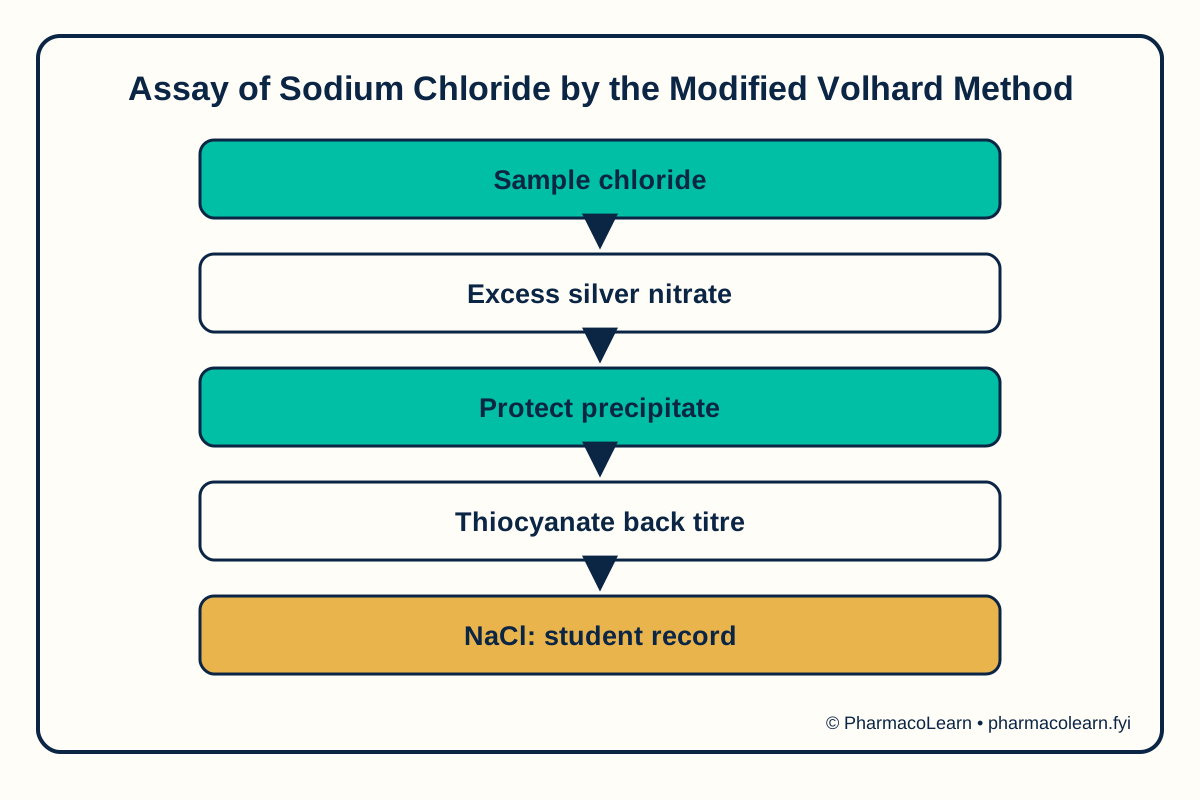
Silver ion first precipitates sample chloride as silver chloride. An accurately known excess of silver remains; thiocyanate back titrates that excess in the presence of a ferric endpoint system. One mole silver consumed by chloride corresponds to one mole sodium chloride. In the modified Volhard method, silver chloride must be separated or protected so thiocyanate does not displace chloride from the precipitate and bias the result. The instructor must specify the approved modification; a hazardous coating solvent should not be assumed.
4. Procedure
- Verify sample preparation, silver and thiocyanate standardization, nitric-acid medium, blank, and approved precipitate handling. Mark missing details Record here.
- Dissolve the assigned sample and transfer the validated aliquot to a flask.
- Add a measured excess of standardized silver nitrate in the prescribed order to form silver chloride.
- Apply the verified modification that prevents silver chloride from reacting with thiocyanate.
- Back titrate remaining silver with standardized thiocyanate to the specified ferric endpoint.
- Record both delivered silver and thiocyanate titres, apply any blank, then calculate chloride and sodium chloride on the actual sample basis.
5. Calculation, graph, or images as appropriate
| Observation | Actual teaching record |
|---|---|
| Sample mass and aliquot | Record here |
| Silver nitrate concentration and volume | Record here |
| Thiocyanate concentration and volume | Record here |
| Approved modification | Record here |
| Blank correction | Record here |
| Sodium chloride mass and percentage | Record here |
Assumed values for practice only: assumed silver nitrate volume 20.00 mL at assumed 0.1000 mol/L, and assumed thiocyanate volume 8.00 mL at assumed 0.1000 mol/L. Assumed blank correction is zero solely for this calculation example. None are measured values or instructions.
- Assumed silver added = 0.02000 × 0.1000 = 0.002000 mol.
- Assumed silver left = 0.00800 × 0.1000 = 0.000800 mol.
- Illustrative chloride = 0.002000 minus 0.000800 = 0.001200 mol.
- Illustrative NaCl mass = 0.001200 × 58.44 g/mol = 70.13 mg in the assumed aliquot, rounded. Actual percentage must be recorded here.
6. Result
Record the actual result here only when the stated conditions and observations are confirmed. The monograph decision is made by the qualified reviewer against the assigned current monograph or approved method and recorded in the student record. This page decides nothing: it does not pass, fail, identify, or release any sample. Safety note: Silver nitrate and nitric acid can injure skin and eyes. Collect silver waste under instructor supervision. Confirm the modification in the approved local method before any laboratory work.
7. References
- Pharmacy Council of India, Pharm.D. Regulations, 2008.
- East Point College of Pharmacy, Pharmaceutical Inorganic Chemistry Manual.
- USDA FSIS, Determination of Salt by Volhard Method.
Back to Pharmaceutical Inorganic Chemistry Practicals · All Pharm D Practicals · Pharm D
Theory notes: Pharmaceutical Inorganic Chemistry