
← Pharmaceutical Inorganic Chemistry Practicals
Assay of Potassium Iodide by Potassium Iodate Titration
1. Aim
To calculate iodide content in an assigned potassium iodide preparation using a validated potassium iodate endpoint. The exact monograph and any correction for free iodine are specified in your college lab manual and instructor's method sheet.
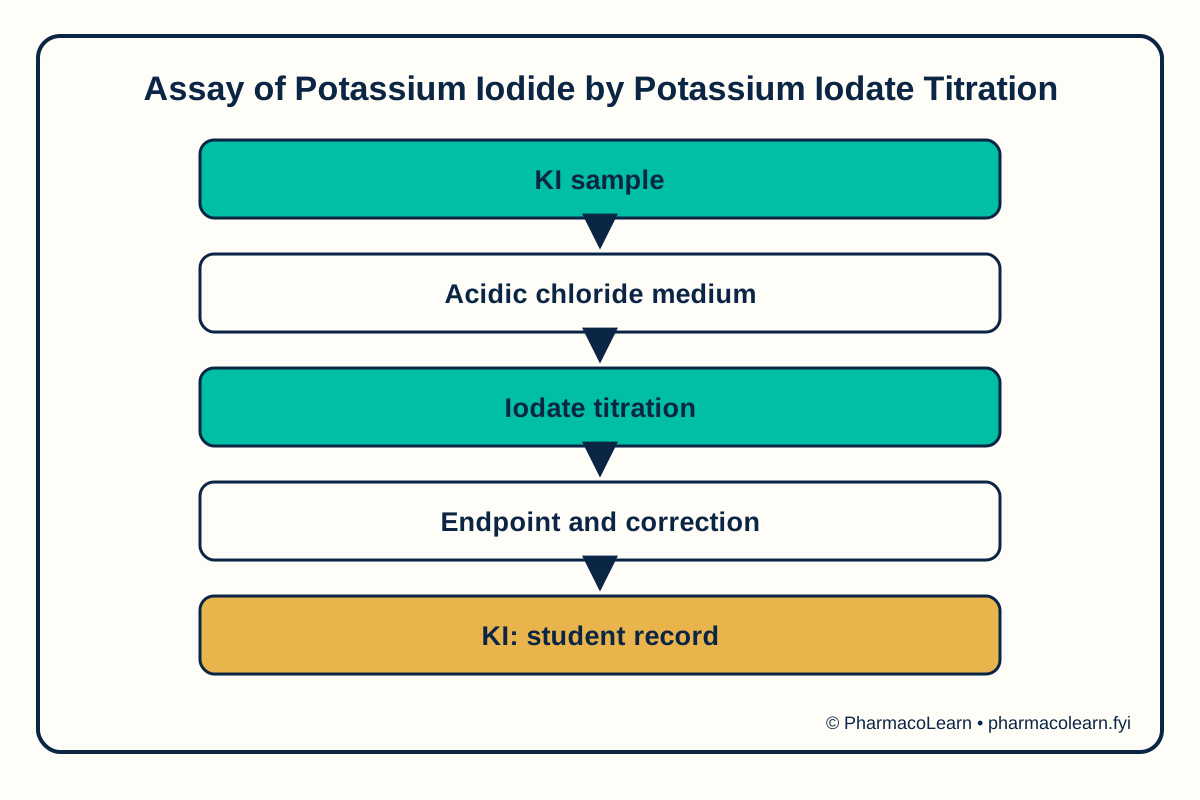
2. Requirements
Assigned potassium iodide sample, standardized potassium iodate, specified hydrochloric-acid medium and endpoint reagent, suitable water, burette, flask, pipette, balance, and iodine-containing waste vessel. The indicator or extraction variant, exact volumes, titrant concentration, and sample mass are specified in your college lab manual and instructor's method sheet.
3. Theory
In sufficiently acidic chloride medium, iodate oxidizes iodide to an iodine(I) chloride endpoint species. The assay relation is two iodide ions per iodate ion for the specified iodate endpoint. Potassium iodide formulations containing free iodine require a separate correction, so a simple titre is not automatically a KI result. Endpoint techniques differ across monographs, including indicator and phase methods; the student must use one verified method without mixing their factors.
4. Procedure
- Identify whether the assigned sample is pure KI or an iodine-containing preparation. Record the controlling monograph and any required free-iodine correction; otherwise record the uncertainty and consult the instructor.
- Have the instructor supply the approved acid medium, standardized iodate, and endpoint reagent or a verified dataset.
- Prepare the assigned sample solution and record its actual mass and any dilution.
- Titrate with iodate in the prescribed medium to the validated endpoint, recording initial and final burette readings.
- Apply the specified blank and free-iodine correction if relevant, then calculate KI using the method-specific equivalence factor.
5. Calculation, graph, or images as appropriate
| Observation | Actual teaching record |
|---|---|
| Sample identity and mass | Record here |
| Iodate standardized molarity | Record here |
| Endpoint method | Record here |
| Initial/final burette readings | Record here |
| Free-iodine correction, if relevant | Record here |
| Calculated KI content | Record here |
Assumed values for practice only: assumed pure KI sample, assumed no free-iodine correction, assumed iodate titre 10.00 mL, and assumed standardized iodate concentration 0.0500 mol/L. These are invented calculation inputs only.
- Assumed iodate amount = 0.01000 L × 0.0500 mol/L = 0.000500 mol.
- At the verified 2:1 iodide-to-iodate relation for this endpoint, illustrative KI amount = 0.001000 mol.
- Using 166.00 g/mol, illustrative KI mass = 166.00 mg in the assumed aliquot.
- Actual sample content and percentage must be recorded here until the monograph, endpoint, sample mass, and any correction are confirmed.
6. Result
Record the actual result here only when the stated conditions and observations are confirmed. The monograph decision is made by the qualified reviewer against the assigned current monograph or approved method and recorded in the student record. This page decides nothing: it does not pass, fail, identify, or release any sample. Safety note: Acidic iodate systems can release irritating iodine species. Work under teaching-lab supervision and use the approved endpoint system and waste route.
7. References
- Pharmacy Council of India, Pharm.D. Regulations, 2008.
- United States Pharmacopeia, Potassium Iodide monograph.
- University of British Columbia, Iodate and Iodide Reaction.
- Taiwan Ministry of Health and Welfare, Potassium Iodide Assay.
Back to Pharmaceutical Inorganic Chemistry Practicals · All Pharm D Practicals · Pharm D
Theory notes: Pharmaceutical Inorganic Chemistry