
← Pharmaceutical Inorganic Chemistry Practicals
Assay of Sodium Benzoate by Nonaqueous Titration
1. Aim
To explain and calculate the nonaqueous acidimetric assay of an assigned sodium benzoate sample using a verified teaching record. The controlling monograph, sample form, and release limit are to be recorded from the assigned current monograph or approved college method in the student record.
2. Requirements
Assigned sodium benzoate sample or instructor-supplied dataset, standardized perchloric-acid titrant in a validated nonaqueous medium, glacial acetic acid, prescribed indicator or potentiometric endpoint, blank, burette, flask, balance, and dedicated hood. Exact concentrations, volumes, reagent preparation, and sample mass are specified in your college lab manual and instructor's method sheet.
3. Theory
Sodium benzoate is titrated as a base in a nonaqueous acidic solvent. In the method described by the teaching manual, perchloric acid supplies the titrant and the reaction is one equivalent of acid per mole of sodium benzoate. A solvent blank corrects background titrant use. Nonaqueous solvent choice and endpoint strongly affect the result, so aqueous acid-base directions cannot be substituted. The source manual labels its aim as permanganometry in one line but describes a nonaqueous perchloric-acid method in its principle and procedure; this article follows the latter and flags the inconsistency for Moose.
4. Procedure
- Verify the controlling monograph, standardized titrant, solvent, endpoint, and institutional perchloric-acid controls; resolve details with the approved local method.
- For a real class, have trained staff prepare and dispense approved reagents in the designated hood. Students may instead receive a verified dataset.
- Record sample mass and any dilution or aliquot factor, then set up the matched solvent blank.
- Titrate the blank and sample using the validated endpoint system; log all initial and final burette readings.
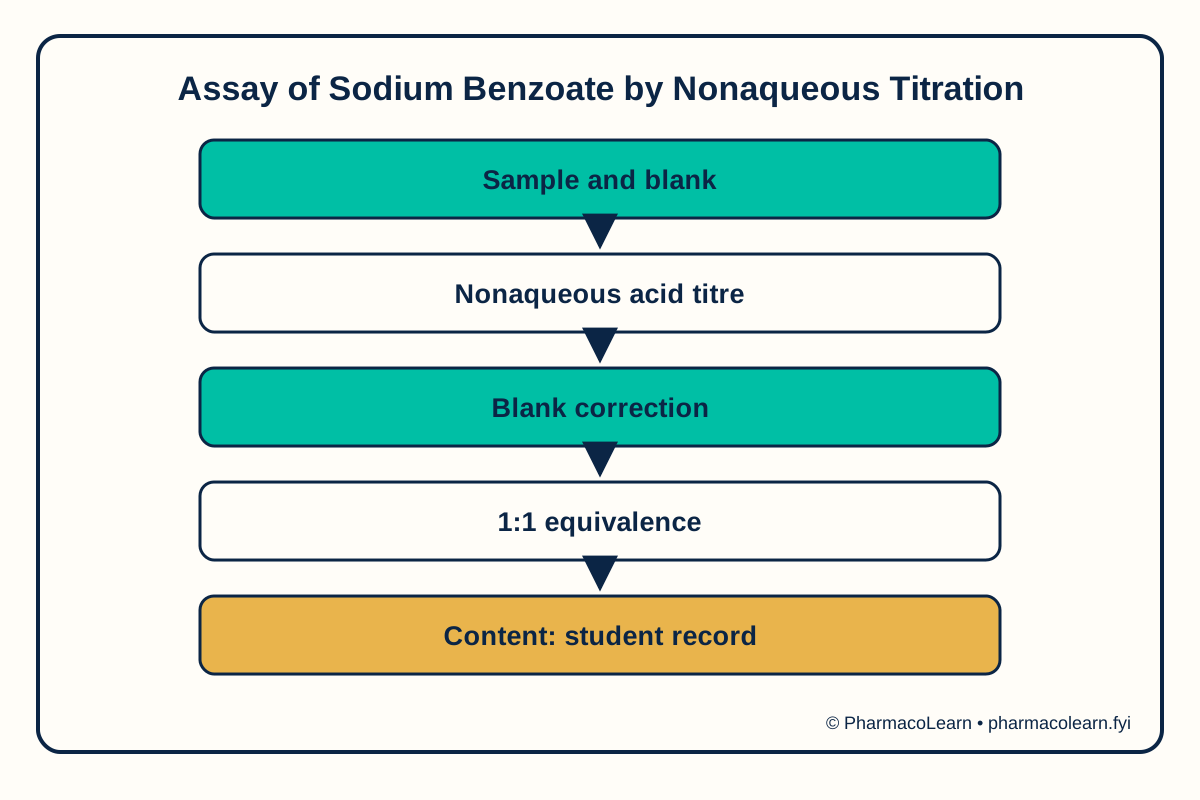
- Subtract the blank titre from the sample titre, calculate sodium benzoate by the 1:1 mole relation, and compare with the verified monograph only after the actual sample basis is known.
5. Calculation, graph, or images as appropriate
| Observation | Actual teaching record |
|---|---|
| Sample mass and form | Record here |
| Standardized acid molarity | Record here |
| Sample initial/final readings | Record here |
| Blank initial/final readings | Record here |
| Corrected titre | Record here |
| Actual content and percentage | Record here |
Assumed values for practice only: assumed sample titre 10.20 mL, assumed blank titre 0.20 mL, and assumed acid concentration 0.1000 mol/L. These invented values are not measurements or preparation instructions.
- Assumed corrected titre = assumed 10.20 minus assumed 0.20 = 10.00 mL.
- Assumed acid amount = assumed 0.01000 L × assumed 0.1000 mol/L = 0.001000 mol.
- At 1:1, illustrative sodium benzoate amount = 0.001000 mol. Using 144.11 g/mol, illustrative mass in the assumed aliquot is 144.11 mg.
- Record the actual percentage here when the sample mass and readings are supplied. The pass status is determined by the qualified reviewer against the assigned current monograph or approved method and recorded in the student record. This page decides nothing: it does not pass, fail, identify, or release any sample.
6. Result
Record the actual result here only when the stated conditions and observations are confirmed. The monograph decision is made by the qualified reviewer against the assigned current monograph or approved method and recorded in the student record. This page decides nothing: it does not pass, fail, identify, or release any sample. Safety note: Perchloric acid in organic solvent poses a severe reaction and exposure hazard. Do not prepare this titrant from article text. Use a designated perchloric-acid hood and trained staff, or teach from a supplied dataset.
7. References
- Pharmacy Council of India, Pharm.D. Regulations, 2008.
- East Point College of Pharmacy, Pharmaceutical Inorganic Chemistry Manual.
Back to Pharmaceutical Inorganic Chemistry Practicals · All Pharm D Practicals · Pharm D
Theory notes: Pharmaceutical Inorganic Chemistry