
← Pharmaceutical Inorganic Chemistry Practicals
Assay of Hydrogen Peroxide by Permanganometry
1. Aim
To estimate hydrogen peroxide in an assigned diluted preparation by potassium permanganate titration. Record the sample strength, dilution, and approved monograph basis here.
2. Requirements
Assigned hydrogen peroxide sample, standardized potassium permanganate titrant, prescribed sulphuric-acid medium, suitable water, burette, pipette, flask, volumetric vessel, gloves, eye protection, and oxidizer waste container. Exact concentrations, dilution, reagent quantities, and endpoint are specified in your college lab manual and instructor's method sheet.
3. Theory
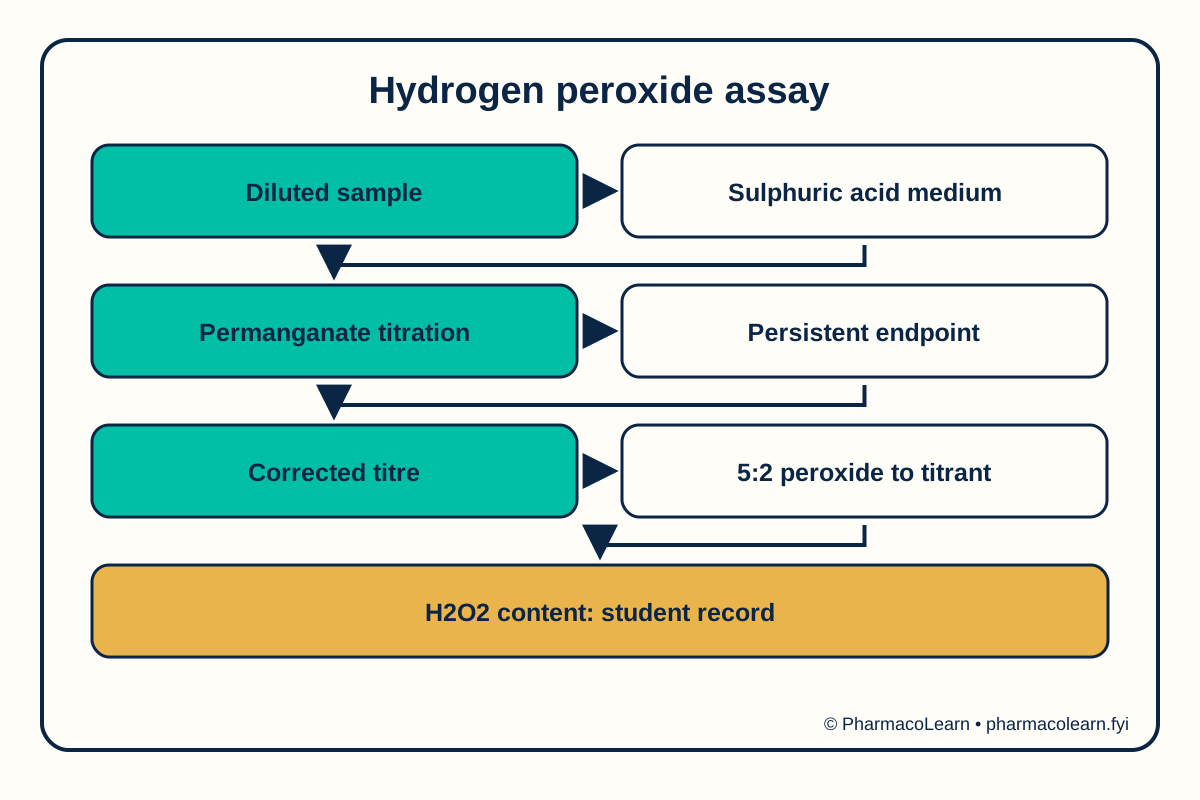
In acid, permanganate oxidizes hydrogen peroxide to oxygen and is reduced to manganese(II): 2MnO4− + 5H2O2 + 6H+ → 2Mn2+ + 5O2 + 8H2O. Hence 2 mol permanganate correspond to 5 mol peroxide. The validated faint persistent permanganate colour is a self-indicating endpoint. Hydrochloric acid is unsuitable because chloride can be oxidized; the approved method specifies sulphuric acid. Peroxide decomposition before analysis lowers the measured content. [2,3]
4. Procedure
- Verify the assigned peroxide preparation, safe dilution, permanganate standardization, sulphuric-acid conditions, and endpoint persistence rule; obtain anything missing from the approved local method.
- Prepare the verified sample dilution under supervision and transfer the prescribed aliquot to a flask.
- Add the validated sulphuric-acid medium and mix.
- Fill the burette with standardized permanganate and record the initial reading.
- Titrate with mixing until the specified faint persistent colour appears, then record the final reading.
- Repeat as prescribed and calculate peroxide from the 5:2 mole relation and verified dilution.
5. Calculation, graph, or images as appropriate
| Observation | Actual teaching record |
|---|---|
| Sample strength and original volume | Record here |
| Dilution and aliquot | Record here |
| Permanganate standardized molarity | Record here |
| Initial and final burette readings | Record here |
| Endpoint appearance | Record here |
| Calculated H2O2 in aliquot | Record here |
Assumed values for calculation practice only: assume the permanganate titre is assumed 10.00 mL and its standardized molarity is assumed 0.0200 mol/L. Both are invented example inputs, not laboratory instructions.
- Assumed permanganate amount = assumed 0.01000 L × assumed 0.0200 mol/L = 0.000200 mol.
- Using the 5:2 peroxide-to-permanganate ratio, illustrative H2O2 amount = 0.000200 × 5 ÷ 2 = 0.000500 mol.
- Using molar mass 34.01 g/mol, illustrative H2O2 mass = 0.000500 mol × 34.01 g/mol = 0.01701 g, or 17.01 mg after rounding, in the assumed aliquot.
- Original preparation strength must be recorded here until its actual dilution factor, original volume, measured titre, and reporting units are known.
| Student record field | Entry |
|---|---|
| Case or product | Record here |
| Method | Record here |
| Observation | Record here |
| Inference | Record here |
| Supervisor check | Record here |
| Outcome | Record here |
6. Result
Report the actual assay only after checking the validated procedure, observed readings, sample basis, and dilution. Record the supervised outcome here. This page is a supervised-activity guide; it does not report a completed case. Use the verified protocol’s endpoint and dilution, since this illustrative calculation cannot define a clinical or product-release result. Safety note: Peroxide and acid are irritating oxidizing materials; oxygen gas evolves during the assay. Use a supervised teaching lab, small approved quantities, eye protection, and the institutional oxidizer waste procedure.
7. References
- Pharmacy Council of India, Pharm.D. Regulations, 2008.
- East Point College of Pharmacy, Pharmaceutical Inorganic Chemistry Manual.
- Ahsanullah University of Science and Technology, Chemistry Laboratory Manual.
Back to Pharmaceutical Inorganic Chemistry Practicals · All Pharm D Practicals · Pharm D
Theory notes: Pharmaceutical Inorganic Chemistry