
← Pharmaceutical Inorganic Chemistry Practicals
Assay of Calcium Gluconate by Complexometry
1. Aim
To estimate calcium in the assigned calcium gluconate preparation by an EDTA complexometric assay. The dosage form and monograph basis are specified in your college lab manual and instructor's method sheet.
2. Requirements
Assigned calcium gluconate sample, standardized EDTA titrant, prescribed alkaline medium and metallochromic indicator, suitable water, burette, pipette, volumetric vessel, flask, balance, and labelled aqueous waste container. Exact buffer, pH, reagent concentration, volumes, and sample mass are specified in your college lab manual and instructor's method sheet.
3. Theory
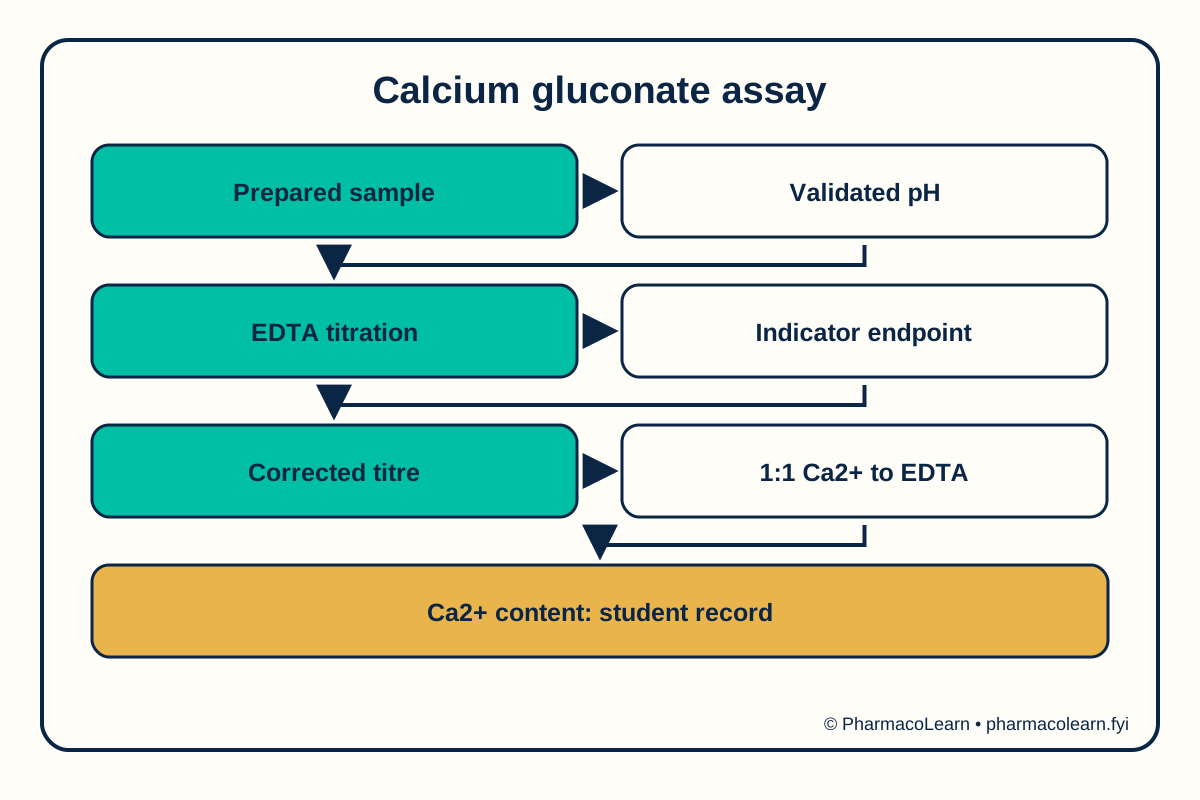
EDTA forms a stable 1:1 complex with Ca2+ under suitable pH conditions. A validated indicator changes appearance when free calcium at the endpoint is depleted. Some methods add magnesium to sharpen an indicator endpoint, so the method’s blank and additions must be followed exactly. The titration directly yields moles of calcium; conversion to calcium gluconate depends on the precise chemical form and monograph basis. [2,3]
4. Procedure
- Check the assigned monograph, calcium gluconate form, EDTA standardization, pH condition, indicator, and any magnesium addition; resolve details with the approved local method.
- Prepare the prescribed sample solution and transfer a measured aliquot to the titration flask.
- Set the medium to the validated pH and add the specified indicator and adjunct reagent if required.
- Fill the burette with standardized EDTA and record the initial reading.
- Titrate to the specified stable colour change, then record the final reading.
- Repeat and calculate calcium in the aliquot, applying the verified sample dilution and reporting basis.
5. Calculation, graph, or images as appropriate
| Observation | Actual teaching record |
|---|---|
| Sample form and mass | Record here |
| Sample dilution and aliquot | Record here |
| EDTA standardized molarity | Record here |
| Initial and final burette readings | Record here |
| Endpoint appearance | Record here |
| Calculated Ca2+ in aliquot | Record here |
Assumed values for calculation practice only: assume an EDTA titre of assumed 10.00 mL and standardized EDTA concentration of assumed 0.0500 mol/L. Both are invented values for learning.
- Assumed EDTA amount = assumed 0.01000 L × assumed 0.0500 mol/L = 0.000500 mol.
- At the 1:1 binding ratio, illustrative Ca2+ amount = 0.000500 mol.
- Using atomic mass 40.08 g/mol, illustrative elemental calcium mass = 0.000500 mol × 40.08 g/mol = 0.02004 g, or 20.04 mg in the assumed aliquot.
- Calcium gluconate percentage must be recorded here until the actual formula, sample mass, dilution, titre, and monograph conversion are confirmed.
| Student record field | Entry |
|---|---|
| Case or product | Record here |
| Method | Record here |
| Observation | Record here |
| Inference | Record here |
| Supervisor check | Record here |
| Outcome | Record here |
6. Result
Report the actual assay only after checking the validated procedure, observed readings, sample basis, and dilution. Record the supervised outcome here. This page is a supervised-activity guide; it does not report a completed case. The EDTA mole ratio is fixed by complex formation, while indicator and pH conditions are method specific. Safety note: Alkaline reagents and indicators may irritate skin and eyes. Use the approved teaching-lab protocol, protective equipment, and the assigned waste route.
7. References
- Pharmacy Council of India, Pharm.D. Regulations, 2008.
- East Point College of Pharmacy, Pharmaceutical Inorganic Chemistry Manual.
- California State University Dominguez Hills, Determination of Calcium by EDTA Titration.
Back to Pharmaceutical Inorganic Chemistry Practicals · All Pharm D Practicals · Pharm D
Theory notes: Pharmaceutical Inorganic Chemistry