
← Pharmaceutical Inorganic Chemistry Practicals
Assay of Copper Sulphate by Iodometry
1. Aim
To estimate copper(II) in an assigned copper sulphate preparation by iodometric titration. Its hydrate and monograph reporting basis are to be recorded from the assigned current monograph or approved college method in the student record.
2. Requirements
Assigned copper sulphate preparation, verified iodide reagent, standardized sodium thiosulphate, prescribed acid or buffer and starch indicator, suitable water, burette, pipette, flask, balance, and copper-containing waste vessel. Exact reagent concentrations, quantities, sample dilution, timing, and endpoint are specified in your college lab manual and instructor's method sheet.
3. Theory
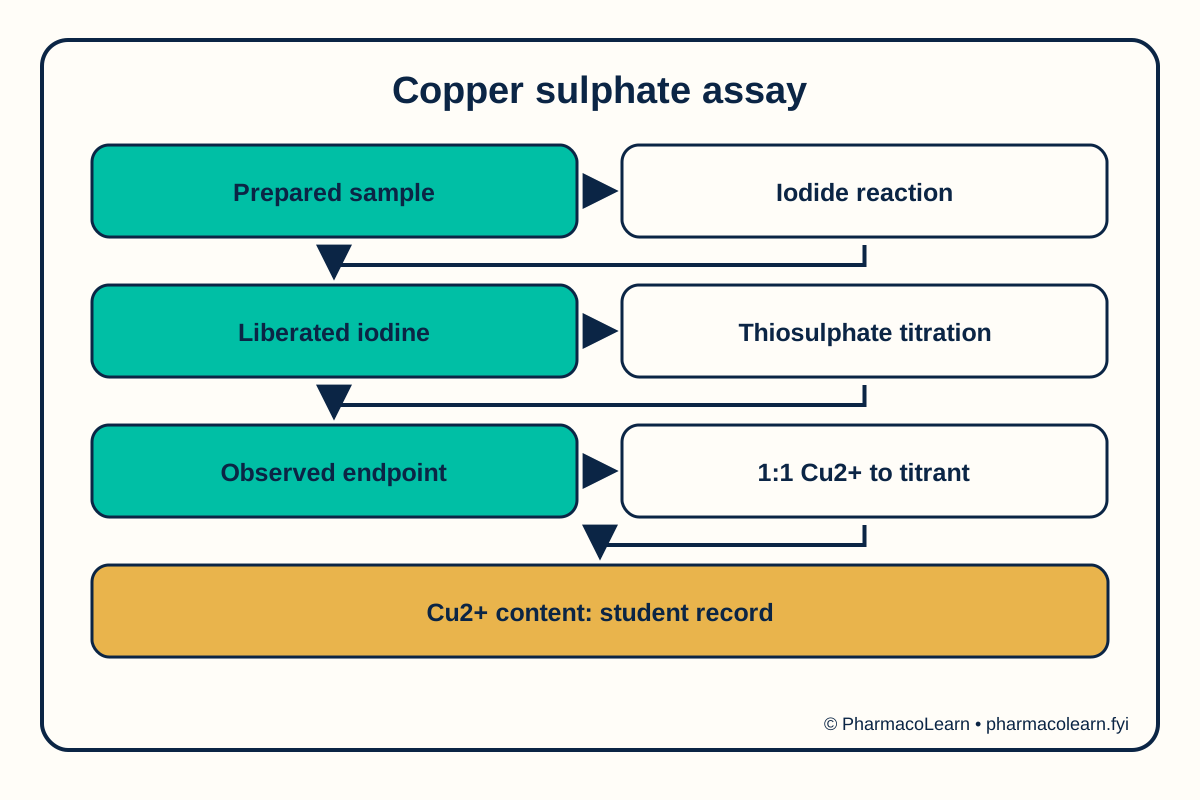
Copper(II) reacts with iodide to form copper(I) iodide and iodine: 2Cu2+ + 4I− → 2CuI + I2. The liberated iodine consumes thiosulphate: I2 + 2S2O3²− → 2I− + S4O6²−. Combining the reactions gives one mole of copper(II) per mole of thiosulphate. Starch helps recognize the iodine endpoint when used in the specified sequence. The sample must be assayed promptly because iodine loss and side reactions can change the titre. [2,3]
4. Procedure
- Confirm the sample monograph, hydrate, iodide conditions, thiosulphate standardization, starch-addition point, and blank rule; missing items are to be recorded from the assigned current monograph or approved college method in the student record.
- Prepare the sample solution and transfer a prescribed aliquot to a flask.
- Add the iodide and any prescribed medium in the validated order; protect from excessive light if directed.
- Titrate the iodine liberated with standardized sodium thiosulphate. Add starch at the stage specified by the method.
- Continue to the defined endpoint and record the burette readings.
- Repeat as required, correct for any specified blank, and calculate copper(II) before converting to a product basis.
5. Calculation, graph, or images as appropriate
| Observation | Actual teaching record |
|---|---|
| Sample form and hydrate | Record here |
| Sample mass and aliquot | Record here |
| Thiosulphate standardized molarity | Record here |
| Initial and final burette readings | Record here |
| Blank-corrected titre | Record here |
| Calculated Cu2+ in aliquot | Record here |
Assumed values for calculation practice only: assume a blank-corrected thiosulphate titre of assumed 10.00 mL and standardized concentration of assumed 0.1000 mol/L. Both are invented example inputs.
- Assumed thiosulphate amount = assumed 0.01000 L × assumed 0.1000 mol/L = 0.001000 mol.
- From the overall 1:1 copper-to-thiosulphate relation, illustrative Cu2+ amount = 0.001000 mol.
- Using atomic mass 63.55 g/mol, illustrative elemental copper mass = 0.001000 mol × 63.55 g/mol = 0.06355 g, or 63.55 mg in the assumed aliquot.
- Record copper sulphate mass and percentage here only after the hydrate, actual sample mass, aliquot factor, and measured titre are established.
| Student record field | Entry |
|---|---|
| Case or product | Record here |
| Method | Record here |
| Observation | Record here |
| Inference | Record here |
| Supervisor check | Record here |
| Outcome | Record here |
6. Result
Report the actual assay only after checking the validated procedure, observed readings, sample basis, and dilution. Record the supervised outcome here. This page is a supervised-activity guide; it does not report a completed case. For stoichiometry, the balanced reactions in the independent analytical-chemistry laboratory reference control over inconsistent shorthand in a teaching manual. Safety note: Iodine vapour can irritate and copper waste must be collected. Use teaching-lab supervision and the approved waste stream. Never interpret the illustrative mass as an assay result.
7. References
- Pharmacy Council of India, Pharm.D. Regulations, 2008.
- East Point College of Pharmacy, Pharmaceutical Inorganic Chemistry Manual.
- Analytical Chemistry LibreTexts, Iodometric Determination of Cu in Brass.
Back to Pharmaceutical Inorganic Chemistry Practicals · All Pharm D Practicals · Pharm D
Theory notes: Pharmaceutical Inorganic Chemistry