
← Pharmaceutical Analysis Practicals
Study of Quenching Effect in Fluorimetry
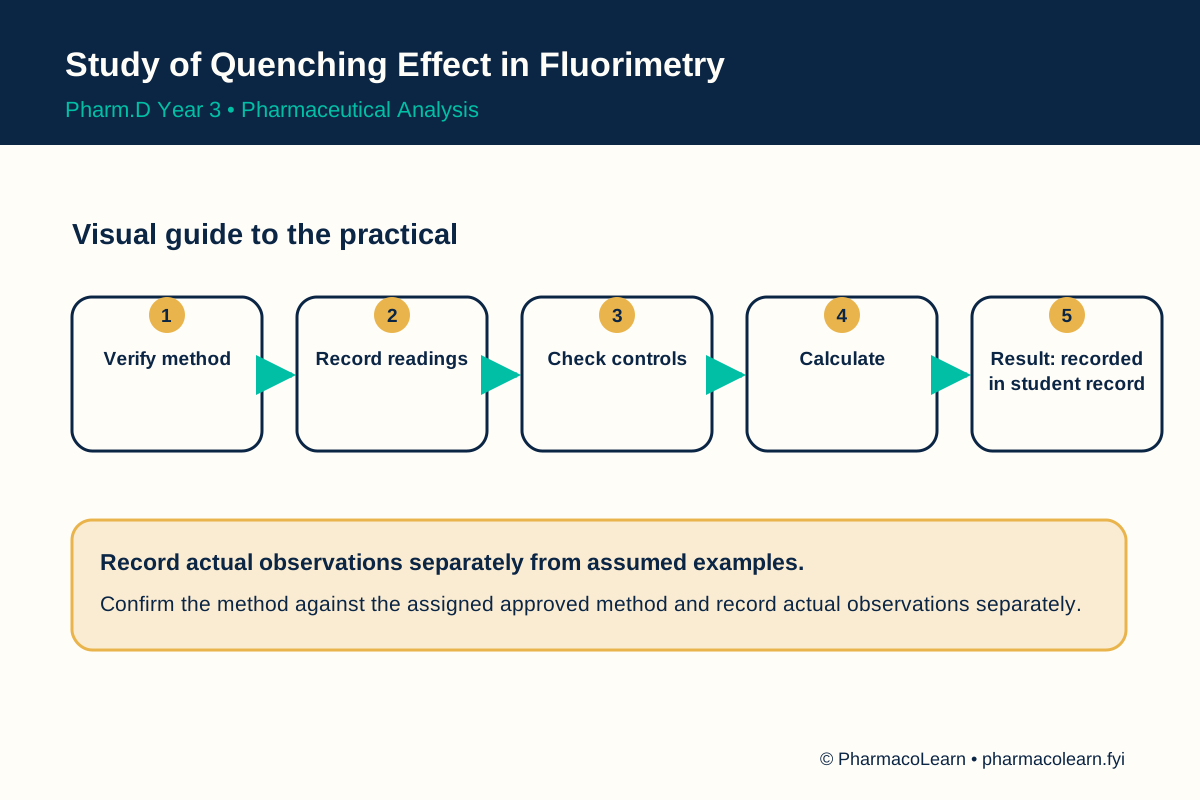
1. Aim
To complete the Year 3 syllabus practical study of quenching effect in fluorimetry using an instructor-approved method or dataset. Actual analyte, measurements, and result must be entered in the student record.
2. Requirements
Instructor-approved sample and reference standard, validated method, instrument and calibration records, blank and controls, observation sheet, calculator or graphing aid, protective equipment, and chemical waste route. Confirm sample identity from its label and use the college method sheet for reagent quantities, concentrations, wavelengths, pH, and temperature. Acceptance criteria are to be recorded from the assigned current monograph or approved college method in the student record.
3. Theory
Quenching reduces fluorescence through interactions or other conditions. Comparing signals requires identical excitation, emission, concentration, and optical settings. Inner-filter effects and drift can resemble quenching, so controls matter. The Stern-Volmer relationship may be useful only if the data and mechanism support its assumptions.
4. Procedure
- Confirm sample identity, method version, hazards, instrument calibration, and required controls.
- Record raw standards, blanks, sample readings, units, and any preparation or dilution factors.
- Follow the verified laboratory method under instructor supervision, or analyze its supplied dataset.
- Measure or review paired fluorescence readings without and with a labelled quencher. Normalize to the control and plot an approved quenching relation if the method allows.
- Check the fit, control recovery, and measurement range before applying a formula.
- Report the calculation with units, method limitations, and unresolved details recorded in the student record.
5. Observation and calculation
| Student record field | Entry |
|---|---|
| Case or product | Record here |
| Method | Record here |
| Observation | Record here |
| Inference | Record here |
| Supervisor check | Record here |
| Outcome | Record here |
Assumed values for calculation practice only: Assumed unquenched fluorescence is 100 units and assumed quenched fluorescence is 75 units. Assumed signal ratio F0/F = 100/75 = 1.33. These invented signals do not establish mechanism. Each invented input and output is assumed, not a reagent instruction or actual laboratory result.
6. Output or final result
Submit a labelled paired fluorescence signals, calculations where justified, and a conditional conclusion. Record the supervised outcome here.
Teaching-lab safety: Use instructor-supervised chemical handling and the approved disposal method. No assumed value here authorizes a preparation or analytical release decision.
This page is a supervised-activity guide; it does not report a completed case.
7. Sources
- PharmacoLearn Pharm.D Year 3 syllabus
- PCI Pharm.D Regulations and Syllabus
- USP <857> Ultraviolet-Visible Spectroscopy
- USP <1226> Verification of Compendial Procedures
Back to Pharmaceutical Analysis Practicals · All Pharm D Practicals · Pharm D
Theory notes: Pharmaceutical Analysis