
← Human Anatomy and Physiology Practicals
Study of special senses using charts, models, and specimens
1. Aim
To identify the main receptor organs and pathways for vision, hearing and balance, smell, and taste on charts or models, and to distinguish skin sensation as a related general sense. [1, 2]
2. Requirements
Labelled and unlabelled charts or models of the eye, ear, nasal cavity, tongue, and skin; an observation sheet; and gloves if the instructor supplies specimens that require them. The models available, fine landmarks to be assessed, specimen-handling rules, and cleaning method are specified in your college lab manual and instructor's method sheet. This is a visual identification exercise; no sensory test on a person is required. [1]
3. Theory
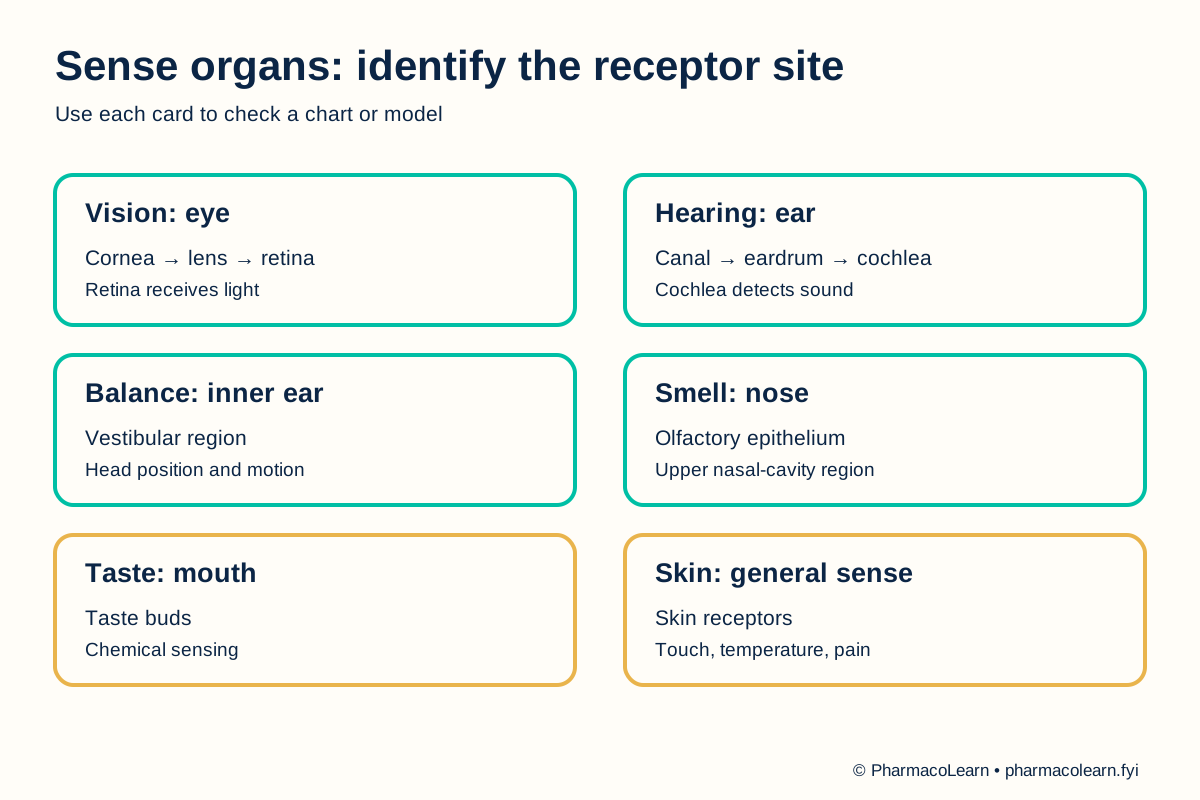
Special senses use receptors in specialized organs. In the eye, the cornea and lens help focus light on the retina. In the ear, sound travels through the outer and middle ear toward the cochlea; inner-ear structures also contribute to balance. Smell receptors lie in the nasal cavity, while taste receptor cells are found in taste buds in the mouth. Skin receptors detect touch, temperature, and pain, but skin sensation is usually classified as a general sense. The PCI theory outline includes skin among sense organs, so it is compared here without relabelling it a special sense. [2, 3, 4]
4. Procedure
- Confirm with the instructor which charts, models, or specimens may be handled. Check orientation and fragile removable parts. Local handling instructions are specified in your college lab manual and instructor's method sheet. [1]
- On the eye model, trace light from cornea through the lens toward the retina. Identify the optic nerve if the model shows it. Record a structure that is absent from the model as not displayed. [3]
- On the ear chart, identify the outer ear and ear canal, eardrum, middle-ear region, cochlea, and balance-related inner-ear region. Trace the sound route to the cochlea and distinguish it from the balance region. [2, 4]
- On the nasal-cavity chart, locate the olfactory region. On the tongue or mouth chart, locate taste buds and name the surface or region on which they are shown. Do not infer that every raised bump on a model represents a taste bud. [2, 4]
- On the skin chart, identify the epidermis and dermis and point to receptor-bearing regions if shown. Explain that the skin example represents general somatic sensation. [2, 4]
- Cover the labels and identify each receptor site again. Record a visible clue, the sense involved, and whether the model actually displays the structure. Ask the instructor to resolve uncertain labels. [2]
- Return model parts correctly, follow the local cleaning rule, and wash hands after shared equipment. [1]
5. Calculation, graph, or images as appropriate
There is no calculation. Complete the observation table from the assigned material. [2, 3, 4]
| Sense or comparison | Receptor region to locate | Structure or path to identify | Shown locally? |
|---|---|---|---|
| Vision | Retina | Cornea, lens, retina, optic nerve | Record here |
| Hearing | Cochlea | Ear canal, eardrum, middle ear, cochlea | Record here |
| Balance | Vestibular inner ear | Balance-related inner-ear region | Record here |
| Smell | Olfactory epithelium | Upper nasal-cavity region | Record here |
| Taste | Taste buds | Tongue or oral-cavity receptor site | Record here |
| Skin sensation | Skin receptors | Epidermis, dermis, sensory endings | Record here |
Worked identification example: On a labelled eye section, the light-sensitive layer at the back of the eye is the retina. Record whether the retinal layer is visible on the assigned model here. [3]
6. Result
Sensory receptor regions and associated structures identified on the assigned material: Record here. Record model omissions separately from uncertain identification. No sensory impairment is assessed by this exercise. [2]
7. References
- Pharmacy Council of India. Pharm.D. Regulations, 2008, Appendix A. Lists special senses for chart, model, and specimen study.
- Gadhvi M, Moore MJ, Waseem M. Physiology, Sensory System. StatPearls. Distinction between general and special senses.
- National Library of Medicine. Eye anatomy. MedlinePlus Medical Encyclopedia. Cornea, lens, and retina.
- Marzvanyan A, Alhawaj AF. Physiology, Sensory Receptors. StatPearls. Hearing, balance, smell, taste, and skin receptors.
Back to Human Anatomy and Physiology Practicals · All Pharm D Practicals · Pharm D
Theory notes: Human Anatomy and Physiology