
← Human Anatomy and Physiology Practicals
Effect of load and after-load on a muscle twitch
1. Aim
To compare the shortening of a sciatic-gastrocnemius preparation under a free load and an after-load, using an instructor-approved simulation or archived traces. Identify what changes when a given weight acts on the muscle before stimulation or only during contraction. [1, 2]
2. Requirements
An approved simulation or instructor-supplied isotonic recordings with load labels and stimulus marks; a ruler or measurement cursor; a record sheet; and a graphing surface. A demonstration may show a stimulator, electrodes, lever or transducer, load support, and recorder. The preparation source, stimulus settings, load values, lever calibration, trace units, and any authorization for biological material are specified in your college lab manual and instructor's method sheet. This article gives no animal preparation instructions. [2, 3, 4]
3. Theory
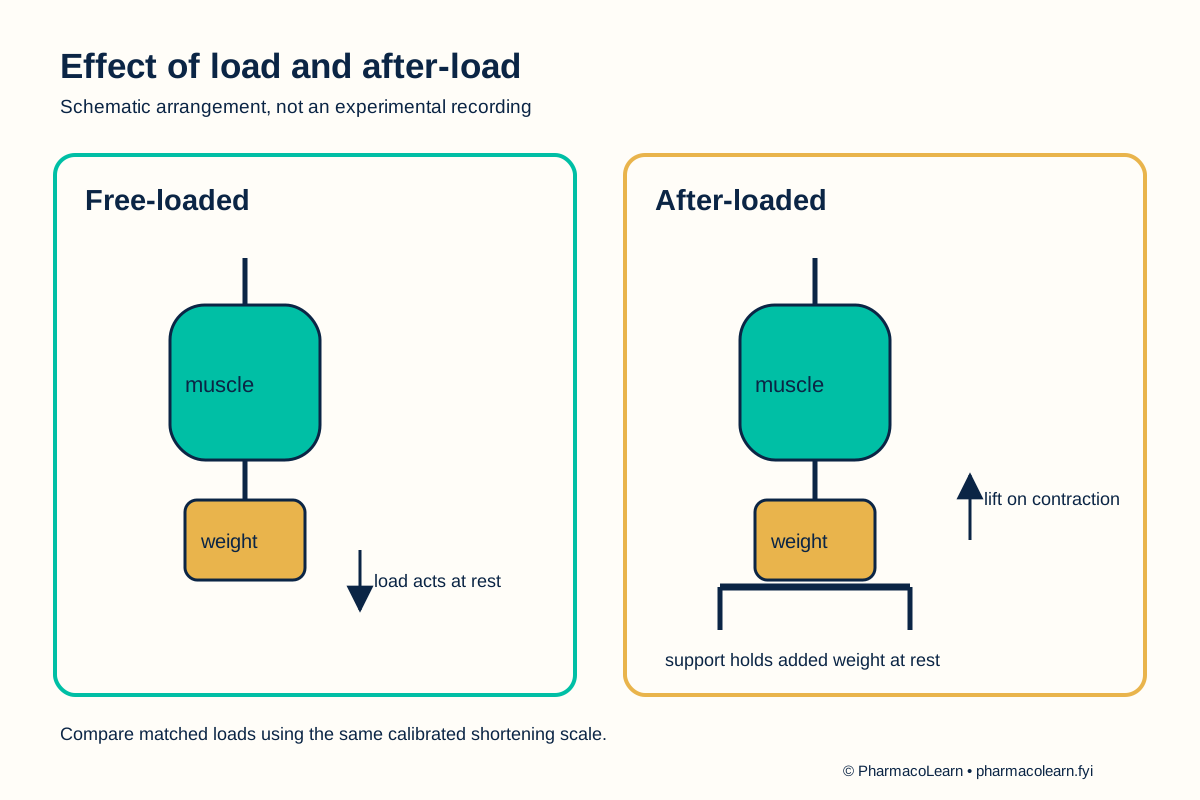
In a free-loaded arrangement, the muscle supports the external weight at rest, before the stimulus. That load can change the muscle's initial length. In an after-loaded arrangement, a support carries the added weight at rest; the contracting muscle encounters and lifts it only after developing enough force. This difference in initial loading can change the delay before shortening and the distance shortened, even when the labeled weight is the same. Compare only records made with the same recording mode, stimulus conditions, and response scale. [2]
An isotonic recording shows shortening against a load; it does not directly measure force unless a calibrated force channel is also supplied. An after-loaded trace may first show a period of force development with no visible shortening. If a load cannot be lifted, the absence of shortening must be recorded rather than assigned a zero twitch force. [2, 3]
4. Procedure
- Obtain a locally approved simulation or archived trace set showing at least one comparable free-loaded and after-loaded condition. Any work with biological material needs separate institutional authorization, trained personnel, and the applicable welfare procedure. The local authorization and material source are specified in your college lab manual and instructor's method sheet. [4]
- Read the trace legend. Identify the stimulus marker, time direction, shortening axis, initial baseline, load label, and whether the weight is supported before stimulation. Record the actual load, settings, axis calibration, and units here. [2]
- For a free-loaded trace, note the resting position with the load already acting on the muscle. Mark stimulus onset and the first detectable shortening. [2]
- For the same labeled load under after-loading, verify that a support carries the added weight before stimulation. Mark stimulus onset, the first detectable shortening, and the largest shortening. If the setup cannot be confirmed from the record, mark the loading mode as unresolved. [2]
- Repeat the comparison across any additional supplied load pairs. Keep the same measurement convention for every trace. Do not invent a load series or stimulus setting when the record does not provide one. [2]
- Enter the observations below. Plot load on the horizontal axis and shortening on the vertical axis, with separate series for free-loaded and after-loaded traces, only if load and displacement scales are known. [2]
- Submit the annotated traces and describe which arrangement shortened more for each comparable pair. Follow the college lab manual and instructor's method sheet for submission format. [2]
5. Calculation, graph, or images as appropriate
The table is a blank record, not a set of expected values. Use only calibrated measurements from the supplied traces. [2]
| Load pair | Load and unit | Loading mode | Stimulus-to-shortening delay and unit | Maximum shortening and unit | Lifted load? |
|---|---|---|---|---|---|
| A | Record here | Free-loaded | Record here | Record here | Record here |
| A | Same labeled load, Record here | After-loaded | Record here | Record here | Record here |
| B, if supplied | Record here | Free-loaded | Record here | Record here | Record here |
| B, if supplied | Same labeled load, Record here | After-loaded | Record here | Record here | Record here |
Calculation: For each trace, shortening equals the calibrated baseline position minus the position at maximum shortening, with the axis direction checked first. For a matched pair, shortening difference equals after-loaded shortening minus free-loaded shortening. If calibrated force and distance are available, external work equals force multiplied by the distance the load is lifted. The force, distance, units, and any computed result must be recorded here. A displacement trace alone cannot supply a force value. [2]
6. Result
At the matched load or loads, the observed differences in shortening and stimulus-to-shortening delay must be recorded here. State the data source and whether each load was lifted. Any comparison is limited to the supplied preparation and conditions; do not report a universal result from the schematic. [2]
7. References
- Pharmacy Council of India. Pharm.D. Regulations, 2008, Appendix A. Lists the effect of load and after-load using a gastrocnemius sciatic-nerve preparation.
- Wesleyan College. BIO340 Laboratory Guide 6: Excitation and Contraction of Frog Skeletal Muscle. Describes supported after-loading, free-loading, and comparisons of latency, shortening, and work.
- William Paterson University. Animal Physiology Lab Manual, Lab 6: Frog Leg Muscle Contraction. Explains recording methods and load effects.
- Committee for Control and Supervision of Experiments on Animals. Acts, Rules and Guidelines. Institutional animal-use oversight.
Back to Human Anatomy and Physiology Practicals · All Pharm D Practicals · Pharm D
Theory notes: Human Anatomy and Physiology