
← Human Anatomy and Physiology Practicals
Determination of hemoglobin content of blood
1. Aim
To demonstrate estimation of blood hemoglobin concentration with a Sahli acid-haematin comparator and record its direct scale reading.
2. Requirements
A labelled blood specimen supplied under supervision; a complete Sahli haemoglobinometer with matched comparator and graduated tube; calibrated pipette; approved hydrochloric acid reagent; water for gradual dilution; mixing rod; timer; and designated biological and chemical waste containers. The published Sahli method uses 0.02 mL blood and 0.1 mol/L hydrochloric acid. The local reagent identity, starting fill mark, comparator calibration, and approved water are specified in your college lab manual and instructor's method sheet; check them before use. Wear a laboratory coat, gloves, and eye protection. [1, 2]
3. Theory
Acid converts hemoglobin in the blood sample to a brown acid-haematin solution. Adding water lightens the solution until its colour appears to match the fixed comparator. The graduated tube then gives an estimated hemoglobin concentration. This is a visual comparison and depends on lighting, clean glass, accurate blood volume, and the observer's colour judgement. A WHO evaluation found the Sahli method less reliable than the best-performing comparator in that study. It is presented here as a supervised historical teaching method, not as a basis for patient care. A laboratory seeking a clinical result must use its validated method. [1]
4. Procedure
- Confirm the specimen label, the approved reagent, and the instructor's method. Treat all blood as potentially infectious. Put on the required protective equipment. A trained person must obtain any specimen; do not collect blood independently. [2]
- Check that the comparator, graduated tube, and pipette are clean and intact. Check the comparator's calibration status and the tube's units: follow your college lab manual and your instructor's method sheet for quantities, editions, and instruments. Work in the lighting specified locally. [1]
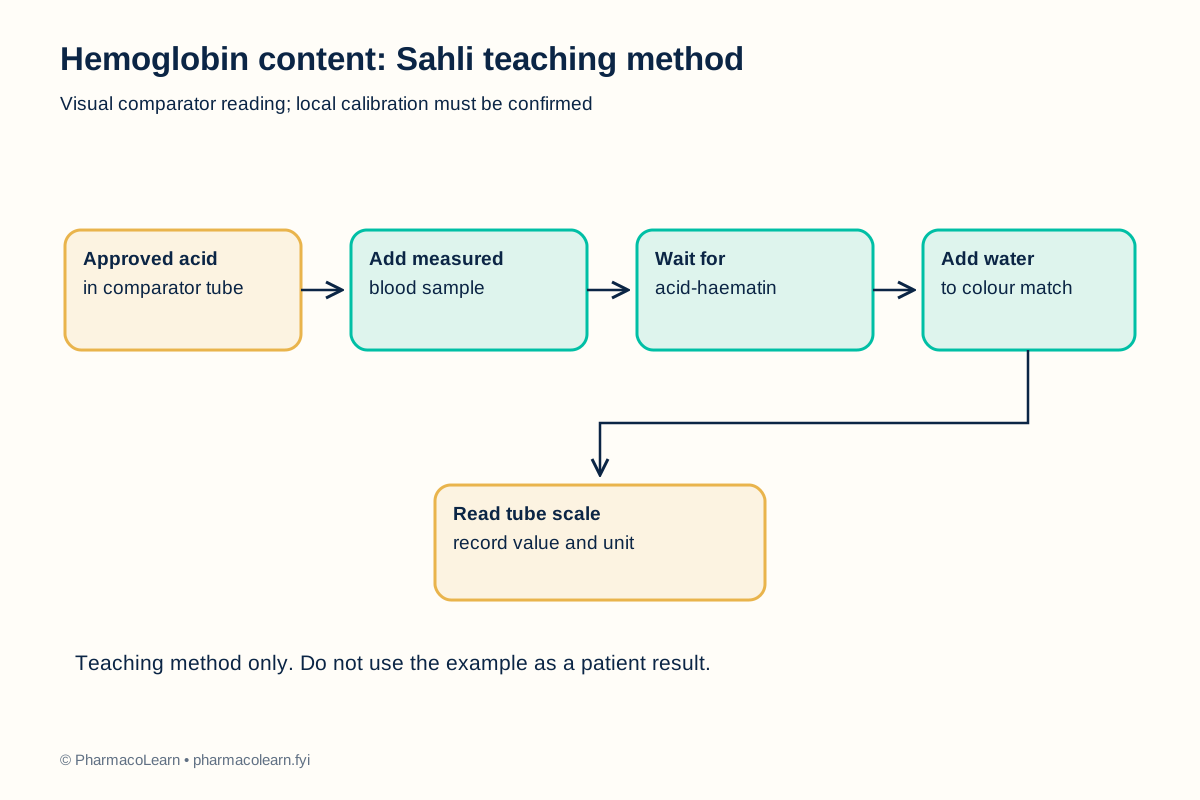
- Add the approved acid to the starting mark specified for the local Sahli tube: follow your college lab manual and your instructor's method sheet for quantities, editions, and instruments. Do not guess the mark or use an unlabelled acid. [1]
- With a calibrated pipette, transfer 0.02 mL of well-mixed blood into the acid without touching the pipette tip to exposed skin. Rinse the blood from the pipette tip into the acid as directed by the local procedure: follow your college lab manual and your instructor's method sheet for quantities, editions, and instruments. Mix without splashing. [1]
- Allow 3 minutes for acid-haematin formation in the published Sahli procedure. Add approved water gradually, mixing between additions, until the sample colour matches the two standards under the stated lighting. Avoid adding too much water at once. [1]
- Read the liquid level at the meniscus against the tube's hemoglobin scale. Record the value and unit exactly as printed. A unit conversion or correction factor for the local model is specified in your college lab manual and instructor's method sheet and must not be invented. [1]
- Record any poor colour match, cloudy solution, damaged tube, or uncertain scale. Ask the instructor to review an ambiguous reading. Dispose of blood and acid-containing materials by their designated routes, remove gloves, and wash hands. [1, 2]
5. Calculation, graph, or images as appropriate
The Sahli reading is taken directly from the calibrated tube. No numerical factor is supplied for an unknown comparator. Use this observation table during the practical. [1]
| Observation | Record |
|---|---|
| Comparator and tube identification | Record during practical |
| Scale unit printed on tube | Record during practical |
| Sample colour at final match | Record during practical |
| Graduated scale reading | Record during practical |
| Uncertainty or reason to repeat | Record during practical |
Worked recording example: If a teaching comparator scale is read as 12 g/dL, write hemoglobin concentration by Sahli method = 12 g/dL. This is assumed teaching data, not a measured or normal value. Record the student's actual reading here. [1]
6. Result
Record the observed hemoglobin reading, unit, and method name here after instructor review. Do not infer anaemia or another diagnosis from this teaching exercise. [1]
7. References
- Van Lerberghe W, Keegels G, Cornelis G, Ancona C, Mangelschots F B, and Van Balen H. Haemoglobin measurement: the reliability of some simple techniques for use in a primary health care setting. Bulletin of the World Health Organization. 1983;61(6):957-965. Sahli method procedure and reliability comparison.
- Centers for Disease Control and Prevention. Blood Specimens: Safety. Blood handling and personal protection. Reviewed 3 May 2016.
- Pharmacy Council of India. Pharm.D. Regulations, 2008, Appendix A. Syllabus authority for hemoglobin content of blood.
Back to Human Anatomy and Physiology Practicals · All Pharm D Practicals · Pharm D
Theory notes: Human Anatomy and Physiology