
← Human Anatomy and Physiology Practicals
Determination of erythrocyte sedimentation rate
1. Aim
To determine the erythrocyte sedimentation rate (ESR) of a blood specimen by the Westergren method and report the distance of red-cell settling after one hour.
2. Requirements
A correctly labelled venous blood specimen supplied by a trained person; approved trisodium citrate anticoagulant solution; clean, dry Westergren sedimentation tube; vertical stand; timer; and a means of reading the tube scale. The WHO SOP describes trisodium citrate at 31.3 g/L mixed as one volume citrate to four volumes blood. The reagent identity, preparation, and specimen collection container used locally are specified in your college lab manual and instructor's method sheet; check them before testing. [1]
Wear a laboratory coat, gloves, and any additional protective equipment required by the local blood-handling assessment. Have designated biological waste and sharps containers available. [1, 2]
3. Theory
When anticoagulated blood stands in a vertical tube, red cells settle and leave a clear plasma layer above them. ESR is the height of that plasma layer after a defined time, expressed in millimetres in one hour. Red-cell properties and plasma proteins can affect settling, so ESR is a nonspecific observation rather than a diagnosis. Tube angle, vibration, temperature, sample age, and the blood-to-anticoagulant ratio can also change the result. For a comparable reading, the tube must be vertical, the time fixed, and the local method followed consistently. [1]
The Westergren method reads the boundary between clear plasma and the upper edge of the settled red-cell column at exactly 60 minutes. Compare with your laboratory's current reference interval and interpretation guidance. [1]
4. Procedure
- Under instructor supervision, verify the specimen label, collection time, approved citrate reagent, and local safety instructions. Treat all blood as potentially infectious. Wear the required protective equipment and never mouth-pipette. [1, 2]
- Confirm that the specimen and citrate were combined in the ratio required by the selected Westergren procedure. The WHO SOP specifies four parts blood to one part citrate. The exact volumes supplied in the local collection system are specified in your college lab manual and instructor's method sheet. Reject a clotted, haemolysed, wrongly filled, or uncertain specimen according to the local policy. [1]
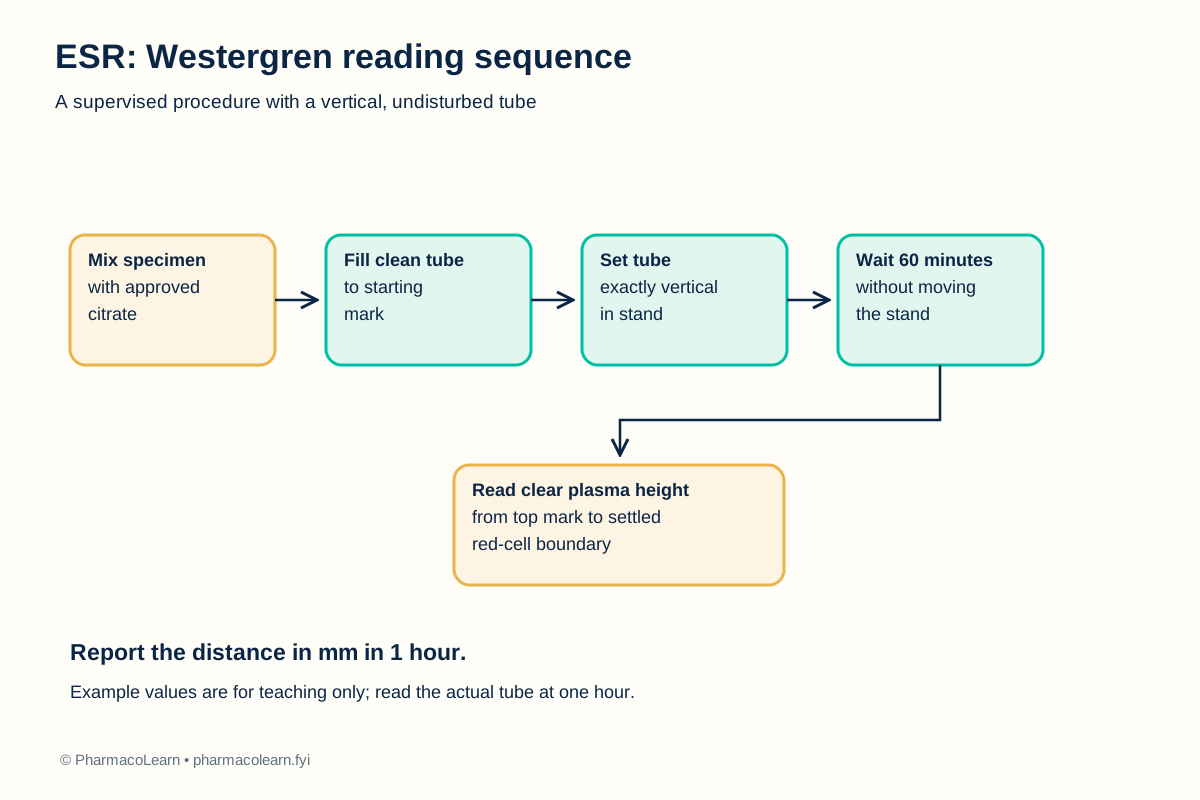
- Gently mix the anticoagulated specimen. Fill a clean, dry Westergren tube to the designated starting mark without air bubbles. Use the tube and filling method specified locally: follow your college lab manual and your instructor's method sheet for quantities, editions, and instruments. [1]
- Place the tube firmly in its stand, with its base seated and the tube exactly vertical. Keep the stand away from direct sunlight, heating, drafts, and vibration. The WHO SOP describes a conventional room temperature of 18 to 25 °C; the actual temperature conditions are specified in your college lab manual and instructor's method sheet. [1]
- Start the timer when the tube is set up. Leave it undisturbed for 60 minutes. Do not tilt or move it during sedimentation. [1]
- At exactly one hour, read the height of clear plasma above the upper margin of the settled red cells to the nearest millimetre. Record the reading as mm in 1 hour. If the boundary is indistinct or the setup was disturbed, flag the reading and follow the laboratory's repeat rule, which is governed by your laboratory's current repeat rule. [1]
- Dispose of the blood-containing tube and materials through the designated route, clean the work surface, remove gloves, and wash hands. [2]
5. Calculation, graph, or images as appropriate
ESR is read directly from the tube scale; no multiplication factor or graph is required. Record the observed distance and the exact setup and reading times. [1]
| Item | Teaching example | Actual observation |
|---|---|---|
| Starting mark | Zero mark aligned with the blood column | Record during practical |
| Elapsed time | 60 minutes | Record during practical |
| Clear plasma layer at one hour | 12 mm | Record during practical |
| ESR report | 12 mm in 1 hour | Calculate from actual reading |
Worked reading example: If the clear plasma layer extends from the starting mark to the 12 mm graduation after exactly one hour, report ESR = 12 mm in 1 hour. This number is invented solely to show how the scale is read. It is not a normal value or an observation from a person. [1]
6. Result
Worked example: The illustrative ESR is 12 mm in 1 hour. Record the actual result here from the student's reading and local quality checks. Clinical interpretation is outside this teaching example.
7. References
- S. M. Lewis and Sudarshan Kumari. Guidelines on Standard Operating Procedures for Haematology, section 14, Erythrocyte Sedimentation Rate. World Health Organization Regional Office for South-East Asia, January 2000. Westergren principle, citrate proportion, vertical setup, one-hour reading, and sources of error.
- Centers for Disease Control and Prevention. Blood Specimens: Safety. Protective equipment, hand hygiene, and contaminated sharps guidance. Reviewed 3 May 2016.
- Pharmacy Council of India. Pharm.D. Regulations, 2008, Appendix A, first-year Human Anatomy and Physiology practical list. Syllabus authority for this experiment.
Back to Human Anatomy and Physiology Practicals · All Pharm D Practicals · Pharm D
Theory notes: Human Anatomy and Physiology