
← Human Anatomy and Physiology Practicals
Study of family planning appliances
1. Aim
To identify selected physical contraceptive appliances in a supervised teaching collection, classify their broad method, and distinguish items that require a trained clinician for placement. [1, 2]
2. Requirements
Instructor-approved demonstration samples or sealed product packaging for external and internal condoms, a diaphragm or cervical cap, an intrauterine device model, and a contraceptive implant or vaginal ring model if available; manufacturer labels; a classification chart; gloves for handling shared samples; and an observation sheet. Record the actual product names here. Follow the college lab manual and instructor's method sheet for demonstration-item handling, disposal, and counselling protocol. Do not use clinical stock for a demonstration without authorization. [1, 2]
3. Theory
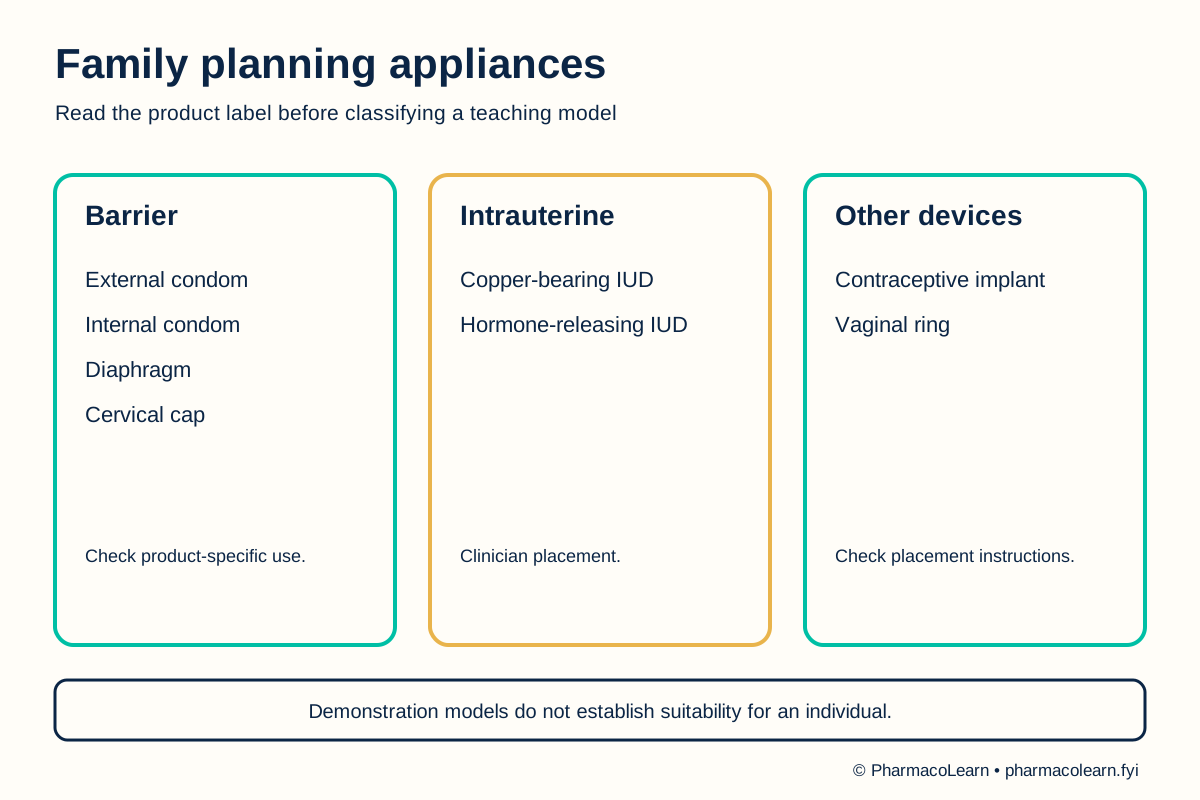
Family planning includes several different physical products. External and internal condoms are barrier methods; condoms can also reduce transmission of some sexually transmitted infections when used correctly. A diaphragm or cervical cap is another barrier device, generally used with spermicide according to product and clinical instructions. Intrauterine devices include copper-bearing and hormone-releasing types, and they must be placed by a trained clinician. A contraceptive implant is a hormone-releasing device placed under the skin by a trained clinician. A vaginal ring is a hormone-releasing method. A model or empty package can show identification features, but it cannot establish suitability, effectiveness, or correct fitting for a particular person. [2, 3]
4. Procedure
- Ask the instructor which demonstration items may be opened and handled. Verify that each is clearly labelled as a model, expired demonstration stock, or sealed product. The local handling and disposal policy is specified in your college lab manual and instructor's method sheet. [1]
- Read each product label before examining its form. Record the name, whether it is a barrier or hormone-releasing device, and whether a clinician must place it. Do not rely on shape alone to identify a product. [2, 3]
- Compare the external and internal condom packages and the demonstrator samples, if supplied. Note that their barrier role differs from the action of an intrauterine device or implant. Do not open sealed clinical stock. [2]
- Locate the rim and flexible dome of a diaphragm or the smaller cap shape on a model, if available. Record the label and storage condition; do not perform fitting or insertion. Record the exact appliance supplied here. [2]
- Identify an intrauterine device model by its label as copper-bearing or hormone-releasing. Identify any implant or vaginal ring model by its own label. Record a missing item as not supplied, not as a method that does not exist. [2, 3]
- Cover the labels and repeat the classification using the observation table. Ask the instructor to resolve any uncertain identification. Discuss that counselling and selection are individualized clinical tasks. [2, 3]
- Return demonstration items to their assigned containers, follow the local cleaning rule, and wash hands. [1]
5. Calculation, graph, or images as appropriate
There is no calculation. Complete the table from the actual teaching collection. [2, 3]
| Appliance | Broad category | Placement or use distinction | Supplied locally? |
|---|---|---|---|
| External condom | Barrier | User-applied | Record here |
| Internal condom | Barrier | User-applied | Record here |
| Diaphragm or cervical cap | Barrier | Fitting and instructions depend on product | Record here |
| Copper or hormone-releasing IUD | Intrauterine | Clinician placement | Record here |
| Contraceptive implant | Hormone-releasing | Clinician placement | Record here |
| Vaginal ring | Hormone-releasing | Product-specific instructions | Record here |
Worked classification example: A labelled copper-bearing intrauterine device model belongs in the intrauterine category and requires clinician placement. Record the model available locally here. [2, 3]
6. Result
Appliances identified, categories assigned, and placement distinction recorded: Record here. This exercise does not provide individual contraceptive counselling or authorize use of a demonstration item. [2]
7. References
- Pharmacy Council of India. Pharm.D. Regulations, 2008, Appendix A. Lists study of different family planning appliances.
- World Health Organization and Johns Hopkins Bloomberg School of Public Health. Family Planning: A Global Handbook for Providers, 2022 edition. Contraceptive device categories and provider roles.
- Centers for Disease Control and Prevention. Contraception and Birth Control Methods. Barrier, intrauterine, implant, and ring methods.
Back to Human Anatomy and Physiology Practicals · All Pharm D Practicals · Pharm D
Theory notes: Human Anatomy and Physiology