
← Human Anatomy and Physiology Practicals
Determination of clotting time
1. Aim
To observe the formation of a fibrin thread in a nonheparinized capillary tube and report the elapsed time by the capillary-tube teaching method. [1]
2. Requirements
An authorized instructor or trained collector; nonheparinized glass capillary tube; sterile single-use lancet; approved skin antiseptic; sterile swabs and dressing; stopwatch; small glass file; protective gloves and eye protection; sharps and contaminated-glass containers. The local collection policy, approved puncture site and antiseptic, and availability of a safe demonstration setup are specified in your college lab manual and instructor's method sheet. If a live demonstration is unavailable, use an instructor-supplied observation record. [1, 2]
3. Theory
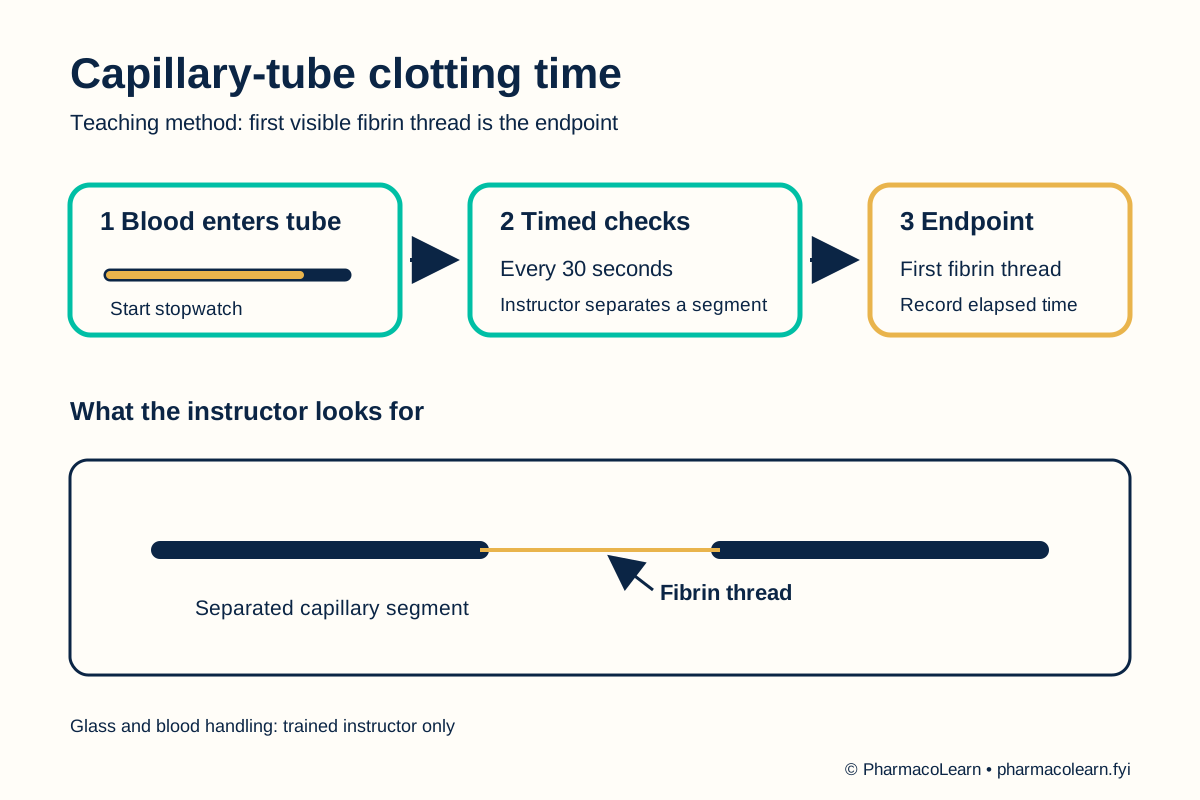
Coagulation converts soluble fibrinogen into fibrin, which can become visible as a fine thread when a blood-filled capillary tube is separated. In this teaching method, time begins when blood enters the tube and ends at the first scheduled check showing a fibrin thread. The result depends on sample collection, timing, tube type, temperature, and the interval between checks. It is a method-specific observation, not the same measurement as a laboratory prothrombin time or activated partial thromboplastin time. Do not use it to diagnose a bleeding disorder or make treatment decisions. [1]
4. Procedure
- The instructor confirms consent, local authorization, protective equipment, and the disposal plan. Students must not puncture themselves or one another. If collection is not approved, work from a supplied timing record. Follow the instructor's local decision for this supervised exercise. [1, 2]
- Set out a nonheparinized capillary tube, stopwatch, and glass file. Check that the tube is clean and intact. Record the method and tube identity; the local tube specification is specified in your college lab manual and instructor's method sheet. [1]
- A trained collector prepares the approved site, uses a new sterile lancet, and immediately discards it in a sharps container. The approved site and antiseptic are specified in your college lab manual and instructor's method sheet. The collector lets blood enter the tube without forceful squeezing. [1, 2]
- Start the stopwatch as blood first enters the tube. Fill the tube to at least two-thirds of its length, as described in the cited teaching manual, and place it on a protected surface. Record any delay between blood entry and the start of timing. [1]
- At 30 seconds, the instructor scores the tube near one end and breaks off a short segment away from people. The instructor gently separates the ends and checks for a fibrin thread. Students observe without handling the broken glass. [1]
- If no thread appears, the instructor repeats the check with a fresh segment every 30 seconds until a thread is first seen. Record the first positive check in seconds. Handle every broken piece as contaminated glass. [1, 2]
- Dress the puncture site, dispose of all contaminated material in approved containers, clean the work area, remove gloves, and wash hands. Record any interruption or difficulty seeing the thread. [2]
5. Calculation, graph, or images as appropriate
Use the first check with a visible thread as the endpoint. The following sequence is invented solely to demonstrate the calculation; it is not a specimen result or a reference interval. [1]
| Time after blood entered tube | Example observation |
|---|---|
| 30 seconds | No thread |
| 60 seconds | No thread |
| 90 seconds | No thread |
| 120 seconds | No thread |
| 150 seconds | No thread |
| 180 seconds | Thread first visible |
Worked example: The first positive check is at 180 seconds. Divide 180 by 60 to obtain 3.0 minutes. Report the capillary-tube method and the 30-second observation interval alongside the time. Record the actual observed endpoint here. Compare with your laboratory's current reference interval. [1]
6. Result
Capillary-tube clotting time: ______ minutes, based on the first observed fibrin thread. State the collection conditions and any deviation. This classroom result is not suitable for clinical interpretation. [1]
7. References
- Northern Virginia Community College. NAS 162 Campus Lab, Exercise V, Part II: Coagulation Time. 2009. Source for the nonheparinized capillary tube and 30-second fibrin-thread checks.
- World Health Organization. Guidelines on Drawing Blood: Capillary Sampling. 2010. Source for trained collection and safe sharps handling.
- Pharmacy Council of India. Pharm.D. Regulations, 2008, Appendix A. Syllabus authority for clotting time.
Back to Human Anatomy and Physiology Practicals · All Pharm D Practicals · Pharm D
Theory notes: Human Anatomy and Physiology