
← Human Anatomy and Physiology Practicals
Measurement of blood pressure
1. Aim
To obtain and record two seated blood-pressure readings with a validated automatic upper-arm monitor, then calculate their arithmetic mean for a supervised teaching exercise. [1]
2. Requirements
A validated, calibrated automatic upper-arm blood-pressure monitor; a cuff that fits the participant's arm according to the device instructions; a chair with back support; a table that supports the arm at heart level; a timer; and a recording sheet. The device's validation status, calibration record, cuff-size range, and local consent process are specified in your college lab manual and instructor's method sheet. [1]
3. Theory
Blood pressure is reported as systolic pressure over diastolic pressure in millimetres of mercury (mm Hg). An upper-arm automatic monitor estimates these values from cuff-pressure oscillations during inflation and deflation. Position, recent activity, talking, clothing under the cuff, and cuff fit can alter the reading. Repeated readings provide a more useful description of the teaching observation than a single value. A classroom measurement alone is not a diagnosis. [1, 2]
4. Procedure
- Explain the exercise and obtain consent under the local teaching-lab policy. Confirm that the monitor is validated and calibrated and that the cuff fits the participant's arm. Device details and the local policy are specified in your college lab manual and instructor's method sheet. [1]
- Ask the participant to avoid smoking, exercise, and caffeinated drinks for 30 minutes before measurement when feasible. Record any departure from these conditions rather than concealing it. [1]
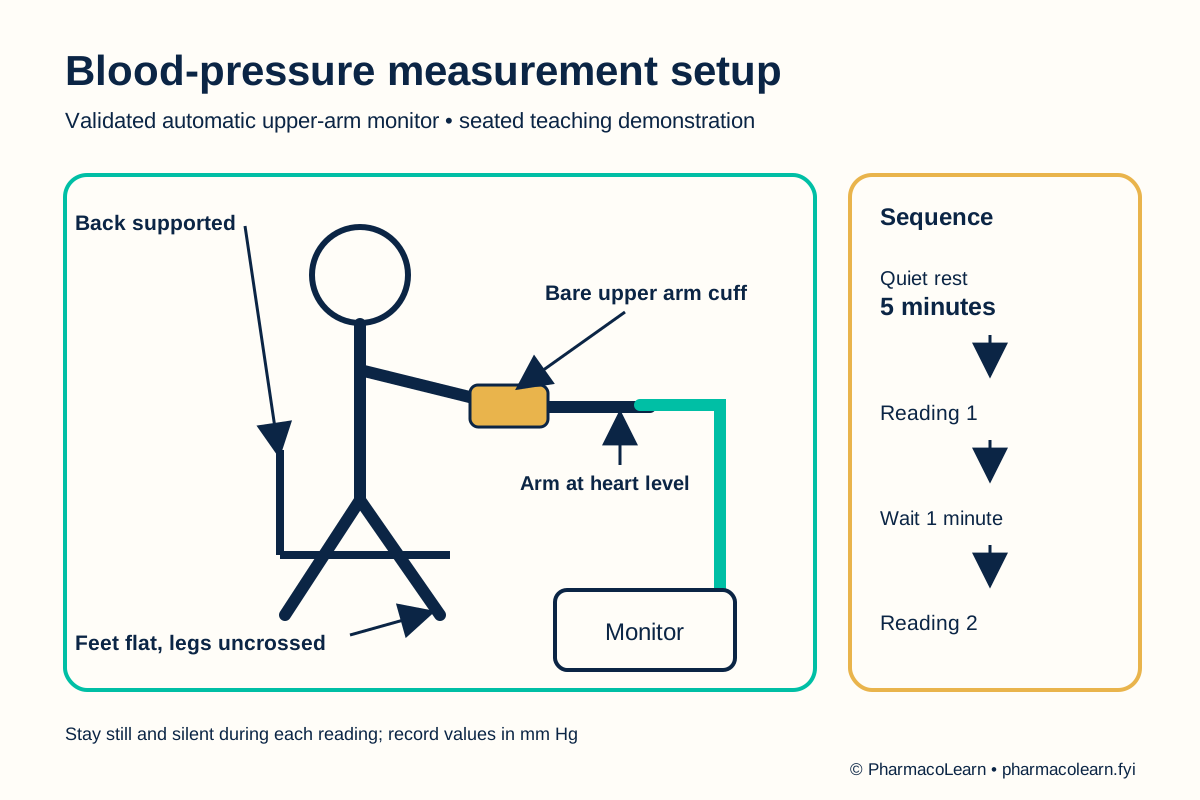
- Seat the participant with back supported, feet flat, legs uncrossed, and the arm resting on a table at heart level. Allow at least 5 minutes of quiet rest. The participant should not talk during rest or measurement. [1]
- Place the correctly sized cuff on the bare upper arm, with its lower edge above the elbow bend, following the device markings and instructions. Record the arm used. Exact placement markings for the local device are specified in your college lab manual and instructor's method sheet. [1]
- Start the monitor and let it complete a reading without conversation or arm movement. Record systolic and diastolic values exactly as displayed, in mm Hg, along with the time and arm. If the device reports an error, follow its instructions and document the repeat. [1]
- Wait 1 minute and take a second reading in the same seated position and on the same arm. Record it separately. [1]
- Calculate the arithmetic mean of the two systolic values and the two diastolic values. Note the device, cuff size, arm, preparation deviations, and any error messages. Refer any health concern to a qualified clinician under the local policy; the action route is specified in your college lab manual and instructor's method sheet. [1, 2]
5. Calculation, graph, or images as appropriate
The numbers below are invented arithmetic examples, not an actual participant result, a normal value, or a diagnostic threshold.
| Reading | Systolic (mm Hg) | Diastolic (mm Hg) |
|---|---|---|
| First | 116 | 74 |
| Second, 1 minute later | 120 | 78 |
Worked example: Mean systolic pressure = (116 + 120) / 2 = 118 mm Hg. Mean diastolic pressure = (74 + 78) / 2 = 76 mm Hg. Report the example mean as 118/76 mm Hg. Record the actual pair of readings and their mean here. Keep the original readings because an average alone hides variation. [1]
6. Result
First reading: Record here mm Hg. Second reading: Record here mm Hg. Arithmetic mean: Record here mm Hg. Identify the arm, cuff and monitor, and any departure from the preparation steps. Do not assign a diagnosis from this practical. [1, 2]
7. References
- American Heart Association. Blood Pressure Measurement Instructions. 2024. Source for validated equipment, cuff fit, posture, rest, preparation, and readings one minute apart.
- American Heart Association. Measurement of Blood Pressure in Humans: Top Things to Know. 2019. Context for accurate measurement and interpretation limits.
- Pharmacy Council of India. Pharm.D. Regulations, 2008, Appendix A. Syllabus authority for blood pressure.
Back to Human Anatomy and Physiology Practicals · All Pharm D Practicals · Pharm D
Theory notes: Human Anatomy and Physiology