
← Pharmacognosy and Phytopharmaceuticals Practicals
Macro, Powder and Microscopic Study of Nux vomica
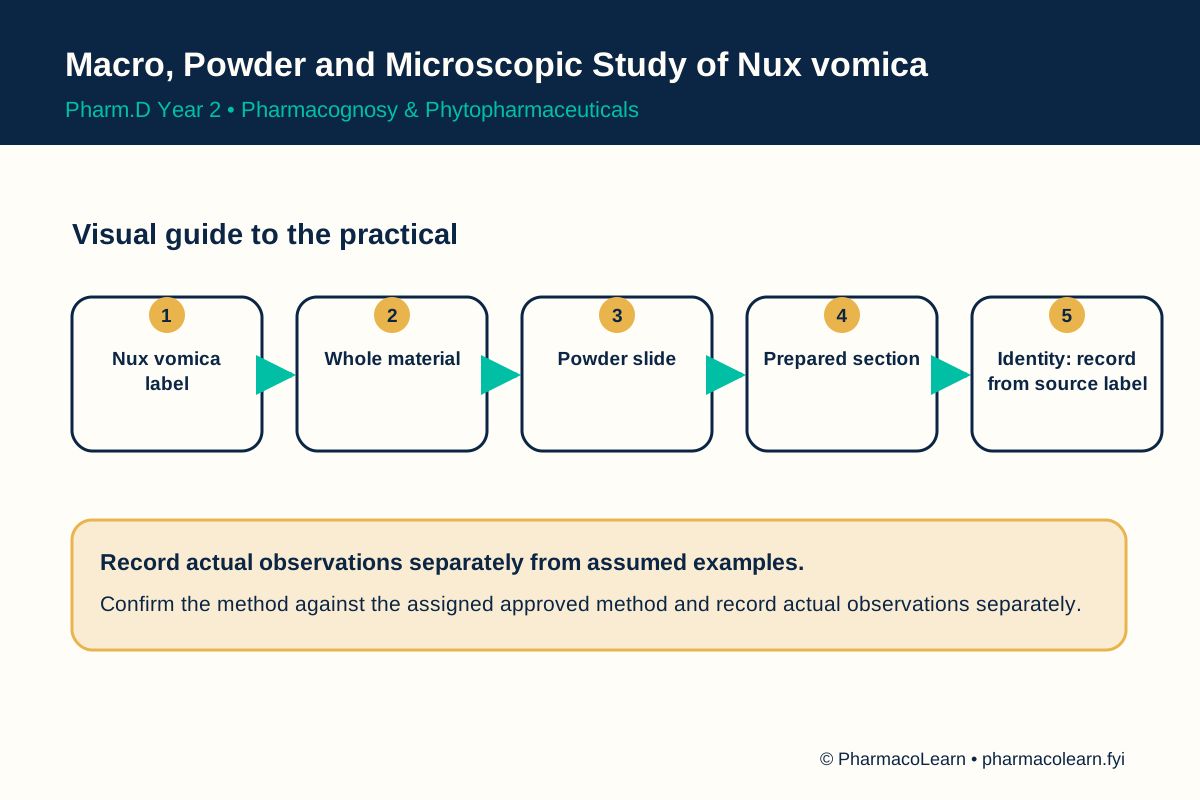
1. Aim
To document macroscopic, powder, and section-microscopic features of an authenticated Nux vomica teaching specimen and compare them with a verified botanical reference. Actual species, part, and identity must be entered in the student record.
2. Requirements
Instructor-authenticated dried seeds, sealed display container or high-resolution specimen image, prepared powder slide, prepared transverse section or micrograph, microscope, hand lens, reference atlas, observation sheet, gloves, and approved disposal route. Actual species, plant part, slide preparation, stain, and magnification must be entered in the student record.
3. Theory
The syllabus names Nux vomica, but a crude-drug name alone is insufficient to establish species, plant part, or authenticity. The candidate species Strychnos nux-vomica is cited as a taxonomic reference, not assigned to the teaching sample. Begin with the labelled whole material, then compare its visible form with the powder and a prepared section. For this entry, useful observation targets include seed outline, surface, and edge in the whole material and seed-coat hairs and internal tissue in microscopic material. These are structures to look for, not claims that every supplied slide will display them. Powdering destroys much of the intact arrangement, so a fragment may need confirmation in a section. A species-specific monograph and control specimen are required before making a diagnostic claim. Nux vomica is a highly toxic crude drug. Use sealed samples and prepared slides only.
4. Procedure
- Record the Nux vomica specimen code, labelled botanical name, part, source, and reference used; unresolved label details must be entered in the student record.
- Inspect the sealed dried seeds or its approved photograph and write direct observations of seed outline, surface, and edge.
- Examine the instructor-prepared powder slide, beginning at low power, then record visible fragments without assigning an identity from one structure.
- Inspect the prepared section or authenticated micrograph and locate tissue arrangements that might explain the powder fragments.
- Compare all three views with the approved species- and part-specific reference, listing both matching and missing characters.
- Write a conditional identification and note contamination, adulteration, or slide-quality concerns for instructor review.
5. Observation and calculation
| Student record field | Entry |
|---|---|
| Case or product | Record here |
| Method | Record here |
| Observation | Record here |
| Inference | Record here |
| Supervisor check | Record here |
| Outcome | Record here |
Assumed observations for practice only: an assumed Nux vomica display specimen shows assumed a flattened seed, and an assumed powder slide shows assumed a seed-coat hair. These invented observations show how to use the table. They do not identify a real specimen. The actual features, species, and conclusion must be entered in the student record. No mass, reagent volume, stain concentration, or therapeutic value is assumed.
6. Output or final result
Submit a labelled three-view record for Nux vomica with evidence for and against the assigned identity. The actual identity and quality decision must be entered in the student record.
Teaching-lab safety: Nux vomica contains toxic alkaloids. Use sealed display material and prepared slides only; no tasting, grinding, or unsupervised handling.
This page is a supervised-activity guide; it does not report a completed case.
7. Sources
- PharmacoLearn Pharm.D Year 2 syllabus
- PCI Pharm.D Regulations and Syllabus
- Kew Plants of the World Online, relevant Nux vomica taxon
Back to Pharmacognosy and Phytopharmaceuticals Practicals · All Pharm D Practicals · Pharm D
Theory notes: Pharmacognosy and Phytopharmaceuticals