
← Pharmacognosy and Phytopharmaceuticals Practicals
Macro, Powder and Microscopic Study of Ginger
1. Aim
To compare whole, powdered, and sectioned Ginger teaching material with an authenticated botanical reference. The specimen species and identity are specified in your college lab manual and instructor's method sheet.
2. Requirements
Sealed authenticated dried rhizome pieces, instructor-prepared powder slide and section, microscope, hand lens, botanical atlas, specimen log, gloves. Actual species, stain, magnification, and plant part must be entered in the student record.
3. Theory
Ginger is a crude-drug name rather than proof of botanical identity. A whole sample preserves surface, fracture, and part arrangement, while powdering leaves isolated tissue fragments. Examine starch grains and vascular fragments only where the reference for the verified species and part supports them. Tissue shape, mounting medium, and preparation artifacts can alter appearance. A single fragment cannot establish authenticity. The accepted Zingiber officinale name is a reference; the batch identity requires verification. Compare the three views, document discrepancies, and preserve the specimen record for review.
4. Procedure
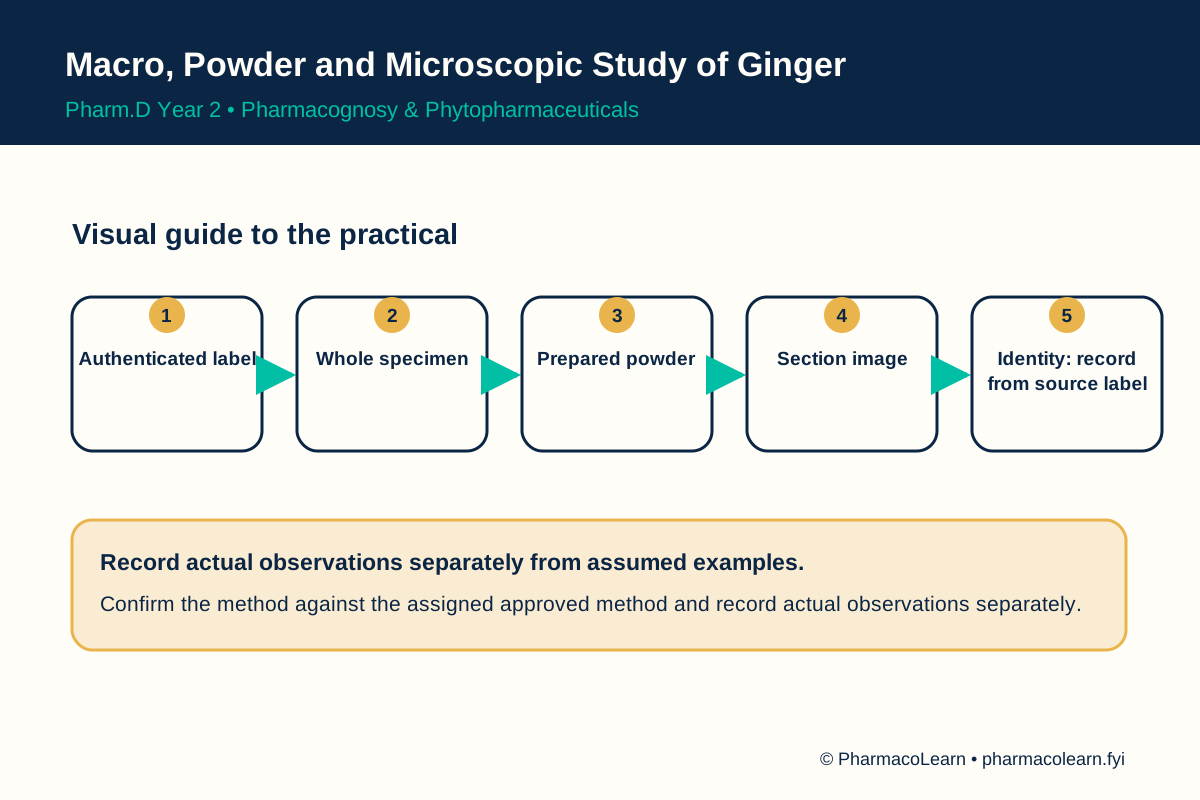
- Copy the Ginger specimen code, botanical label, plant part, and source from the container; flag missing data Record here.
- Inspect the sealed dried rhizome pieces or approved photograph for colour, surface, shape, and fracture without tasting.
- Examine a prepared powder slide at the instructor-selected powers and draw visible fragments.
- Examine an authenticated section or reference micrograph and locate corresponding tissues.
- Compare the three records with a species-specific monograph and state whether the evidence is sufficient.
5. Observation and calculation
| Student record field | Entry |
|---|---|
| Case or product | Record here |
| Method | Record here |
| Observation | Record here |
| Inference | Record here |
| Supervisor check | Record here |
| Outcome | Record here |
Assumed observations for practice only: an assumed Ginger sample has an assumed rough outer surface and an assumed powder image shows a vessel fragment. Both observations are invented. The real species, part, microscopic match, and identity remain your college lab manual and instructor's method sheet.
6. Output or final result
Produce a labelled three-view record and conditional identification for Ginger. Actual identity: Record here.
Teaching-lab safety: Use sealed material and prepared slides. Do not taste, inhale powder, or use a teaching specimen medicinally.
This page is a supervised-activity guide; it does not report a completed case.
7. Sources
- PharmacoLearn Pharm.D Year 2 syllabus
- PCI Pharm.D Regulations and Syllabus
- Kew taxonomic reference relevant to Ginger
- WHO Quality Control Methods for Herbal Materials
Back to Pharmacognosy and Phytopharmaceuticals Practicals · All Pharm D Practicals · Pharm D
Theory notes: Pharmacognosy and Phytopharmaceuticals