
← Pharmacognosy and Phytopharmaceuticals Practicals
Macro, Powder and Microscopic Study of Datura
1. Aim
To document macroscopic and microscopic characters of an authenticated Datura teaching specimen without assuming its species or plant part. Specimen identity is specified in your college lab manual and instructor's method sheet.
2. Requirements
Authenticated, sealed Datura specimen or prepared image set; pre-mounted powder slide or section; microscope; hand lens; approved flora or monograph; labels; gloves; waste plan. Species, plant part, mounting medium, stain, and diagnostic characters for this batch are specified in your college lab manual and instructor's method sheet.
3. Theory
Datura is a genus in the Solanaceae. Kew recognizes several species, including Datura metel and Datura stramonium, so the syllabus word Datura does not identify a species. Macroscopic study records leaf or other part shape and surface only after the part is confirmed. Powder microscopy can reveal fragmented epidermis, hairs, vessels, or other tissues, but their diagnostic value must be matched to an authenticated reference for the exact species and part. Datura materials can be poisonous; the study should use sealed specimens and prepared slides, with no ingestion or hand grinding.
4. Procedure
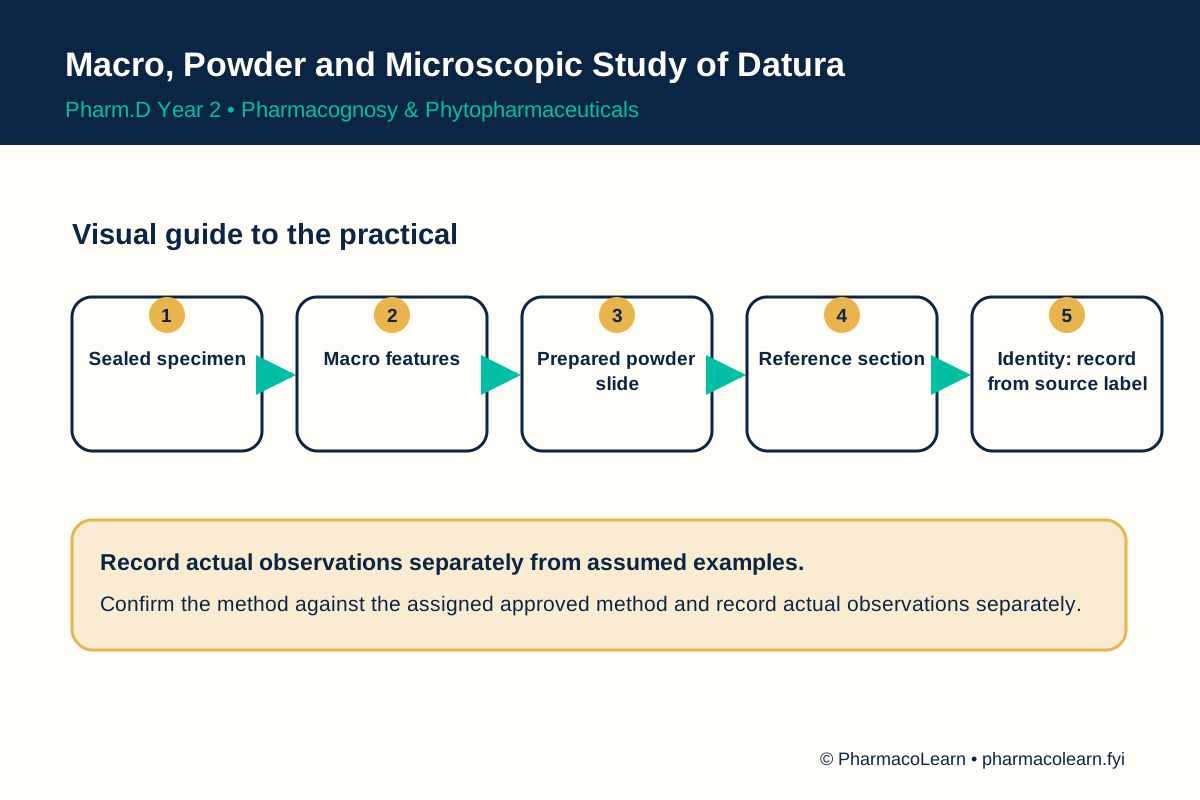
- Verify the instructor label for species, plant part, origin, and specimen code; missing details are specified in your college lab manual and instructor's method sheet.
- Observe a sealed whole specimen or high-resolution image and record visible form, surface, and colour.
- Examine an instructor-prepared powder slide at the approved magnifications and sketch visible fragments.
- Examine an authenticated section or reference micrograph and compare its tissues with the powder view.
- List characters that are observed, characters supported by a species-specific reference, and characters still uncertain.
5. Observation and calculation
| Student record field | Entry |
|---|---|
| Case or product | Record here |
| Method | Record here |
| Observation | Record here |
| Inference | Record here |
| Supervisor check | Record here |
| Outcome | Record here |
Assumed observations for practice only: an assumed leaf image shows an assumed broad lamina, and an assumed prepared powder image shows an assumed epidermal fragment. These invented features do not establish Datura species or authenticity. The actual features and identity must be entered in the student record.
6. Output or final result
Submit labelled macro, powder, and section observations with a conditional identification. Actual species and authenticity: Record here.
Teaching-lab safety: Datura is poisonous. Keep plant material sealed, avoid tasting or grinding it, wash hands, and follow instructor and institutional disposal rules.
This page is a supervised-activity guide; it does not report a completed case.
7. Sources
- PharmacoLearn Pharm.D Year 2 syllabus
- PCI Pharm.D Regulations and Syllabus
- Kew Plants of the World Online, Datura metel
- Kew Plants of the World Online, Datura stramonium
- PCI Pharm.D Regulations and Syllabus
Back to Pharmacognosy and Phytopharmaceuticals Practicals · All Pharm D Practicals · Pharm D
Theory notes: Pharmacognosy and Phytopharmaceuticals