
← Pharmacognosy and Phytopharmaceuticals Practicals
Chemical Tests for Lipids (Castor Oil, Sesame Oil, Shark Liver Oil, Beeswax)
1. Aim
To examine an authenticated Lipids (Castor Oil, Sesame Oil, Shark Liver Oil, Beeswax) sample using appropriate reference and control records, then state what the tests support. Sample identity and actual findings must be entered in the student record.
2. Requirements
Authenticated four separately labelled lipid samples, positive and negative controls, instructor-approved method sheet, observation record, labelled glassware, protective equipment, and waste plan. Exact reagent names, quantities, concentrations, temperature, and time are specified in your college lab manual and instructor's method sheet from the method.
3. Theory
Castor and sesame oils, shark liver oil, and beeswax are different materials. A generic lipid-positive test cannot distinguish all four; compare each against its own monograph. Shark liver oil also requires a verified ethical and sourcing record. In this practical, the student first describes the supplied material and then records the specific test response, including physical state, miscibility, and validated lipid-identification reactions. A reference and negative control help distinguish a sample signal from reagent colour or background behaviour. The observed response must be compared with the relevant monograph, because a shared response is rarely unique to one substance. A failed control makes the interpretation invalid, regardless of the apparent sample reaction.
4. Procedure
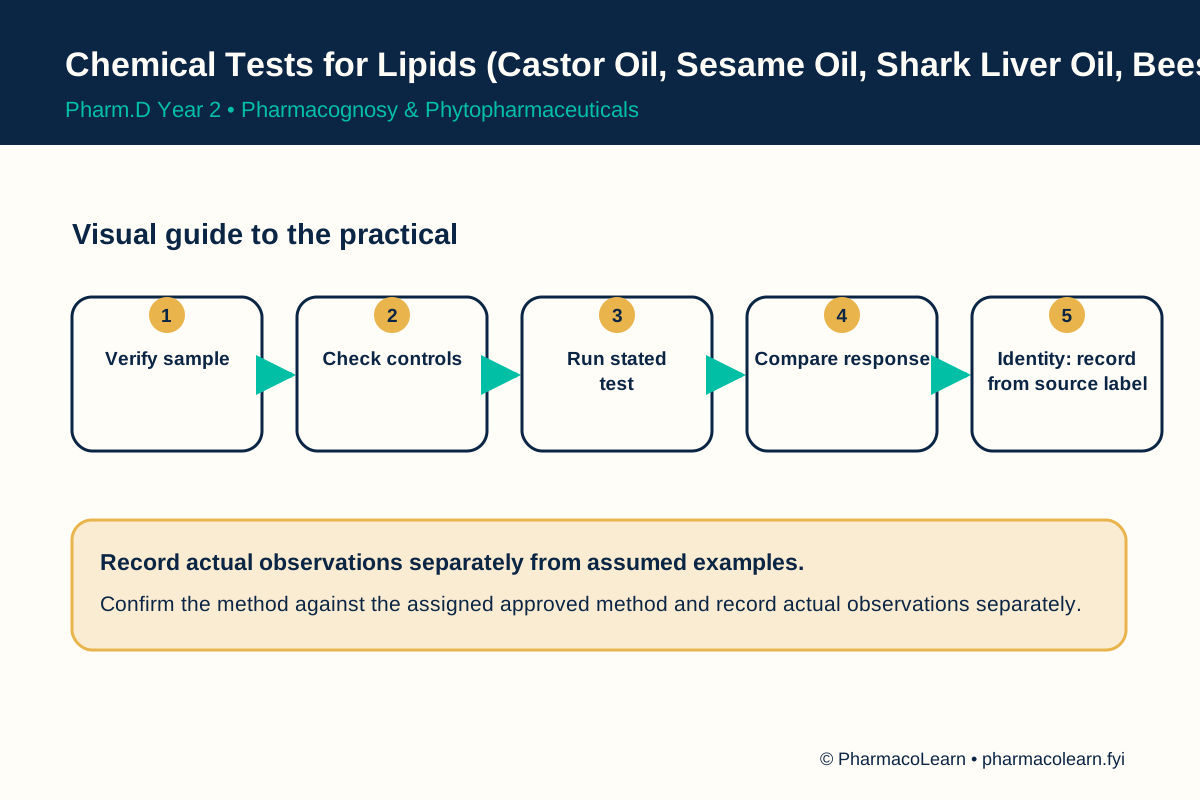
- Confirm the sample label, source or grade, applicable monograph, and method revision.
- Record dry or neat appearance and any visible contamination without tasting or directly smelling the material.
- Read the positive and negative control records, or observe the instructor preparing them under the approved method.
- Perform or review the method-specific chemical or physical tests, entering each raw response before interpretation.
- Compare sample and controls with the acceptance description; record the criterion from the assigned current monograph.
- Report whether the available evidence supports identity, contradicts it, or remains insufficient.
5. Observation and calculation
| Student record field | Entry |
|---|---|
| Case or product | Record here |
| Method | Record here |
| Observation | Record here |
| Inference | Record here |
| Supervisor check | Record here |
| Outcome | Record here |
Assumed observations for practice only: an assumed Lipids (Castor Oil, Sesame Oil, Shark Liver Oil, Beeswax) sample shows an assumed response during the instructor-selected test, while an assumed positive control responds and an assumed negative control does not. These invented observations demonstrate the table format only. The actual reagent, response, source, and identity are specified in your college lab manual and instructor's method sheet. No assumed quantity is a laboratory instruction.
6. Output or final result
Provide a test-by-test record and a conditional identification statement for Lipids (Castor Oil, Sesame Oil, Shark Liver Oil, Beeswax). Record the supervised outcome here.
Teaching-lab safety: Use instructor-supervised chemical handling and the approved waste stream. Do not ingest, inhale powder, or use the teaching material as a medicine or food.
This page is a supervised-activity guide; it does not report a completed case.
7. Sources
- PharmacoLearn Pharm.D Year 2 syllabus
- PCI Pharm.D Regulations and Syllabus
- WHO Quality Control Methods for Herbal Materials
- Relevant official or compendial method
Back to Pharmacognosy and Phytopharmaceuticals Practicals · All Pharm D Practicals · Pharm D
Theory notes: Pharmacognosy and Phytopharmaceuticals