
← Pharmaceutical Inorganic Chemistry Practicals
Limit Test for Chlorides
1. Aim
To compare the chloride-derived opalescence of a prepared test solution with a matched reference standard and record a conditional pass or fail decision. This is the first limit-test exercise, item 1(a), in the PCI Year 1 Pharmaceutical Inorganic Chemistry practical list. The applicable material monograph and permitted chloride limit are to be recorded from the assigned current monograph or approved college method in the student record. [1, 2]
2. Requirements
The assigned sample, monograph-specific preparation instruction, verified chloride reference solution, suitable water, nitric acid and silver nitrate reagents of the approved grade, matched comparison cylinders, pipettes, timer, clean viewing area, coat, gloves, eye protection, and separate silver-containing waste container are required. Sample mass, standard concentration, reagent concentrations and volumes, final solution volume, development time, lighting, and acceptance criterion are to be recorded from the assigned current monograph or approved college method in the student record. [2]
3. Theory
When soluble chloride ions meet silver ions in an acidified aqueous medium, fine silver chloride particles produce opalescence. A limit test does not usually determine an exact chloride concentration. Instead, a test preparation is compared with a reference preparation representing the permitted limit under matched conditions. If the test is no more opalescent than the reference, it meets that particular comparison criterion; a stronger appearance indicates failure or requires investigation under the controlling monograph. [2]
The comparison is meaningful only if the test and standard have equivalent final volumes, reagent additions, development times, vessel dimensions, and viewing conditions. Dirty glassware or chloride-containing water can create false opalescence. A clear blank checks background contamination. If the sample is naturally coloured or cloudy, a different or modified method may be needed and must be recorded here. [2]
4. Procedure
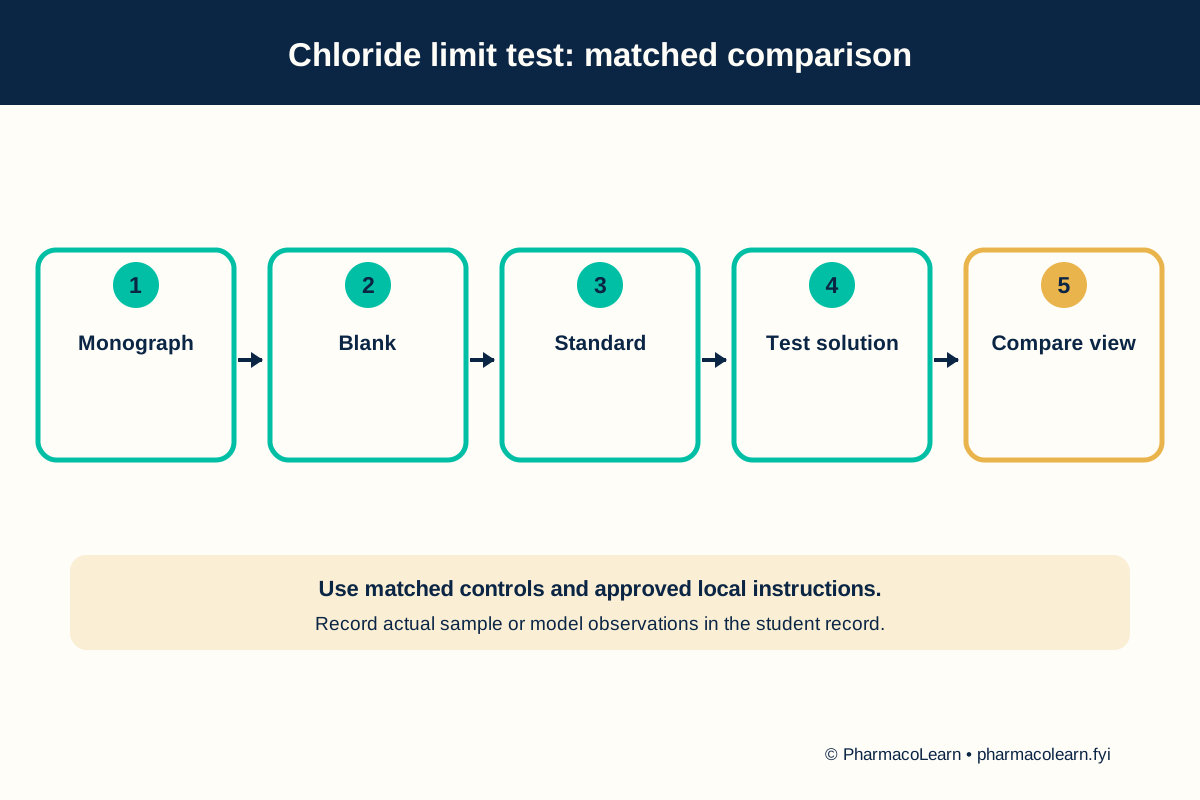
- Identify the assigned material and obtain the current approved monograph. Record its specific sample preparation and chloride limit; both are to be recorded from the assigned current monograph or approved college method in the student record when supplied. [1, 2]
- Inspect and label matched cylinders for blank, standard, and test. Use the prescribed water and clean glassware. [2]
- Prepare the chloride standard and test solution exactly as the monograph directs. Record reagent batch, sample mass, dilution, and final volume. [2]
- Add the specified nitric acid and silver nitrate solutions to both test and standard in the same order. Exact strengths, volumes, and timing must be specified in your college lab manual and instructor's method sheet. [2]
- Mix and allow the same prescribed development interval. Keep the cylinders under identical light and background conditions. [2]
- Compare opalescence using the specified viewing direction. Check the blank and repeat the comparison if the blank shows contamination or either solution has an interfering colour. [2]
- Record test versus standard as less, equal, or greater, then give a conditional pass or fail only against the verified monograph criterion. Collect silver-containing waste separately. [2]
5. Calculation, graph, or images as appropriate
| Observation | Actual teaching record |
|---|---|
| Monograph and chloride limit | Record here |
| Sample and standard preparation | Record here |
| Blank appearance | Record here |
| Standard opalescence | Record here |
| Test opalescence | Record here |
| Comparison and decision | Record here |
Pre-assumed observations for interpretation only: Suppose the blank is clear and the test is visibly less opalescent than a valid matched standard after the same development time. Under a monograph whose rule is “test not more opalescent than standard,” the hypothetical sample passes that comparison. If the test is more opalescent, it does not pass. These visual examples are not actual results or a universal chloride limit. No numeric concentration or volume is assumed. [2]
6. Result
Report the named monograph, preparation, blank status, matched comparison, and conditional decision. Without the actual standard and sample observation, the result must be recorded here. Safety note: Nitric acid can burn, and silver nitrate stains and irritates. Handle reagents under teaching-lab supervision with eye and skin protection and collect all silver-containing liquid for designated disposal. [2]
7. References
- Pharmacy Council of India. Pharm.D. Regulations, 2008, Pharmaceutical Inorganic Chemistry practical list.
- Centurion University. Handbook of Inorganic Impurities in Pharmaceuticals, limit test of chloride.
Back to Pharmaceutical Inorganic Chemistry Practicals · All Pharm D Practicals · Pharm D
Theory notes: Pharmaceutical Inorganic Chemistry