
← Pharmaceutical Inorganic Chemistry Practicals
Assay of Ammonium Chloride by Acid-Base Titration
1. Aim
To determine ammonium chloride in an assigned preparation by the validated formaldehyde-assisted acid-base titration. Record the assigned sample identity, monograph, and reporting basis from the approved local method sheet.
2. Requirements
Assigned ammonium chloride sample, verified sodium hydroxide titrant, neutralized formaldehyde reagent, prescribed indicator or endpoint system, suitable water, burette, pipettes, volumetric vessel, conical flask, balance, fume hood, and labelled waste container. Follow your college lab manual and instructor's method sheet for titrant concentration, sample mass, formaldehyde quantity, endpoint system, and blank.
3. Theory
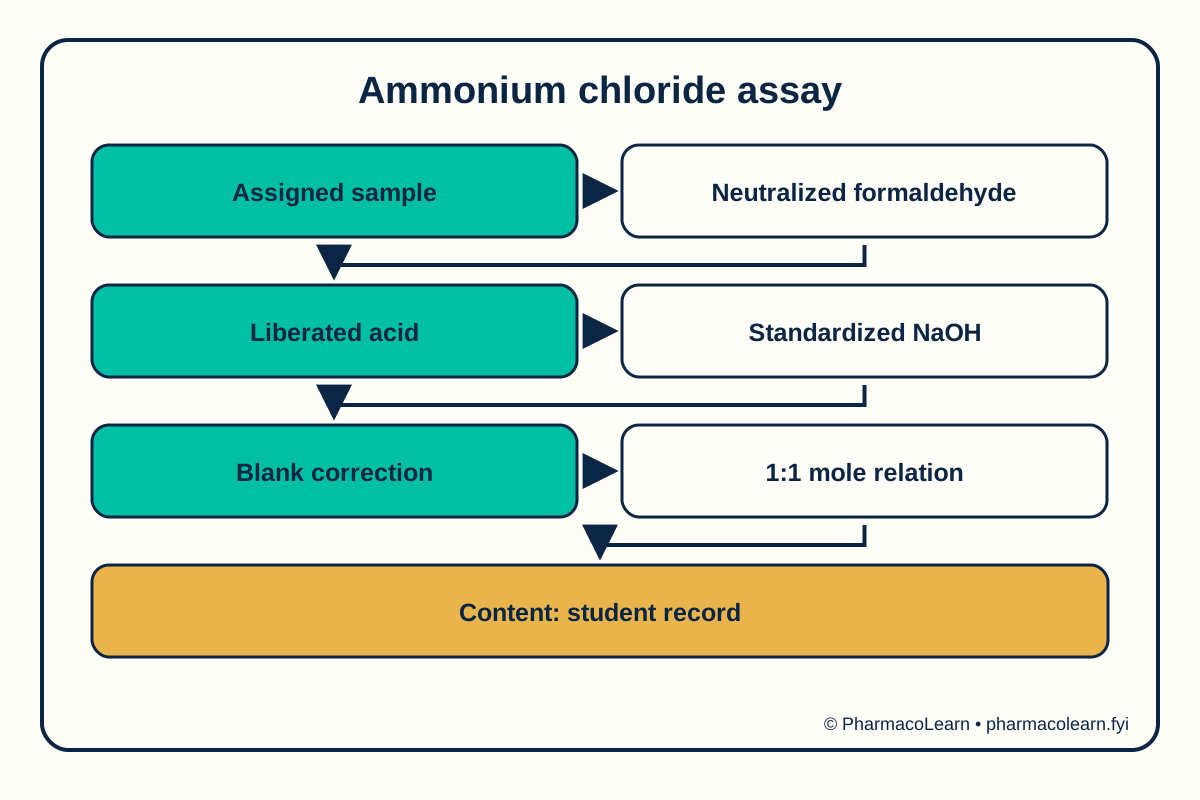
Ammonium is a weak acid and is not conveniently measured by a simple visual strong-acid/strong-base titration. In the formaldehyde-assisted method, formaldehyde binds ammonia derived from ammonium and liberates an equivalent amount of acid. Standardized sodium hydroxide measures the liberated acid. For the specified method the mole relation is one mole NaOH per mole NH4Cl, after any prescribed blank correction. The reagent must be neutralized as directed, and the calculation cannot rescue an unverified endpoint or reagent blank. [2]
4. Procedure
- Confirm the controlling monograph and teaching protocol. Record sample form, dilution plan, standardized NaOH concentration, indicator, and blank treatment; unresolved entries must be recorded here.
- Under instructor supervision in a fume hood, prepare the assigned sample solution and the specified neutralized formaldehyde reagent. Do not invent a preparation concentration or volume.
- Pipette the verified sample aliquot into a flask. Prepare the reagent blank if the chosen method calls for it.
- Add the prescribed formaldehyde reagent and indicator in the validated order. Allow the stated reaction time; exact time is specified in your college lab manual and instructor's method sheet.
- Titrate with standardized sodium hydroxide to the protocol endpoint, recording initial and final burette readings.
- Repeat the determination as prescribed, apply any verified blank correction, and calculate content on the monograph basis.
5. Calculation, graph, or images as appropriate
| Observation | Actual teaching record |
|---|---|
| Assigned sample and basis | Record here |
| Sample mass and aliquot | Record here |
| NaOH standardized molarity | Record here |
| NaOH initial and final readings | Record here |
| Blank volume if prescribed | Record here |
| Calculated content | Record here |
Assumed values for calculation practice only: assume the blank-corrected NaOH volume is assumed 10.00 mL and the standardized NaOH molarity is assumed 0.1000 mol/L. These are invented teaching values, not measured readings or reagent instructions.
- Assumed NaOH amount = assumed 0.01000 L × assumed 0.1000 mol/L = 0.001000 mol.
- Using the 1:1 assay relation, assumed NH4Cl amount in this illustrative aliquot = 0.001000 mol.
- Using the molar mass 53.49 g/mol, illustrative NH4Cl mass = 0.001000 mol × 53.49 g/mol = 0.05349 g, or 53.49 mg in the assumed aliquot.
- Actual whole-sample content and percentage must be recorded here because actual dilution, sample mass, titre, blank, and reporting basis are not supplied.
| Student record field | Entry |
|---|---|
| Case or product | Record here |
| Method | Record here |
| Observation | Record here |
| Inference | Record here |
| Supervisor check | Record here |
| Outcome | Record here |
6. Result
Report the actual assay only after checking the validated procedure, observed readings, sample basis, and dilution. Record the supervised outcome here. This page is a supervised-activity guide; it does not report a completed case. The East Point manual describes this formaldehyde-assisted assay, but the local monograph and exact endpoint govern implementation. Safety note: Formaldehyde is hazardous. Use a supervised teaching lab, a functioning hood, and the institution’s exposure and waste controls. No student should prepare or titrate an unapproved formulation independently.
7. References
- Pharmacy Council of India, Pharm.D. Regulations, 2008.
- East Point College of Pharmacy, Pharmaceutical Inorganic Chemistry Manual.
Back to Pharmaceutical Inorganic Chemistry Practicals · All Pharm D Practicals · Pharm D
Theory notes: Pharmaceutical Inorganic Chemistry