
Bioassay of Histamine by Interpolation Using Isolated Guinea Pig Ileum
1. Aim
To study bioassay of histamine by interpolation using isolated guinea pig ileum using an instructor-approved demonstration, diagram, or existing dataset, and document the supported interpretation. The approved model and actual outcome must be entered in the student record.
2. Requirements
Instructor-approved histamine standards and unknown response records, relevant method sheet, labelled observation or response record, graph paper or spreadsheet when needed, ethical approval and facility documentation where animal material is involved, and a supervisor. Exact species or tissue source, concentrations, dosing, bath composition, temperature, timing, and equipment settings are specified in your college lab manual and instructor's method sheet.
3. Theory
Interpolation within a valid tissue-response range is the central idea of this syllabus entry. Experimental pharmacology links a controlled input with a measured biological response. A valid interpretation depends on the preparation, controls, stable baseline, calibration, and documented method. The student should separate raw observations from inference and should not equate a teaching trace with clinical efficacy. Replacement, reduction, and refinement guide animal-related teaching. This article uses existing approved records or simulation as its student-facing route; any physical animal or isolated-tissue work requires institutional authorization and trained staff.
4. Procedure
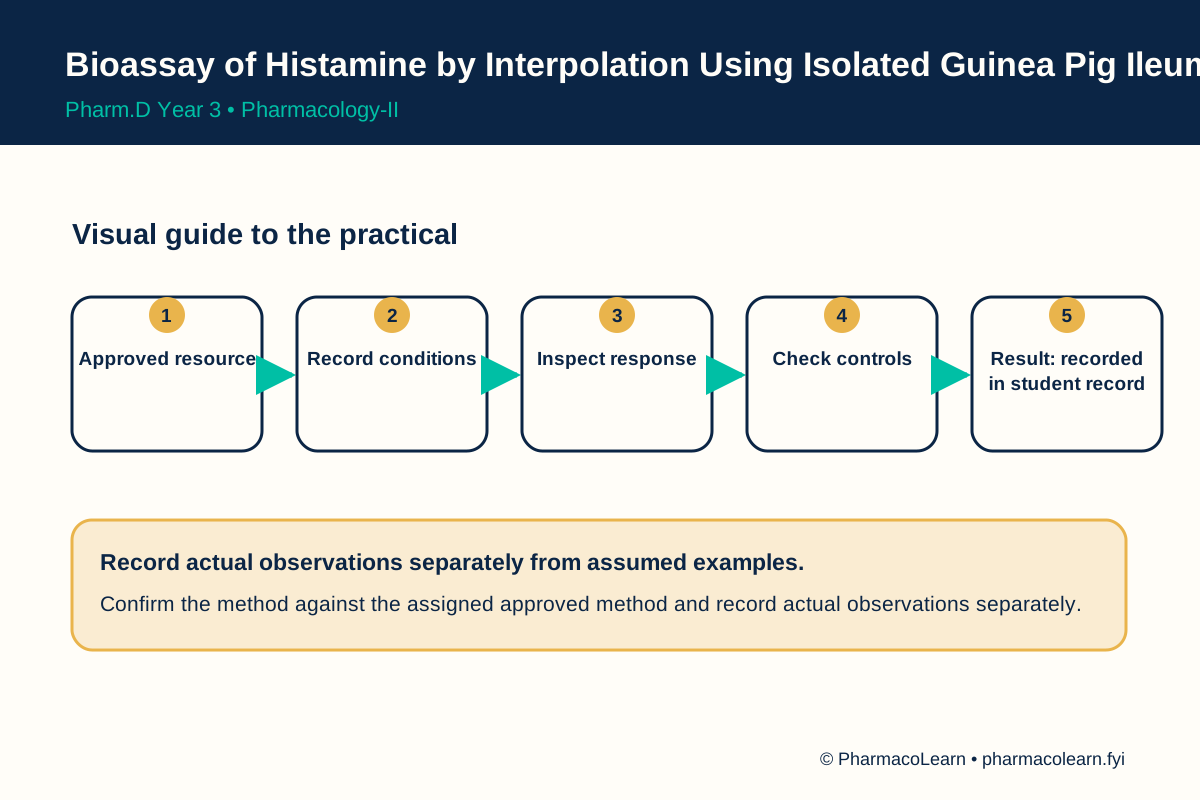
- Confirm the exact syllabus entry, institutional approval status, and instructor-selected teaching resource.
- Record the source, species or tissue if relevant, apparatus or dataset identifiers, and controls. Missing information is specified in your college lab manual and instructor's method sheet.
- Check the standard series and unknown are from a stable preparation. Plot the accepted range and interpolate the unknown only between neighbouring standards.
- Write raw observations before naming an effect, and compare them with the relevant controls or standard.
- Calculate or graph only when units, inputs, and method validity are documented; flag unsupported results Record here.
- State the conclusion, its uncertainty, and whether the exercise used a demonstration, recording, simulation, or approved physical preparation.
5. Observation and calculation
| Student record field | Entry |
|---|---|
| Case or product | Record here |
| Method | Record here |
| Observation | Record here |
| Inference | Record here |
| Supervisor check | Record here |
| Outcome | Record here |
Assumed values or observations for practice only: Assumed standard responses of 25 and 55 units at assumed 1 and 3 arbitrary concentration units bracket an assumed unknown response of 40 units. Linear practice interpolation gives an assumed 2 units; a real assay needs its approved model. Every invented input and output is assumed; it is not an animal procedure, dose instruction, or actual laboratory result.
6. Output or final result
Submit a labelled histamine interpolation with controls, observations, and a conditional interpretation. Record the supervised outcome here.
Teaching-lab safety: Teaching-lab supervision and institutional animal ethics approval are required for any live-animal or isolated-tissue work. Students should use approved recordings or simulations unless explicitly trained and authorized. No drug dose or animal procedure is specified here.
This page is a supervised-activity guide; it does not report a completed case.
7. Sources
- PharmacoLearn Pharm.D Year 3 syllabus
- PCI Pharm.D Regulations and Syllabus
- CCSEA Acts, Rules and Guidelines
- NC3Rs, The 3Rs
- IUPHAR Pharmacodynamics
Back to Pharmacology-II Practicals · All Pharm D Practicals · Pharm D
Theory notes: Pharmacology II