
Effect of Drugs on Pesticide Toxicity Using Rats as a Model
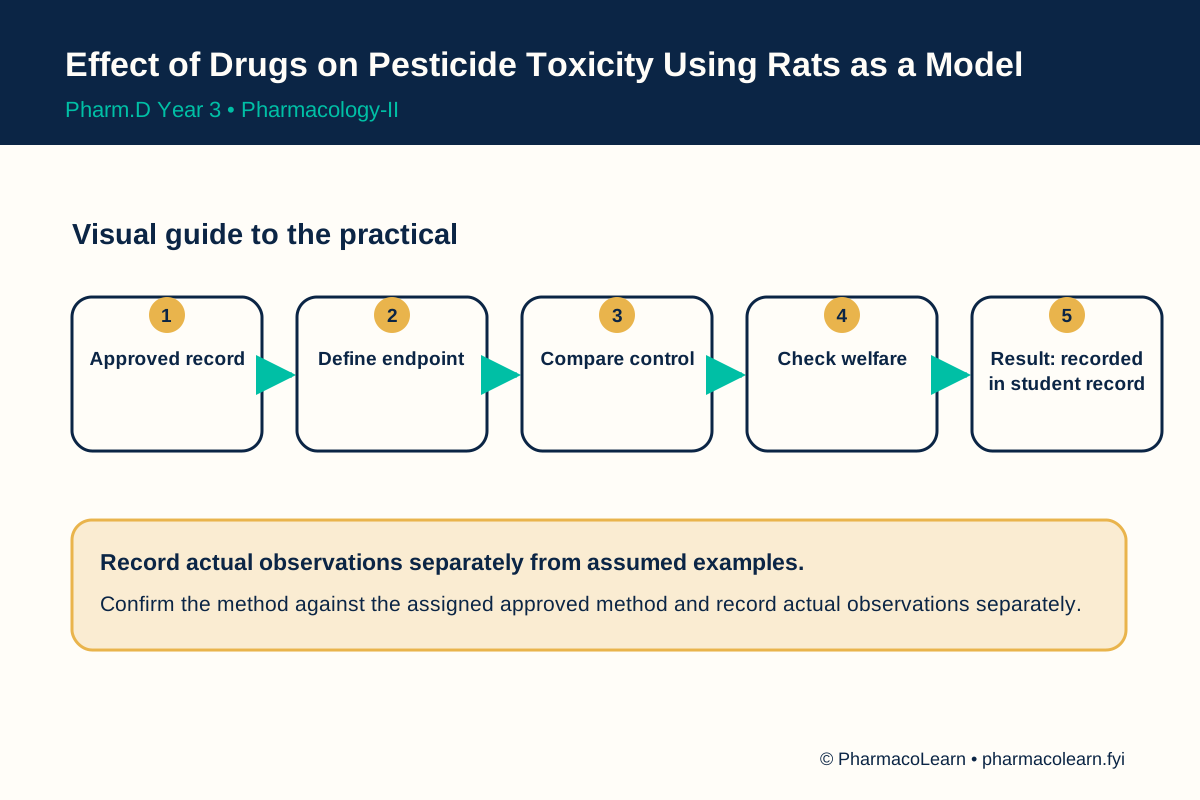
1. Aim
To interpret the syllabus-listed effect of drugs on pesticide toxicity using rats as a model from an approved video, archival record, or simulation. Actual experimental result must be entered in the student record.
2. Requirements
Instructor-approved, de-identified record or simulation; protocol and ethical authorization reference; control and test labels; defined outcome and units; quality and welfare notes; observation sheet. Actual drug amount, exposure, animal preparation, timing, and endpoint criteria are to be recorded from the approved protocol or instructor-supplied dataset in the student record from the approved protocol.
3. Theory
Pesticide toxicity is a severe model and requires strict institutional ethical authorization. Teaching should focus on existing records, exposure classification, predefined endpoints, intervention timing, and welfare outcomes. A difference between two records cannot establish protection without adequate design and controls. No exposure or treatment protocol is given.
4. Procedure
- Confirm the exact syllabus entry and the institutional approval status of the source record.
- Transcribe model, intervention, control, outcome units, time points, and any missing fields.
- Examine de-identified approved study records. Identify pesticide class, outcome variable, control group, intervention, monitoring, and humane endpoint fields. Compare only like outcomes.
- Check baseline quality, blinding or allocation notes, measurement validity, and welfare information.
- Calculate only from accepted matching records; write Record here wherever method information is missing.
- Report the supported observation and limits without making a treatment or safety claim.
5. Observation and calculation
| Student record field | Entry |
|---|---|
| Case or product | Record here |
| Method | Record here |
| Observation | Record here |
| Inference | Record here |
| Supervisor check | Record here |
| Outcome | Record here |
Assumed values or observations for practice only: An assumed data table has an assumed symptom score of 3 in one record and an assumed score of 1 in another. The scale and every number are invented, so efficacy is specified in your college lab manual and instructor's method sheet. Every invented input and output is assumed, never a dose, exposure instruction, or actual result.
6. Output or final result
Present a labelled study design and endpoint map and conditional finding. Actual outcome: Record here.
Teaching-lab safety: Use only approved recordings or simulations. Any live-animal, toxicant, or isolated-organ work requires ethical authorization, trained staff, and institution-specific safety controls. No exposure or dosing procedure is provided.
This page is a supervised-activity guide; it does not report a completed case.
7. Sources
- PharmacoLearn Pharm.D Year 3 syllabus
- PCI Pharm.D Regulations and Syllabus
- CCSEA Acts, Rules and Guidelines
- NC3Rs, The 3Rs
- ARRIVE 2.0 Guidelines
Back to Pharmacology-II Practicals · All Pharm D Practicals · Pharm D
Theory notes: Pharmacology II