
Antihistaminic Property Using Histamine-Induced Anaphylactic Reaction in Guinea Pigs
1. Aim
To interpret antihistaminic property using histamine-induced anaphylactic reaction in guinea pigs using an approved teaching record or simulation and report the supported finding. Syllabus position: Second practical list 5. Actual result must be entered in the student record.
2. Requirements
Instructor-approved video, chart, or de-identified dataset; its protocol and ethics record; labelled control and test conditions; observation sheet; graphing or calculation aid where appropriate; and supervisor review. Actual species or tissue source, doses, concentrations, timing, conditions, and acceptance criteria are to be recorded from the approved protocol or instructor-supplied dataset in the student record.
3. Theory
This historical syllabus model involves a severe animal reaction and needs especially careful ethical review. For teaching, a pre-existing approved dataset can be analyzed to compare reaction scores or timing with controls. Neither a lower score nor a longer latency by itself proves receptor-specific antihistaminic action. The page includes no challenge protocol.
4. Procedure
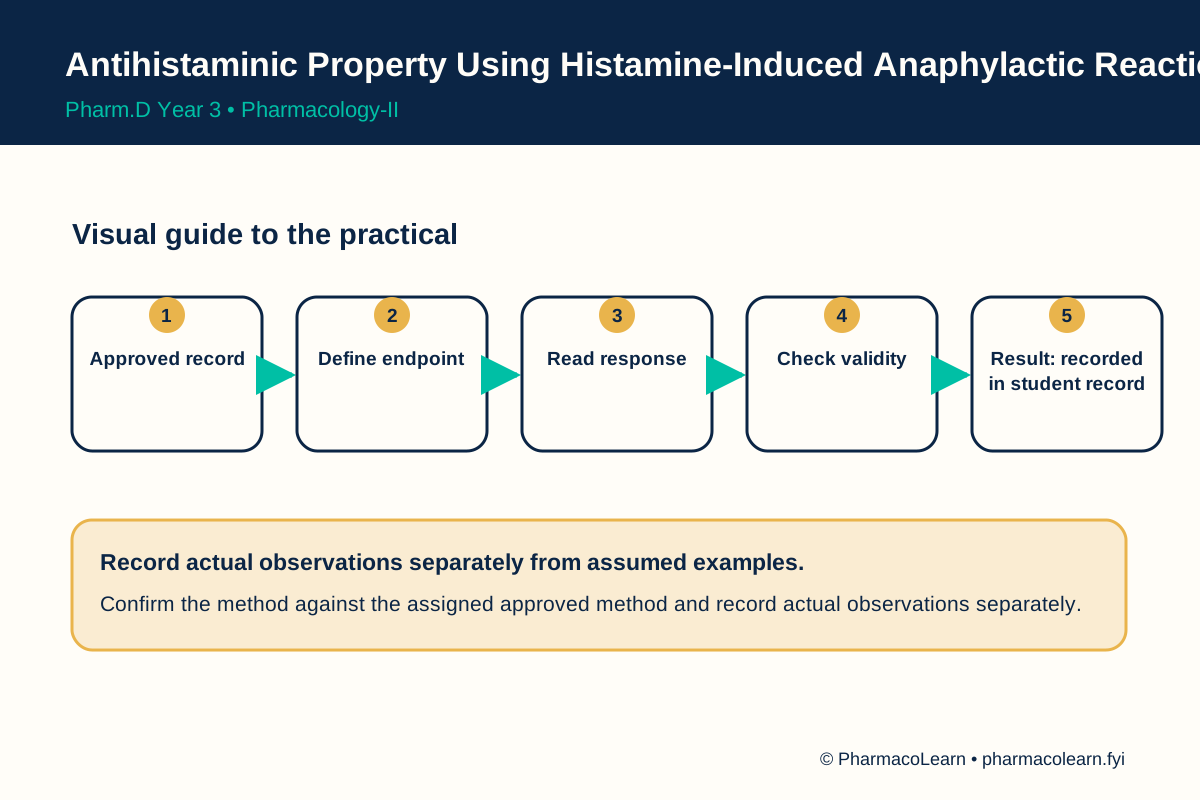
- Confirm the syllabus entry, chosen teaching record, authorization, and outcome definition with the instructor.
- Record the source identifier, species or tissue, controls, time points, units, and missing details without inferring them.
- Confirm that the dataset is de-identified and institutionally approved for teaching. Record the predefined reaction scale, controls, observation window, and welfare outcome. Compare groups using the specified analysis.
- Check baseline quality, replicate or control behavior, and any welfare or validity note before calculation.
- Perform only the analysis supported by the supplied method and mark unresolved values Record here.
- State the result, limitations, and whether the source was a simulation, video, or historical approved record.
5. Observation and calculation
| Student record field | Entry |
|---|---|
| Case or product | Record here |
| Method | Record here |
| Observation | Record here |
| Inference | Record here |
| Supervisor check | Record here |
| Outcome | Record here |
Assumed values or observations for practice only: An assumed control record has an assumed score of 3 and an assumed test record has an assumed score of 1 on an unspecified scale. These invented scores are not clinically or ethically interpretable without the validated scale. Every invented input and output is assumed, not a live-animal procedure or actual result.
6. Output or final result
Submit a labelled reaction score review with a conditional interpretation. Actual experimental outcome: Record here.
Teaching-lab safety: Teaching-lab supervision is required. Any live-animal or isolated-tissue work requires institutional ethical authorization and trained personnel. Students should analyze approved records or simulations here; no dose or animal procedure is specified.
This page is a supervised-activity guide; it does not report a completed case.
7. Sources
- PharmacoLearn Pharm.D Year 3 syllabus
- PCI Pharm.D Regulations and Syllabus
- PharmacoLearn Pharm.D Year 3 Syllabus
- CCSEA Acts, Rules and Guidelines
- NC3Rs: The 3Rs
- ARRIVE 2.0 Reporting Guidelines
- IUPHAR Pharmacodynamics
Back to Pharmacology-II Practicals · All Pharm D Practicals · Pharm D
Theory notes: Pharmacology II