
← Pharmaceutical Analysis Practicals
Chlorides and Sulphates in Calcium Gluconate by Nepheloturbidimetry
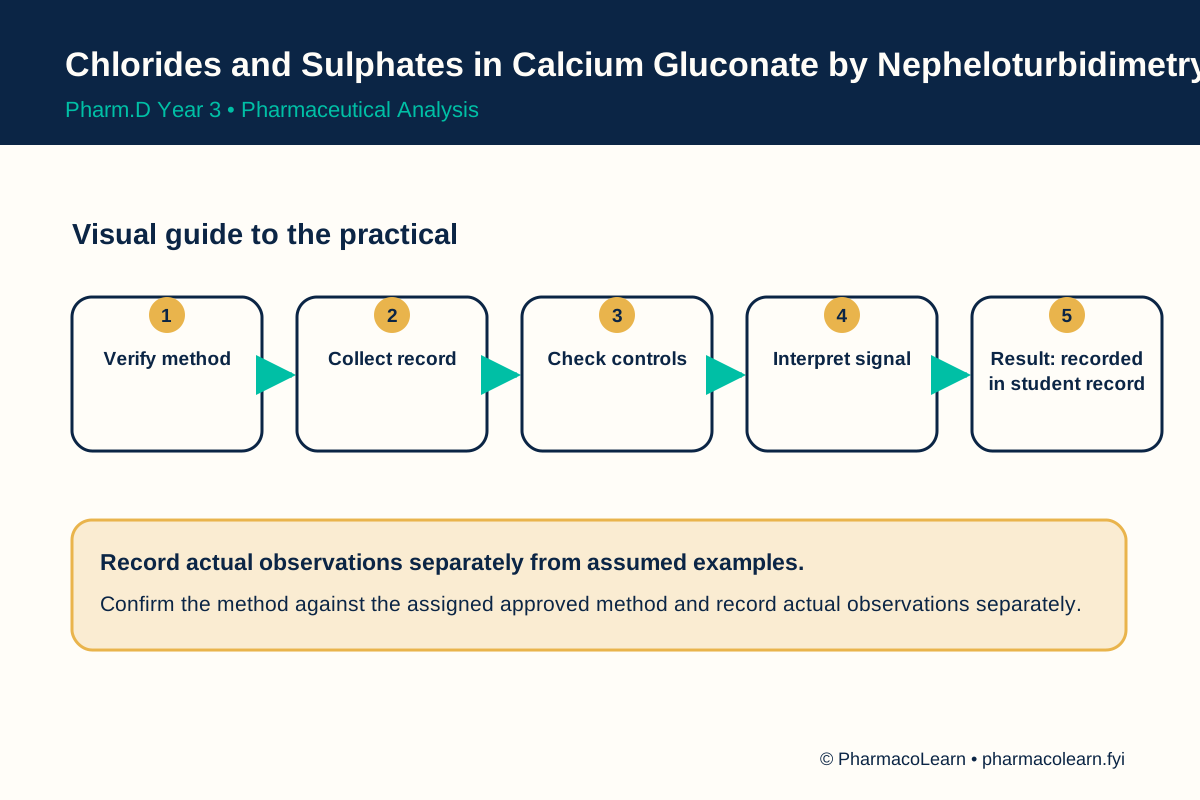
1. Aim
To complete the Year 3 practical chlorides and sulphates in calcium gluconate by nepheloturbidimetry using a verified method, demonstration, or supplied dataset. The actual sample and finding must be entered in the student record.
2. Requirements
Instructor-approved sample or de-identified instrument record, reference standards, blanks and quality controls, method sheet, calibration record, observation form, calculator or plotting tool, protective equipment, and waste procedure. Exact reagents, volumes, concentrations, settings, and limits are specified in your college lab manual and instructor's method sheet.
3. Theory
Light scattering from a controlled precipitate can be compared with standards. Chloride and sulphate need separate, validated reactions and calibration records. Particle size, mixing, timing, and blank correction can strongly affect readings. A single cloudiness observation is not a quantitative impurity result.
4. Procedure
- Identify the syllabus entry, sample or dataset, method revision, instrument calibration, and hazards.
- Record reference, blank, control, and sample measurements with units and source IDs.
- Observe the approved method or analyze the supplied dataset without filling missing conditions by guesswork.
- Record chloride and sulphate channels separately, each with its reagent blank, calibration, sample reading, and method suitability. Interpolate only within the validated range.
- Check method suitability, range, and control behaviour before any calculation or interpretation.
- Report raw observations, the justified calculation, limitations, and your college lab manual and instructor's method sheet items separately.
5. Observation and calculation
| Student record field | Entry |
|---|---|
| Case or product | Record here |
| Method | Record here |
| Observation | Record here |
| Inference | Record here |
| Supervisor check | Record here |
| Outcome | Record here |
Assumed values for practice only: Assumed chloride-channel scattering signal is 20 units and an assumed standard of 1 arbitrary concentration unit gives 20 units. The assumed sample maps to 1 unit before any dilution correction. This says nothing about sulphate. Every invented input and output is assumed, not a real analytical result or operating instruction.
6. Output or final result
Provide a labelled two separate impurity calibrations and conditional interpretation. Record the supervised outcome here.
Teaching-lab safety: Perform chemical or instrument work only under instructor supervision with the approved safety and waste procedures. Assumed values are examples only.
This page is a supervised-activity guide; it does not report a completed case.
7. Sources
- PharmacoLearn Pharm.D Year 3 syllabus
- PCI Pharm.D Regulations and Syllabus
- PharmacoLearn Year 3 Syllabus
- USP Verification of Compendial Procedures
- Method-specific primary reference
Back to Pharmaceutical Analysis Practicals · All Pharm D Practicals · Pharm D
Theory notes: Pharmaceutical Analysis