
← Biopharmaceutics and Pharmacokinetics Practicals
Protein Binding of Highly and Poorly Bound Drugs
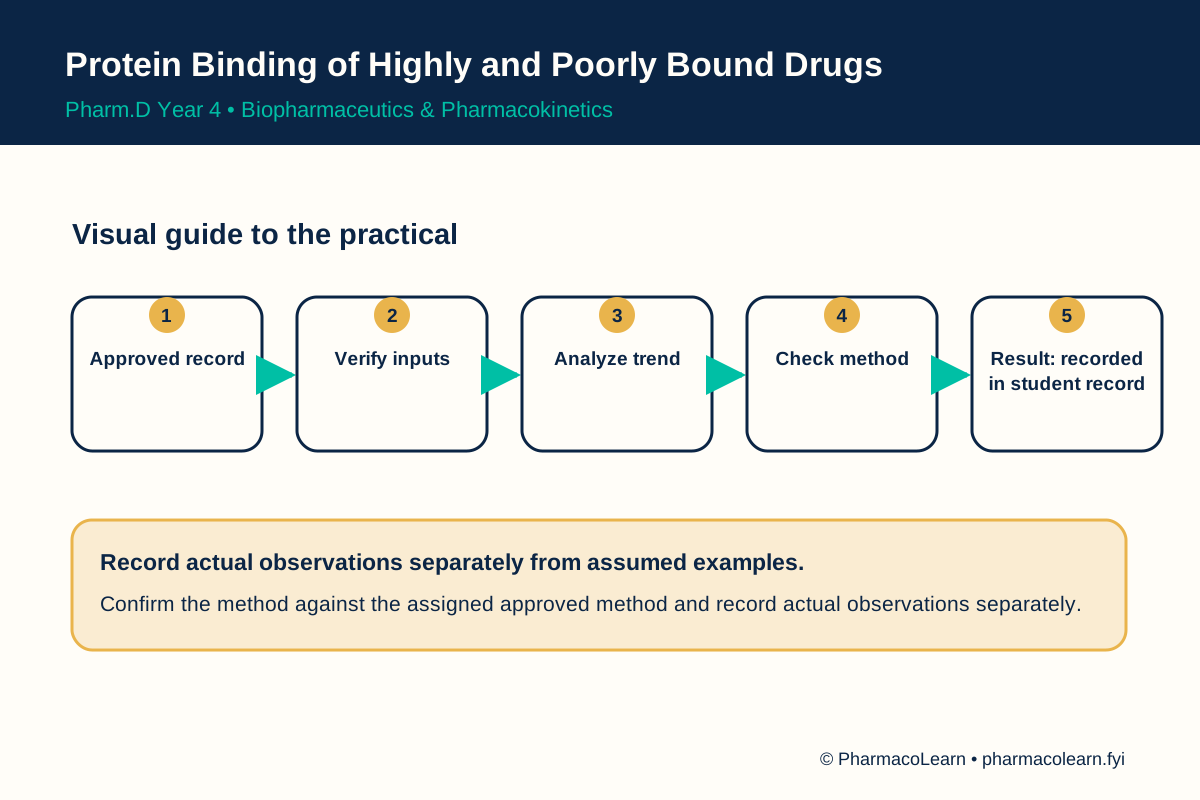
1. Aim
To study year 4 biopharmaceutics 4 using supervised records and report the supported outcome. Actual case, sample, and result must be entered in the student record.
2. Requirements
Approved de-identified dataset or teaching case, current method, source identifiers, calibration and control records where relevant, graphing or calculation tool, supervisor, and privacy or safety procedure. Record the assigned sample and use approved software. Drug identity, dose, and acceptance criteria are to be recorded from the assigned current monograph or approved college method in the student record.
3. Theory
Protein binding compares total and unbound drug in a validated matrix. Different drugs may bind differently, but the labels highly and poorly bound require verified references. Equilibrium, nonspecific adsorption, recovery, and bioanalytical assay performance affect estimates.
4. Procedure
- Confirm the syllabus entry, approved source, ethics or privacy requirements, and method.
- Record actual labels, units, time points, controls, and missing information without guessing.
- Work through the supervised case or dataset: Read approved total and unbound concentration records for two authenticated drugs. Verify units, recovery, and method before calculating unbound fraction.
- Separate raw observations from calculations and check method suitability.
- Use verified formulae and local software only if the full dataset and method support them.
- State the supported result, limitations, and every missing item as Record here.
5. Observation and calculation
| Student record field | Entry |
|---|---|
| Case or product | Record here |
| Method | Record here |
| Observation | Record here |
| Inference | Record here |
| Supervisor check | Record here |
| Outcome | Record here |
Assumed values or observations for practice only: Assumed total concentration is 10 mg/L and assumed unbound concentration is 1 mg/L for one assumed drug. Assumed unbound fraction = 1/10 = 0.10. This is practice only. All invented inputs and outputs are assumed, not a patient result or laboratory instruction.
6. Output or final result
Provide a labelled bound and unbound fractions and supervisor-reviewed conclusion. Record the supervised outcome here.
Teaching-lab safety: Clinical cases must be de-identified and supervised. Human or animal bioavailability work requires prior ethical authorization. No assumed example authorizes dosing or sampling. Software-dependent fitting belongs in the actual lab with its approved program.
This page is a supervised-activity guide; it does not report a completed case.
7. Sources
- PharmacoLearn Pharm.D Year 4 syllabus
- PCI Pharm.D Regulations and Syllabus
- PharmacoLearn syllabus
- Primary method or guidance
Back to Biopharmaceutics and Pharmacokinetics Practicals · All Pharm D Practicals · Pharm D
Theory notes: Pharm D Year 4, 4.5 Biopharmaceutics and Pharmacokinetics