
← Biopharmaceutics and Pharmacokinetics Practicals
Absorption in Animal Inverted Intestine
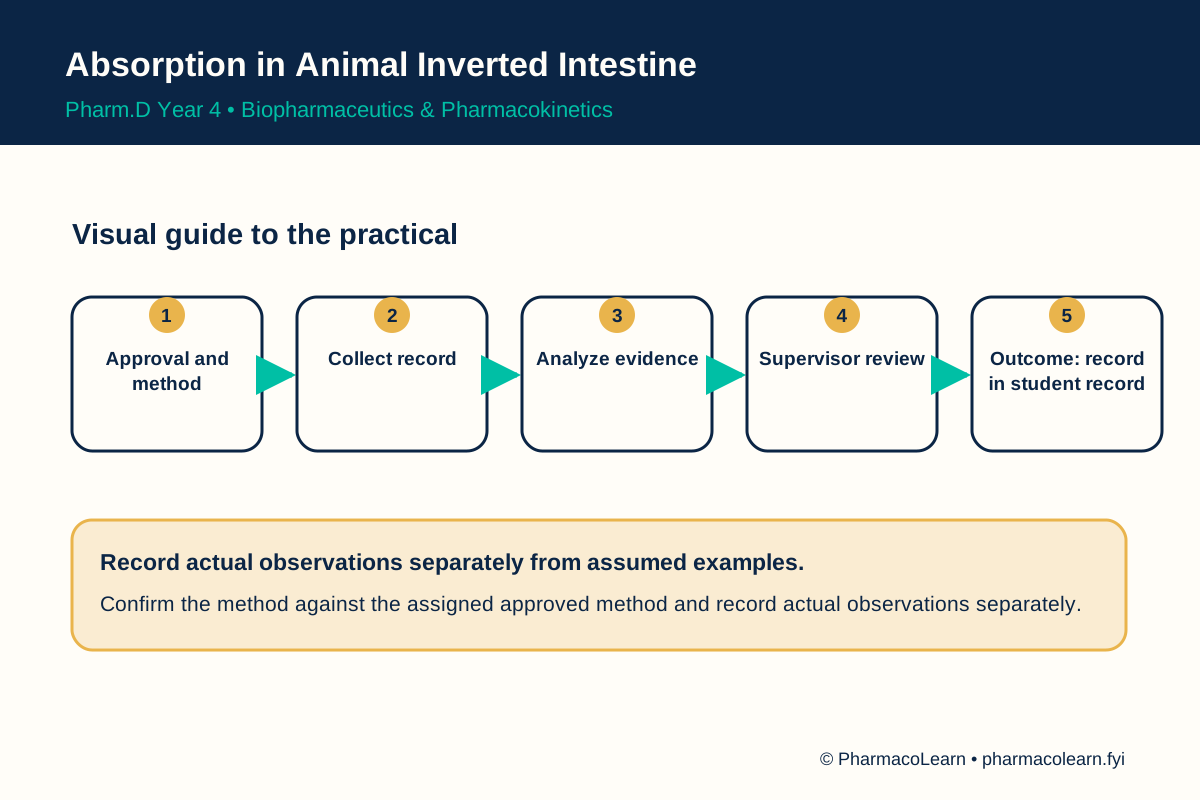
1. Aim
To complete the syllabus requirement year 4 biopharmaceutics 12 through an approved supervised record. Actual work and results must be entered in the student record.
2. Requirements
Instructor-approved syllabus activity, de-identified record or method sheet, relevant controls and source data, supervisor, ethics or privacy documents where applicable, observation form, and approved analysis tool. Exact drug, dose, and acceptance criteria are to be recorded from the assigned current monograph or approved college method in the student record. Follow your college lab manual and instructor for the model, software, and case record.
3. Theory
The inverted intestine model is an ex vivo animal tissue technique. Its interpretation depends on species, tissue viability, orientation, surface area, mixing, and validated concentration assay. This teaching page uses an approved historical dataset or simulation; it does not direct tissue collection or preparation.
4. Procedure
- Confirm the syllabus requirement, approved method or clinical activity, and supervision.
- Record only verified source data, dates, units, identifiers, controls, and ethics status.
- Complete the actual practical or inspect an approved teaching record: Inspect a labelled diagram and supplied donor and serosal-side concentration records. Check tissue viability and blanks, then calculate transfer per unit time only if all measurements are available.
- Separate raw observations from inferred conclusions and note missing data as Record here.
- Use the local verified method or software only where required; use the program approved by your college lab manual and instructor.
- Submit the supported result for instructor or preceptor review, without representing assumed data as actual work.
5. Observation and calculation
| Student record field | Entry |
|---|---|
| Case or product | Record here |
| Method | Record here |
| Observation | Record here |
| Inference | Record here |
| Supervisor check | Record here |
| Outcome | Record here |
Assumed values or observations for practice only: Assumed serosal amount rises by 2 micrograms during an assumed 1-hour interval. Assumed transfer rate is 2 micrograms/hour before area correction. This is invented data. Every invented input and output is assumed and does not represent completed clinical or laboratory work.
6. Output or final result
Provide a labelled ex vivo transfer record and a supervisor-reviewed conclusion. Record the supervised outcome here.
Teaching-lab safety: Clinical material must be de-identified. Human or animal studies need prior ethical authorization and trained personnel. No assumed example authorizes treatment, dosing, or specimen collection.
This page is a supervised-activity guide; it does not report a completed case.
7. Sources
- PharmacoLearn Pharm.D Year 4 syllabus
- PCI Pharm.D Regulations and Syllabus
- PharmacoLearn syllabus
- Primary method or regulation
Back to Biopharmaceutics and Pharmacokinetics Practicals · All Pharm D Practicals · Pharm D
Theory notes: Pharm D Year 4, 4.5 Biopharmaceutics and Pharmacokinetics