
MRM301T — Research Methodology and Biostatistics
4 hrs/week, 4 credits, 60 hours, 100 marks. Notes follow the M.Pharm syllabus, unit by unit.
MRM301T Research Methodology and Biostatistics notes for M.Pharm Semester 3, common to all specialisations: research design, biostatistics with worked examples, medical ethics, CPCSEA guidelines and the Declaration of Helsinki, with free unit wise PDF downloads on PharmacoLearn.
Units in this subject
- Unit 1 — General Research Methodology
- Unit 2 — Biostatistics
- Unit 3 — Medical Research: History and Values in Medical Ethics
- Unit 4 — CPCSEA Guidelines for Laboratory Animal Facility
- Unit 5 — Declaration of Helsinki
Download MRM301T PDF Notes
Free PDFs for this subject, one per unit:
Research Methodology and Biostatistics, subject code MRM301T, is the common theory subject of M.Pharm Semester 3, taken by every specialisation (Pharmaceutics, Pharmaceutical Chemistry, Pharmacology and all others) in the semester devoted to research work. It carries 4 credits and 60 hours of theory, taught at 4 hours per week, for 100 marks.
This subject teaches the student how to do the research that Semester 3 and 4 demand, and how to judge the research of others. Unit 1 covers general research methodology: what research is, how a study is designed, and the defensive machinery (controls, randomization, placebo, blinding) that keeps a study honest. Unit 2 is the biostatistics core, and the reason this page is the M.Pharm Biostatistics notes page for every branch: sample size, the null hypothesis and P values, and the named parametric and non parametric tests, each taught with a fully worked numerical example whose arithmetic is shown step by step. Unit 3 turns to medical research ethics: the four values of autonomy, beneficence, non maleficence and justice in their classic form, informed consent, confidentiality, and the professional practice problems of conflicts of interest, referral and vendor relationships. Unit 4 sets out the CPCSEA guidelines for the laboratory animal facility, the rules under which the preclinical half of a pharmacy research project is housed and run. Unit 5 closes with the Declaration of Helsinki, the founding ethical document of modern medical research, its history and its two sets of principles. A student who masters this subject can plan a defensible project, analyse its data with the right test, and house, consent and report the work inside the rules.
Unit 1: General Research Methodology
1.1 What research is
Research is systematic, controlled and critical investigation carried out to discover new facts, to verify or revise accepted facts, or to build new theory from them. The word itself suggests searching again: knowledge is not collected once and finished, it is re-examined whenever a better instrument, a new drug or a sharper question appears. In pharmacy, research spans the bench (a new molecule, a new formulation), the animal facility (pharmacology and toxicology), the clinic (trials in patients) and the population (pharmacoepidemiology), and the method changes with the territory while the discipline stays the same.
Three characteristics separate research from casual inquiry. It is systematic: the steps are planned in advance and followed in order, so that another worker could repeat them. It is controlled: as far as possible, only the factor under study is allowed to vary, and everything else is held constant, matched or randomised away (sections 1.9 to 1.13 exist for this purpose). And it is empirical: conclusions rest on observations and measurements, not on authority or plausibility. A result that cannot, in principle, be tested against observation is not yet a research finding.
Research is also classified by purpose. Basic (pure) research pursues knowledge for its own sake, such as the mechanism of a receptor. Applied research aims at a practical problem, such as improving the dissolution of a poorly soluble drug. Action and evaluative research test whether an intervention or a programme works in its real setting. The M.Pharm project usually sits in applied research, but it borrows its rigour from the basic tradition.
1.2 Objectives of research and the research problem
Every study begins as a problem: a gap between what is known and what needs to be known, stated sharply enough to be answered. "Improve the tablet" is not a research problem; "does replacing lactose with mannitol raise the 45 minute dissolution of drug X tablets from 75 percent to at least 85 percent" is one, because it names the intervention, the outcome and the size of change worth having. The objective of a study is the formal statement of what the study will establish. A primary objective names the single main question; secondary objectives list the supporting questions. Objectives must be specific, measurable, achievable with the available facilities, relevant and time bound.
From the objective flow the remaining planning decisions: what will be measured (the outcome variables), in whom or in what (the study units), with what comparison (the control), and how many (the sample size of Unit 2). A hypothesis, a testable prediction that the study will confirm or refute, is often written alongside the objective; its formal statistical twin, the null hypothesis, is the subject of section 2.8. A common failure of student projects is to collect data first and invent the objective afterwards; the objective is not decoration, it is the contract the analysis must fulfil.
1.3 Requirements of a good research study
A defensible study must satisfy a short list of requirements before the first observation is made:
- A written protocol or proposal stating the problem, objectives, design, methods, sample size and analysis plan in advance.
- A design matched to the question, chosen from the families of section 1.7, strong enough for the claim the student wants to make.
- Defined materials and methods, so that the work is reproducible: identified drug source and purity, calibrated instruments, named animal strain, stated inclusion and exclusion criteria for subjects.
- Bias control built in, not argued afterwards: controls, randomization, blinding and a placebo where the design needs them.
- Ethical clearance before the work begins: institutional ethics committee approval for human work, Institutional Animal Ethics Committee approval under CPCSEA for animal work (Unit 4).
- Adequate resources and time: the requirements of research are practical as well as intellectual, and a study that runs out of animals, reagents or follow up time produces fragments, not findings.
- An analysis plan, including which statistical test will answer which objective, decided before the data arrive (Unit 2).
The research process then runs in a fixed order, each step feeding the next:
Problem identified and objectives stated
        |
        v
Review of literature (what is already known)
        |
        v
Study design chosen, protocol written
        |
        v
Ethics approval + sample size fixed
        |
        v
Data collected as per protocol
        |
        v
Data analysed with the planned tests
        |
        v
Interpretation, conclusion, report and thesis
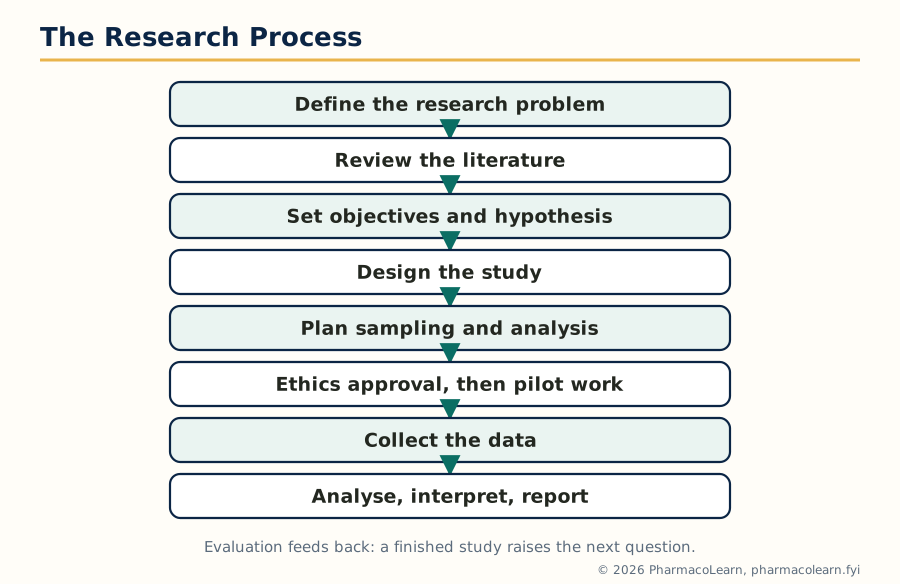 Figure: The research process. No later step can rescue a study whose earlier steps were skipped: a weak design is not repaired by a large sample or a clever test.
1.4 Practical difficulties in research
The syllabus names practical difficulties because real research meets them constantly, and examiners expect the student to know the standard ones and their remedies. Finance and materials: research costs money, and imported reagents, animals and instrument time strain a department budget; the remedies are realistic scoping, institutional and external grants, and designs that answer the question with fewer subjects (a crossover design, section 1.11, is one such economy). Time: a two semester project competes with coursework, and slow steps (animal acclimatization, stability studies, patient recruitment) cannot be hurried; the remedy is a work plan with margins. Non availability and non cooperation of subjects: patients refuse, drop out (section 2.7) or cannot be followed; animal supply fails. Lack of standardised tools and techniques: two laboratories measuring the same quantity differently cannot pool or compare results, which is why validated methods and calibrated instruments are a requirement, not a virtue. Bias of the investigator: the researcher's hope for a positive result is itself a source of error, answered by the machinery of sections 1.9 to 1.13. Ethical and administrative constraints: some questions cannot be asked experimentally in humans at all, and approval timelines are real. Naming the difficulties in the proposal, with the plan for each, is part of research competence.
1.5 Review of literature
The review of literature is the systematic survey of what has already been published on the problem. It does five jobs. It prevents duplication: rediscovering a published result wastes a year. It defines the gap the new study will fill, which sharpens the objective. It borrows and improves methods: the best published design for the same question is the starting point for the new protocol. It supplies the comparison values (expected effect size, expected variability) that the sample size calculation of Unit 2 needs. And it warns of difficulties others have met.
Sources are searched in a hierarchy of reliability. Primary sources (original research papers in peer reviewed journals) carry the evidence; secondary sources (reviews, textbooks) organise it; databases and indexes (PubMed and MEDLINE, Scopus, Web of Science, Google Scholar, and the library's journal holdings) find it. A working review records for each paper the question, the design, the sample, the result and the limitation, not merely the conclusion. The review ends by stating, in a paragraph, what is known, what is disputed and what is missing: the missing part is the justification of the new study.
1.6 Study design: the plan of the investigation
A study design is the complete plan that specifies how subjects or materials are selected, how groups are formed, what is done to each group, what is measured, when, and how the results will be analysed. It is chosen before data collection and written into the protocol. The design decides in advance the strength of conclusion the study can support: a well designed small study outranks a large careless one, because size cannot repair a design flaw, it only estimates the wrong quantity more precisely.
Designing a study means deciding four things. First, the study units and how they are sampled. Second, the comparison structure: is there a control group, and of what kind (section 1.9)? Third, the allocation: who or what receives which intervention, and is it randomised (section 1.10)? Fourth, the measurement plan: outcomes, instruments, time points, and the safeguards of placebo and blinding where perception can distort measurement. The next section names the standard families these choices produce.
1.7 Types of studies
Studies are classified first by whether the investigator assigns the exposure or merely observes it.
| Family | What the investigator does | Standard members | Typical pharmacy use |
|---|---|---|---|
| Descriptive | Observes and reports, no comparison group | Case report, case series, cross sectional survey | ADR case reports, drug utilisation surveys |
| Analytical observational | Observes exposures and outcomes, no assignment | Cohort, case control, cross sectional analytical | Pharmacoepidemiology, risk factor studies |
| Experimental (interventional) | Assigns the intervention | Randomised controlled trial, crossover trial, preclinical experiments | Clinical trials, animal pharmacology |
| Review based | Works on published studies, not new subjects | Narrative review, systematic review, meta analysis | Evidence synthesis for a thesis introduction |
In a cohort study exposed and unexposed groups are followed forward to compare outcome rates; it can estimate incidence but is slow and costly. In a case control study cases (with the outcome) and controls (without) are compared backward for past exposure; it is fast and the classic design for rare outcomes such as rare adverse reactions, but it cannot estimate incidence and leans on records and memory. A cross sectional study measures exposure and outcome at one point in time, a snapshot suited to prevalence. Experimental studies assign the intervention and so support causal claims most strongly; in preclinical work the "subjects" are animals, cell lines or formulations, and the same design logic applies. The choice among them is dictated by the question, the rarity of the outcome, ethics and resources, in that order.
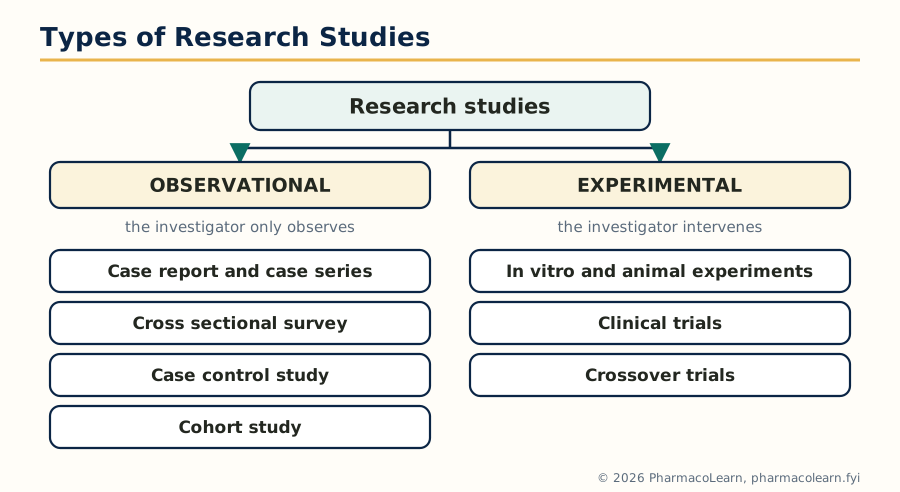 Figure: The families of study designs. Moving right, the investigator controls more of the conditions and the design supports stronger causal claims, at greater cost and ethical weight.
1.8 Errors and bias, and the strategies against them
Two kinds of error threaten a study. Random error is chance variation: it scatters individual results around the truth, shrinks as sample size grows, and is quantified by the confidence intervals and P values of Unit 2. Systematic error, or bias, pushes results consistently away from the truth in one direction; no sample size cures it, because a biased method applied to a million subjects is precisely wrong. Bias enters at every stage: selection bias when the groups differ from the start (healthier patients channelled to the new drug), information or measurement bias when outcomes are measured differently between groups (an unblinded assessor scoring the favoured group generously), and confounding when a third factor linked to both exposure and outcome imitates an effect (age confounding a comparison between a drug given to the young and one given to the old).
The strategies to eliminate errors and bias are the armoury of the next five sections, and they divide by target. Against selection bias and confounding: randomization (section 1.10), supported by restriction and matching at the design stage and adjustment at analysis. Against measurement bias: blinding (section 1.13), standardised instruments and objective endpoints. Against the expectation effects of subjects and the natural course of disease: controls and placebo (sections 1.9 and 1.12). A protocol should name, for each foreseeable bias, the strategy that answers it.
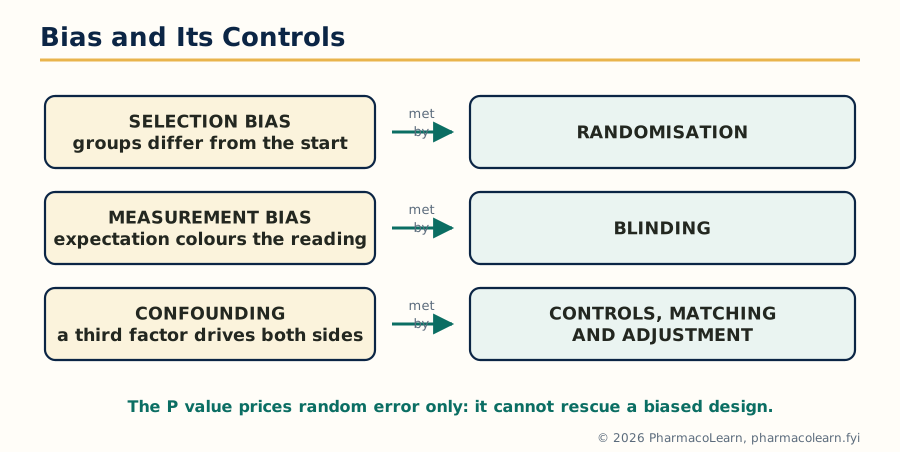 Figure: The bias control toolkit. Each tool answers a named family of bias; a protocol should pair every foreseeable bias with its tool.
1.9 Controls
A control is the comparison condition against which the test condition is judged. Without a control, a change observed after treatment cannot be attributed to the treatment: patients improve spontaneously, measurements drift, seasons change, and disease fluctuates. The control group experiences everything the test group experiences except the active intervention, so the difference between groups isolates the intervention's effect.
Controls are classified by time and by content. A concurrent control runs alongside the test group in the same period and is the standard; a historical control is taken from past records and is weaker, because everything else (care standards, diagnostics, population) has also changed. By content, the control may receive no treatment (acceptable only where no effective treatment exists or withholding is harmless), a placebo (section 1.12), the standard treatment (active control, the usual choice once an effective therapy exists), or a different dose of the same drug. In preclinical work the equivalents are the vehicle control (the solvent or base without drug), the untreated control and the positive control (a standard drug of known effect, proving the assay could have detected an effect). The choice of control is an ethical as well as a scientific decision, and Unit 5 states the governing rule: participants must not be denied the best proven intervention without strong justification.
1.10 Randomization
Randomization is the allocation of subjects to groups by chance alone, using a random process (random number tables or a computer generator) rather than the investigator's judgement, alternation or record number. It does two things no other device does. It removes selection bias at allocation, because nobody, consciously or not, can steer the promising subjects into the favoured group. And it distributes all other factors, known and unknown, between the groups in proportion, so that on average the groups differ only in the intervention: age, severity, habits and confounders nobody has thought of are balanced by the same throw of the dice. This second property is why the randomised controlled trial sits at the top of the design hierarchy.
The standard methods are simple randomization (each subject allocated by an independent random draw; simple, but can leave unequal group sizes in small trials), block randomization (allocation in small blocks, such as blocks of four containing two of each treatment in random order, keeping the groups balanced throughout recruitment) and stratified randomization (randomization performed separately within strata of a strong prognostic factor, such as sex or disease severity, so that factor is balanced exactly). Two disciplines protect the device: the allocation sequence is concealed from the person enrolling subjects (sealed opaque envelopes or a central system), so the next allocation cannot be anticipated and gamed; and once randomised, subjects are analysed in their allocated group (the intention to treat principle), because moving them afterwards reintroduces the selection the dice removed.
1.11 Crossover design
In a crossover design each subject receives two (or more) treatments in sequence, in randomised order, separated by a washout period long enough for the first treatment's effect to disappear. Half the subjects take treatment A then B, the other half B then A, and each subject serves as his or her own control. Because the comparison is made within subjects, the large variation between people is removed from the error term, and the same precision is reached with far fewer subjects: the economy that makes the crossover the standard design of bioequivalence studies and of stable chronic condition trials (the two period, two sequence design of MPH202T is this design at work).
The design has strict conditions. The condition must be chronic and stable, returning to baseline when treatment stops; the treatments must have reversible effects, since a cure or a death in period one leaves nothing to cross over; washout must truly clear the first drug, or a carryover effect contaminates period two; and a period effect (the disease or the season changing between periods) must be checked in the analysis. Where the conditions hold, the crossover is the most efficient design in this unit; where they fail (acute curable infections, progressive fatal disease), it is unusable, and the parallel group design returns.
1.12 Placebo
A placebo is an inert preparation identical in appearance, taste and administration to the test treatment but without its active ingredient. Its scientific purpose is to separate the pharmacological effect of a drug from the placebo effect: the genuine improvement produced by the act of treatment itself, the expectation of benefit, the attention of the investigators and the natural course of the illness. In many symptomatic conditions (pain, anxiety, functional bowel complaints) a third or more of patients improve on placebo alone, so an uncontrolled "improvement" figure is meaningless until the placebo group's improvement is subtracted.
Placebo use is bounded by ethics. It is acceptable where no proven effective treatment exists, where the condition is minor and self limiting, or as an addition on top of standard therapy given to all groups. It is not acceptable to withhold a proven life saving or harm preventing treatment for the sake of a cleaner comparison; there the control must be the standard treatment (section 1.9), and the Declaration of Helsinki (Unit 5) states the exceptions narrowly. In preclinical and formulation work the placebo's cousins, the blank and the vehicle control, carry no such ethical weight and are routine.
1.13 Blinding techniques
Blinding (masking) keeps the identity of the allocated treatment unknown to the people whose knowledge could bend the result. In an open label study everyone knows; it is acceptable for objective endpoints (death, a laboratory value) and unavoidable for some interventions (surgery, devices), but it invites bias everywhere else. In single blinding the subject does not know which treatment he receives, answering expectation and reporting bias on the subject's side. In double blinding neither subject nor investigator or assessor knows, answering the assessor's measurement bias as well; it is the default standard for drug trials with subjective endpoints. Triple blinding adds the analyst or the data monitoring committee to the masked parties. Blinding is engineered, not declared: identical dosage forms, matched taste and packaging, coded labels, sealed code breaks held by a third party, and a documented emergency unblinding procedure. Where two treatments cannot be made to look alike, the double dummy technique gives every subject two preparations, an active one and a dummy matching the other arm. A blind is only as good as its testing: side effects that reveal the drug (dry mouth, bradycardia) can unblind a trial in practice, which is one more reason objective endpoints are prized.
Unit 2: Biostatistics
2.1 Definition and applications
Biostatistics is the branch of statistics that deals with data arising from biological, medical and pharmaceutical work: measurements on living systems, which vary from subject to subject in ways that inanimate measurements do not. Its two arms are descriptive statistics, which summarise and present the data actually collected (means, standard deviations, percentages, tables and graphs), and inferential statistics, which use a sample to draw conclusions about the population it came from, with a stated margin of uncertainty. Nearly everything in this unit belongs to the second arm, because the purpose of a pharmacy experiment is never merely to describe the twelve rats studied: it is to claim something about the drug.
The applications in pharmaceutical research run through the whole pipeline of this degree. Formulation scientists compare dissolution profiles and assay values between batches and products. Pharmacologists compare responses between dose groups in animals and compute potency and dose response quantities. Clinical researchers size trials, compare treatments and test safety signals. Quality units set specification thinking on process capability and sampling. In every case the form of the question is the same: an observed difference, an estimate of the noise around it, and a disciplined decision about whether the difference is real. Biostatistics is that discipline.
2.2 Data and variables: types and measurement scales
The named tests of this unit cannot be chosen, let alone computed, without knowing what kind of data feed them, so the foundations are set out here briefly. A variable is any characteristic measured on each study unit: tablet weight, blood pressure, pain score, sex, cured or not cured. Variables are quantitative (numerical: weight, concentration, count) or qualitative (categorical: sex, blood group, grade of reaction). Quantitative variables are discrete (counts: number of tablets rejected) or continuous (any value in a range: weight, assay percent).
Measurement scales refine the classification, and the scale decides which statistics are legitimate. Nominal scales name categories with no order (blood group). Ordinal scales order categories without equal steps (pain: none, mild, moderate, severe). Interval scales have equal steps but no true zero (temperature in Celsius). Ratio scales have equal steps and a true zero (weight, concentration), and support every arithmetic operation. The practical rule used throughout this unit: parametric tests of sections 2.12 to 2.16 are built for interval and ratio data that are reasonably normally distributed; ordinal data, and numerical data that are badly skewed, go to the non parametric tests of sections 2.17 and 2.18.
2.3 Summarising data: central tendency and dispersion
A set of observations is first summarised by where it centres and how widely it spreads. The mean is the arithmetic average, the sum of observations divided by their number; it uses every value and is the centre the inferential tests are built on, but a single extreme value drags it. The median is the middle value of the ordered set, untouched by extremes, and the right centre for skewed data. The mode is the most frequent value, the only centre available for nominal data.
Spread is measured by the variance and its square root, the standard deviation (SD). The variance averages the squared deviations from the mean, dividing by (n - 1) for a sample, because a sample's deviations are taken around its own mean and slightly understate the population spread; that (n - 1) is the first appearance of the degrees of freedom of section 2.9. The SD, back in the original units, describes how far a typical observation lies from the mean. The standard error of the mean (SE) is a different quantity: SE = SD / sqrt(n), and it measures how precisely the sample mean estimates the population mean. Confusing SD and SE in a thesis table is the commonest descriptive error in pharmacy research: SD describes the data, SE describes the precision of the mean.
Worked example 1 (mean, SD, SE). Ten tablets from a batch weigh (mg): 248, 252, 250, 246, 255, 249, 251, 253, 247, 250.
- Sum = 2501, so mean = 2501 / 10 = 250.1 mg. Ordered, the middle pair is 250 and 250, so the median is 250.0 mg.
- The squared deviations from 250.1 sum to 68.9, so the sample variance s squared = 68.9 / 9 = 7.66 and s = 2.77 mg.
- SE = 2.77 / sqrt(10) = 0.88 mg.
- Reported properly: mean tablet weight 250.1 mg, SD 2.77 mg (the spread of individual tablets); the mean itself is estimated to within about plus or minus 1.96 x 0.88, giving a 95 percent confidence interval of 248.4 to 251.8 mg. The coefficient of variation, 100 x 2.77 / 250.1 = 1.1 percent, expresses the spread relative to the size of the measurement.
2.4 The normal distribution
Most parametric machinery rests on one model of how measurements distribute: the normal (Gaussian) distribution, the symmetrical bell shaped curve fully described by its mean mu and standard deviation sigma. Biological measurements that result from many small independent influences (weights, volumes, many assay values) approximate it, and, crucially, sample means approximate it even when the raw data do not, which is why tests on means work as widely as they do.
The curve's working properties are few and exact. About 68.27 percent of values lie within mean plus or minus 1 SD, about 95.45 percent within plus or minus 2 SD, and about 99.73 percent within plus or minus 3 SD. The conventional 95 percent limits are mean plus or minus 1.96 SD, leaving 2.5 percent in each tail; the 99 percent limits use 2.58 SD. Deviations measured in SD units are called standard normal deviates or z values, and every tail area used in this unit (0.025 beyond z = 1.96, for instance) comes from this curve. When data depart strongly from the bell (heavy skew, many ties, a hard boundary at zero), the parametric tests lose their footing and the rank based tests of section 2.17 take over.
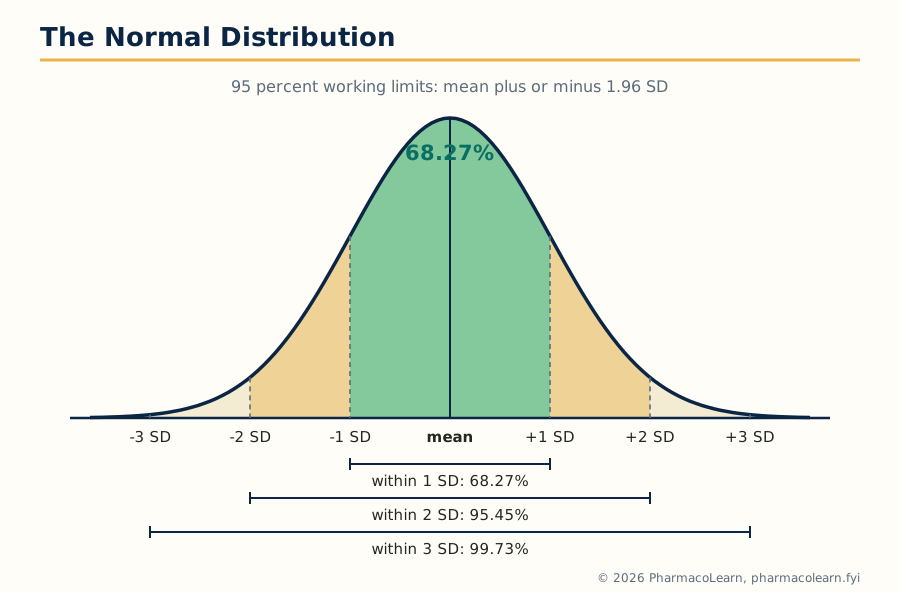 Figure: The normal curve. The areas are exact properties of the model: 68.27 percent within one standard deviation of the mean, 95.45 percent within two, 99.73 percent within three; the 95 percent working limits sit at 1.96 standard deviations.
2.5 Sample size: why it matters
The sample size is the number of study units per group (or in total), and fixing it is a design decision, not an administrative detail. A study that is too small wastes its subjects and its ethics approval: even a real, worthwhile effect will fail to reach significance because the noise swamps it (a Type II error, section 2.10), and the result "no significant difference" then means only "the study could not tell". A study that is too large wastes resources and, in animal and human work, exposes more subjects than the question needs, which is its own ethical fault; it can also make trivial, clinically meaningless differences "significant". The right size is the smallest number that gives the study a predeclared high chance (the power, section 2.10) of detecting the smallest effect worth detecting. Sample size is therefore fixed in the protocol, from the formula of the next section, before the first subject is enrolled; choosing it after seeing the data, or stopping when significance appears, destroys the meaning of the P value.
2.6 Factors influencing sample size
Four quantities decide the size, and the student should be able to state the direction of each:
- The size of the difference to be detected (delta). Smaller differences need larger samples: halving the target difference roughly quadruples the required size, other things equal.
- The variability of the measurement (sigma, the SD). Noisier outcomes need larger samples; the formula carries sigma squared, so a method twice as variable needs four times the subjects. Pilot data and the literature review exist largely to supply an honest sigma.
- The significance level (alpha). The stricter the false positive rate demanded (0.01 instead of 0.05), the larger the sample.
- The power (1 minus beta). The higher the chance demanded of detecting the effect (90 percent instead of 80 percent), the larger the sample.
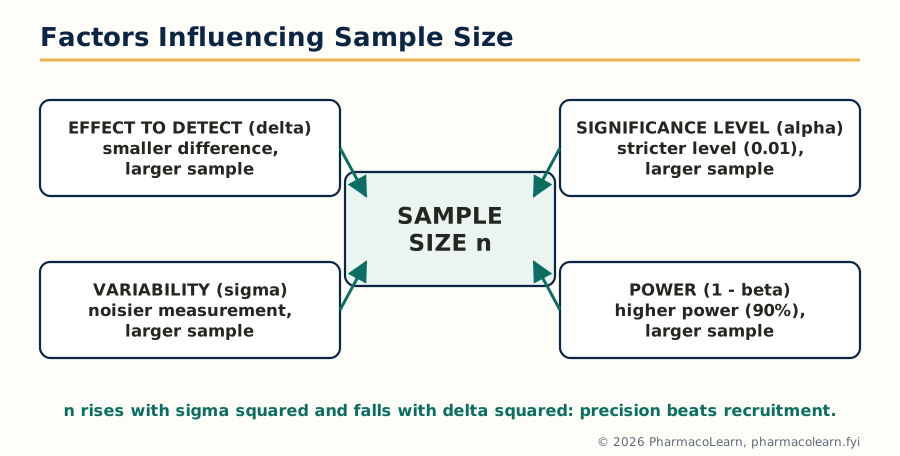 Figure: The four factors that fix a sample size. The difference worth detecting and the variability of the measurement dominate; alpha and power are chosen by convention within narrow ranges.
For comparing two means with equal group sizes, the standard formula is:
n per group = 2 x (z for alpha + z for power) squared x sigma squared / delta squared
with z = 1.96 for a two sided alpha of 0.05 and z = 0.84 for 80 percent power.
Worked example 2 (sample size). A trial is planned to detect a difference of 8 units between two treatments, where the outcome has SD 10, at alpha 0.05 (two sided) with 80 percent power. Then n per group = 2 x (1.96 + 0.84) squared x 100 / 64 = 2 x 7.84 x 100 / 64 = 24.5, rounded up to 25 subjects per group. Note the leverage of variability: with an SD of 5 instead of 10, the same calculation gives 6.1, that is 7 per group. Precision of measurement is worth more than recruitment.
2.7 Dropouts
A dropout is a subject who enters the study but does not complete it or provide the final measurement: the patient who withdraws, moves away, stops the drug for an adverse event, or is lost to follow up; in animal work, an animal that dies or is excluded mid study. Dropouts shrink the achieved sample below the planned size and so erode power, and they are rarely random: patients who drop out because the drug made them ill differ systematically from those who stay, so a completers only analysis can bias the result toward the drug.
Two defences are standard. At the design stage, the computed sample size is inflated for the expected dropout rate: if 25 completers per group are required and 10 percent dropout is expected, enrol 25 / 0.90 = 27.8, that is 28 per group. At the analysis stage, the intention to treat principle analyses every randomised subject in the group to which the dice assigned him, with predeclared rules for the missing values, because that is the comparison randomization bought. The dropout rate itself is always reported, group by group, in the results; a large imbalance in dropouts between groups is a finding, not a footnote.
2.8 Statistical tests of significance and the null hypothesis
A statistical test of significance answers one disciplined question: if there were really no effect, how surprising would data like ours be? The machinery starts with the null hypothesis (H0), the hypothesis of no effect: the two population means are equal, the correlation is zero, the proportions do not differ. The alternative hypothesis (H1) states that an effect exists (two sided: in either direction; one sided: in a named direction). The test computes a test statistic from the data, a standardised distance between what was observed and what H0 predicts, measured in units of the noise (the standard error). Large statistics are evidence against H0; the P value of section 2.9 converts "large" into a probability.
Two disciplines protect the logic. The hypotheses, the test and the significance level are fixed before the data are examined; testing twenty outcomes and reporting the one that crosses 0.05 manufactures false positives at a known rate (with twenty independent tests of true nulls, one crossing is expected by chance alone). And the test must match the design and the data: paired data to a paired test, counts to a count test, skewed data to a rank test. Section 2.20 gathers the matching rules.
2.9 P values, degrees of freedom and interpretation
The P value is the probability, computed assuming the null hypothesis is true, of obtaining a result at least as extreme as the one observed. It is not the probability that the null hypothesis is true, and it is not the probability that the result occurred by chance in any loose sense; it is a conditional probability about the data, given H0. By convention a result with P at or below 0.05 is called statistically significant and H0 is rejected; at or below 0.01, highly significant. The 0.05 line is a convention, not a law of nature: P = 0.049 and P = 0.051 carry nearly identical evidence, and honest reporting gives the exact P where possible.
Degrees of freedom (df) count the number of values free to vary once the statistics already computed are fixed, and they set the exact shape of the t, chi square and F distributions used to judge the test statistic. A sample of n observations used to estimate one mean has n - 1 degrees of freedom for its variance (section 2.3); an unpaired t test on two groups has n1 + n2 - 2; a paired t test on n pairs has n - 1; a chi square test on a table has (rows - 1) x (columns - 1). Every test report in a thesis should carry its degrees of freedom, because the same test statistic means different things at different df.
Interpretation needs three cautions. First, significance is not importance: with a huge sample a trivial difference is significant, and with a small one a large difference may not be; report the size of the effect (the difference and its confidence interval) beside the P value. Second, "not significant" never proves equality; it states that the data do not exclude H0 at the chosen level, which an underpowered study will say about almost everything. Third, a P value says nothing about bias: it prices random error only, and the biased study of Unit 1 gets precise, significant, wrong answers.
The working sequence of a significance test, used by every example in this unit:
State H0 and H1, choose the test and alpha (usually 0.05)
        |
        v
Compute the test statistic from the data
        |
        v
Find its degrees of freedom
        |
        v
Compare with the table value at alpha (or read the P value)
        |
        v
Statistic beyond the table value: reject H0, result significant
Statistic within it: do not reject H0, result not significant
2.10 Type I and Type II errors, and power
Every significance test can err in exactly two ways, and the two errors trade against each other:
| H0 is actually true | H0 is actually false | |
|---|---|---|
| Test says significant (reject H0) | Type I error, probability alpha | Correct: a real effect detected, probability = power |
| Test says not significant | Correct | Type II error, probability beta |
A Type I error is a false alarm: declaring an effect that is not there. Its probability is the significance level alpha, set by the investigator, conventionally 0.05. A Type II error is a miss: failing to detect an effect that is there. Its probability beta falls as the sample size, the true effect size or the measurement precision rises. The power of a test, 1 minus beta, is the probability of detecting an effect of a stated size when it exists; 80 percent power is the conventional planning standard of section 2.6. The trade off is structural: demanding fewer false alarms (smaller alpha) at fixed sample size buys more misses, and the only way to reduce both errors together is more information, a larger sample or a less variable measurement.
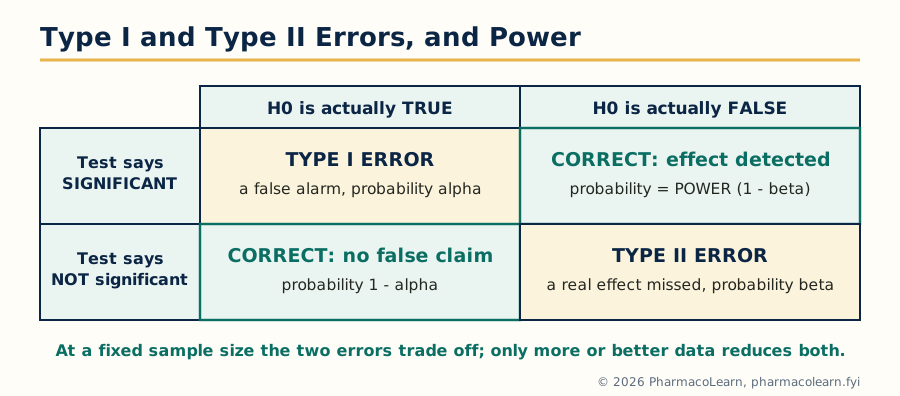 Figure: The decision table of a significance test. Alpha is chosen by the investigator; beta, and with it the power, is set by the sample size, the effect size and the variability.
2.11 Types of significance tests: parametric and non parametric
Significance tests divide into two families. Parametric tests assume the data follow a named distribution, in practice the normal distribution, and work with the actual values through their means and standard deviations. They are the more powerful family when their assumptions hold: the data are interval or ratio scale, roughly normally distributed (or the samples are large enough for means to behave), and the group variances are similar. The syllabus names four: Student's t test, ANOVA, the correlation coefficient and regression. Non parametric (distribution free) tests make no such assumption; most work on the ranks of the observations rather than the values, which makes them robust to skew and outliers and legitimate for ordinal data, at the price of some power when the data really are normal. The syllabus names the Wilcoxon rank tests, non parametric analysis of variance, non parametric correlation and the chi square test. The chi square test sits slightly apart: it works on counts and frequencies rather than measurements at all, and is treated in section 2.19.
2.12 Student's t test: comparing two means
Student's t test (published by W. S. Gosset under the pen name Student) compares means when the population standard deviation is unknown and estimated from the sample, which is always the practical case. Its statistic has the universal shape of this unit: an observed difference divided by its standard error. For two independent groups (the unpaired t test):
t = (mean1 - mean2) / (sp x sqrt(1/n1 + 1/n2))
where sp is the pooled standard deviation, combining both groups' variances, sp squared = ((n1 - 1) s1 squared + (n2 - 1) s2 squared) / (n1 + n2 - 2), and the degrees of freedom are n1 + n2 - 2. Assumptions: independent observations, roughly normal data in each group, similar variances between groups. A one sample variant tests a single mean against a known standard value.
Worked example 3 (unpaired t test). Percentage of drug released at 45 minutes from two tablet formulations, 8 tablets each. Formulation A: 82, 85, 79, 88, 84, 81, 86, 83 (mean 83.5, SD 2.88). Formulation B: 74, 78, 72, 77, 75, 73, 79, 76 (mean 75.5, SD 2.45).
- Difference of means = 83.5 - 75.5 = 8.0.
- Pooled SD: sp squared = (7 x 2.88 squared + 7 x 2.45 squared) / 14 = 7.14, so sp = 2.67.
- Standard error of the difference = 2.67 x sqrt(1/8 + 1/8) = 2.67 x 0.5 = 1.34.
- t = 8.0 / 1.34 = 5.99, with df = 8 + 8 - 2 = 14.
- The table value of t at df 14 and alpha 0.05 (two sided) is 2.145. Since 5.99 exceeds 2.145, the difference is statistically significant (P below 0.05): formulation A releases more drug at 45 minutes, and a gap of 8 percentage points on this variability is far beyond chance.
2.13 The paired t test
When each subject is measured twice (before and after treatment) or subjects come in matched pairs, the paired t test applies: it tests whether the mean of the within pair differences differs from zero, with t = mean difference / (SD of differences / sqrt(n)) and df = n - 1. Pairing is powerful for the same reason the crossover design is: it removes between subject variation from the error. Its assumptions concern the differences, which should be roughly normally distributed. Using an unpaired test on paired data, or the reverse, is a design analysis mismatch that examiners and reviewers both catch.
Worked example 4 (paired t test). Systolic blood pressure (mmHg) in 9 patients before and after 4 weeks of a drug. Before: 152, 148, 160, 146, 155, 150, 158, 149, 154. After: 138, 142, 148, 140, 146, 141, 150, 143, 145. The falls (before minus after) are: 14, 6, 12, 6, 9, 9, 8, 6, 9.
- Mean fall = 8.78 mmHg; SD of the falls = 2.77; standard error = 2.77 / sqrt(9) = 0.92.
- t = 8.78 / 0.92 = 9.49, with df = 9 - 1 = 8.
- Table value at df 8, alpha 0.05: 2.306. Since 9.49 far exceeds it, the fall is statistically significant (P below 0.05). Every patient fell, and the average fall of about 9 mmHg is estimated far too precisely to be chance fluctuation.
2.14 Analysis of variance (ANOVA)
Comparing three or more group means with repeated t tests inflates the Type I error: each test carries its 5 percent false alarm risk, and the risks accumulate. Analysis of variance answers the multi group question with a single test. It partitions the total variation of all observations into two components: variation between groups (the group means scattered around the grand mean, which a real treatment effect inflates) and variation within groups (subjects scattered around their own group mean, pure noise). The ratio of the two, each divided by its degrees of freedom to give mean squares, is the F statistic: F = MS between / MS within. If treatments do nothing, F hovers near 1; a real effect drives it up. The one way ANOVA of the example compares groups on one factor; two way ANOVA extends the partition to two factors and their interaction. A significant F says only that the group means are not all equal; which groups differ is a further question, answered by planned comparisons or post hoc tests, and the overall test must come first to license them.
Worked example 5 (one way ANOVA). Plasma concentrations (microgram per mL) 2 hours after dosing, 5 animals per formulation. Formulation 1: 12.1, 11.8, 12.5, 11.9, 12.2 (mean 12.10). Formulation 2: 10.4, 10.8, 10.2, 10.6, 10.5 (mean 10.50). Formulation 3: 13.2, 12.8, 13.5, 13.0, 13.3 (mean 13.16). Grand mean = 11.92.
| Source of variation | Sum of squares | df | Mean square | F |
|---|---|---|---|---|
| Between formulations | 17.93 | 2 | 8.97 | 135.9 |
| Within formulations (error) | 0.79 | 12 | 0.066 | |
| Total | 18.72 | 14 |
F = 8.97 / 0.066 = 135.9, on (2, 12) degrees of freedom. The table value of F at alpha 0.05 for (2, 12) is 3.89. The computed F dwarfs it: the formulation means differ far beyond what within group noise can explain (P well below 0.05). Note how small the within group sum of squares is: the animals within a formulation agree closely, so even moderate mean differences would have shown. Post hoc comparisons would then identify formulation 2 as the low outlier against 1 and 3.
2.15 Correlation coefficient
Correlation measures the strength and direction of the linear association between two quantitative variables measured on the same units. The Pearson correlation coefficient r runs from -1 (perfect negative linear association) through 0 (no linear association) to +1 (perfect positive). It is computed as r = Sxy / sqrt(Sxx x Syy), where Sxy is the sum of products of the deviations of x and y from their means, and Sxx and Syy are the sums of squared deviations. Three cautions govern its use. Correlation is not causation: a third factor may drive both variables. r measures linear association only; a strong curved relationship can give r near zero. And r is hostage to range and outliers: one extreme point can manufacture or destroy it, which is why the scatter diagram is always drawn first. The significance of r is tested with t = r x sqrt((n - 2) / (1 - r squared)) on n - 2 df; r squared, the coefficient of determination, states the proportion of the variation in y that the linear relation with x accounts for.
Worked example 6, part 1 (correlation). In a pharmacology practical, six preparations were tested at six dose levels (x = 10, 20, 30, 40, 50, 60) and gave percentage inhibitions (y): 18, 22, 38, 40, 52, 63. Means: x bar = 35, y bar = 38.83. The deviation sums are Sxy = 1585, Sxx = 1750, Syy = 1476.8. Then r = 1585 / sqrt(1750 x 1476.8) = 1585 / 1607.5 = 0.986. A very strong positive linear association: as dose rises, inhibition rises almost in step. Its significance: t = 0.986 x sqrt(4 / (1 - 0.972)) = 11.79 on 4 df, against a table value of 2.776, so the correlation is statistically significant.
2.16 Regression
Regression goes one step beyond correlation: it fits the line that best predicts y from x, in the least squares sense of minimising the squared vertical deviations. The simple linear regression line is y = a + b x, with slope b = Sxy / Sxx and intercept a = y bar - b x bar. The slope is the working quantity of pharmacy: units of response per unit of dose, per unit of concentration, per hour. Every calibration curve in analytical work is a regression line, and its inverse use (reading x from a measured y) is the daily arithmetic of assay. Regression assumes the relation is linear, the scatter around the line is roughly even along its length, and (for the significance tests) the residuals are approximately normal. Extrapolation beyond the measured range of x is the standing abuse: the line is evidence only where data stand beneath it.
Worked example 6, part 2 (regression on the same data). Slope b = Sxy / Sxx = 1585 / 1750 = 0.906. Intercept a = 38.83 - 0.906 x 35 = 7.13. The fitted line is: predicted inhibition = 7.13 + 0.906 x dose. Readings: each additional 10 units of dose predicts about 9.1 more percentage points of inhibition; the predicted inhibition at a dose of 45 is 7.13 + 0.906 x 45 = 47.9 percent. r squared = 0.972 says 97.2 percent of the variation in inhibition across these six preparations is accounted for by dose through this line. Correlation and regression are the same data wearing two hats: r summarises the tightness of the scatter, the line turns it into predictions, and neither, alone, proves that dose caused the inhibition; that claim belongs to the experimental design of Unit 1.
| Correlation | Regression | |
|---|---|---|
| Question answered | How strongly are x and y linearly associated? | What y is predicted for a given x? |
| Output | One number, r, between -1 and +1, no units | An equation with slope (units of y per unit of x) and intercept |
| Symmetry | r of x on y equals r of y on x | The line of y on x differs from the line of x on y |
| Typical pharmacy use | Dose response association, method comparison | Calibration curves, prediction, potency estimation |
2.17 Non parametric tests: the Wilcoxon rank tests
When data are ordinal, badly skewed, or the samples are too small for normality to be trusted, the values are replaced by their ranks and the test proceeds on ranks, which no outlier can dominate. The Wilcoxon signed rank test is the non parametric partner of the paired t test: take the differences within pairs, rank their absolute values, restore the signs to the ranks, and sum the positive ranks (W+) and the negative ranks (W-). If the treatment does nothing, the two sums should be about equal; the smaller sum, T, is compared with table values for the number of pairs. The Wilcoxon rank sum test (equivalently the Mann Whitney U test) is the partner of the unpaired t test for two independent groups: all observations are ranked together and the rank sums of the two groups are compared. Assumptions are mild: independent pairs or groups, differences at least ordinal, and (for the signed rank test) a roughly symmetrical distribution of differences. Zero differences are dropped and the sample size reduced accordingly.
Worked example 7 (Wilcoxon signed rank test). Eight subjects show the following changes in a response score after treatment (positive is improvement): +3.2, -1.1, +2.4, +4.0, +1.8, -0.6, +2.9, +3.6. Ranking the absolute values 0.6, 1.1, 1.8, 2.4, 2.9, 3.2, 3.6, 4.0 gives ranks 1 to 8; the two negative differences hold ranks 1 and 2. So W- = 1 + 2 = 3 and W+ = 3 + 4 + 5 + 6 + 7 + 8 = 33 (check: 33 + 3 = 36 = 8 x 9 / 2, the total of all ranks). T = the smaller sum = 3. The table value for n = 8 pairs at alpha 0.05 (two sided) is 4; since T = 3 is at or below it, the improvement is statistically significant. Six of eight subjects improved, and by the rank evidence that pattern is unlikely under no effect.
2.18 Non parametric analysis of variance and correlation
The rank idea extends to the other parametric procedures. For three or more independent groups the counterpart of one way ANOVA is the Kruskal Wallis test: all observations are ranked together, the rank sum of each group is compared with what equal distributions would give, and the statistic H is judged against the chi square distribution. For paired or repeated measurements across three or more conditions the counterpart is the Friedman test. The counterpart of the unpaired comparison remains the Mann Whitney U test of the previous section. For association, the counterpart of Pearson's r is Spearman's rank correlation coefficient (rho), computed exactly like r but on the ranks of x and y, or directly as rho = 1 - 6 x (sum of squared rank differences) / (n x (n squared - 1)). It detects any consistent (monotonic) rise or fall, curved as well as straight, and is the right coefficient for ranked or ordinal data.
Worked example 8 (Spearman rho). Five formulations are ranked 1 to 5 by in vitro dissolution and, independently, by in vivo absorption: dissolution ranks 1, 2, 3, 4, 5; absorption ranks 2, 1, 3, 5, 4. The rank differences are -1, +1, 0, -1, +1, whose squares sum to 4. Then rho = 1 - (6 x 4) / (5 x 24) = 1 - 24 / 120 = 0.80: a strong tendency for the dissolution order to match the absorption order, the rank form of the in vitro in vivo relationship.
2.19 The chi square test
The chi square test handles data that arrive as counts in categories: numbers of patients cured or not, tablets passing or failing, animals responding or not. Its most used form tests association in a contingency table. For each cell an expected frequency is computed from the row and column totals under the null hypothesis of no association, expected = (row total x column total) / grand total, and the statistic accumulates the standardised disagreements: chi square = sum of (observed - expected) squared / expected, over all cells, with df = (rows - 1) x (columns - 1). Conditions: observations independent, categories mutually exclusive, and expected frequencies not too small (the working rule: every expected count at least 5, or nearly so; for a 2 x 2 table with small numbers the Yates continuity correction, subtracting 0.5 from each absolute disagreement, or Fisher's exact test is used). The same statistic family tests goodness of fit of observed counts to a theoretical distribution.
Worked example 9 (chi square test of association). In a trial, nausea was reported by 12 of 60 patients on a drug and 24 of 60 on placebo. The 2 x 2 table, with expected counts under no association in brackets: drug 12 (18) nausea, 48 (42) none; placebo 24 (18) nausea, 36 (42) none.
- Chi square = (12 - 18) squared / 18 + (48 - 42) squared / 42 + (24 - 18) squared / 18 + (36 - 42) squared / 42 = 2.00 + 0.86 + 2.00 + 0.86 = 5.71.
- df = (2 - 1) x (2 - 1) = 1. Table value at alpha 0.05: 3.84. Since 5.71 exceeds 3.84, the association is statistically significant (P below 0.05): nausea is reported less often on the drug than on placebo in this trial. With the Yates correction the statistic is 4.80, still beyond 3.84, so the conclusion stands.
- Note the discipline of the example: the test compares proportions (20 percent versus 40 percent) through their counts. Running a chi square test on percentages alone, without the underlying numbers, is meaningless, because the same percentages on 12 patients would carry almost no evidence.
2.20 Choosing the right test
The examples of this unit reduce to one skill: matching the test to the design and the data. The questions to ask, in order, are: what type of data (measurements or counts, and if measurements, which scale); how many groups; are the observations paired or independent; and are the parametric assumptions defensible?
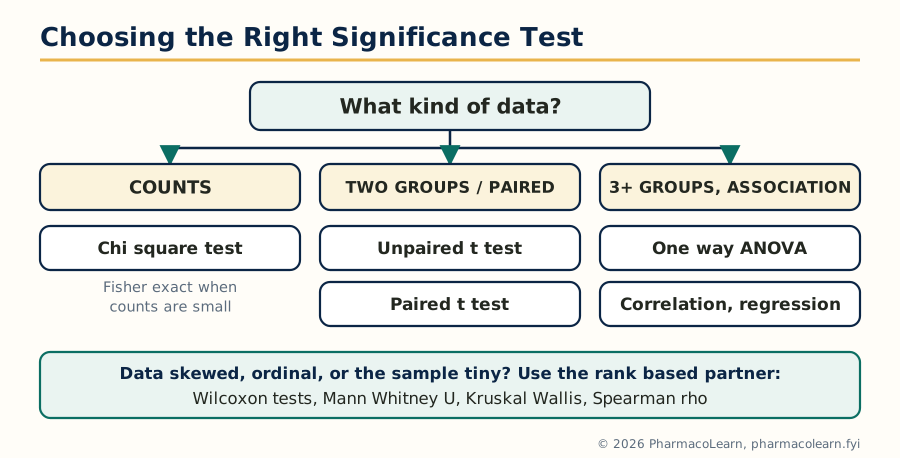 Figure: Choosing the test. Data type first, then structure (groups, pairing), then the parametric question; every road in this unit ends at one of the named tests.
| Situation | Parametric test | Non parametric counterpart |
|---|---|---|
| One mean against a standard value | One sample t test | Wilcoxon signed rank (one sample form) |
| Two independent groups, means | Unpaired (Student's) t test | Mann Whitney U / Wilcoxon rank sum |
| Paired measurements, two conditions | Paired t test | Wilcoxon signed rank test |
| Three or more independent groups | One way ANOVA | Kruskal Wallis test |
| Repeated measures, three or more conditions | Repeated measures ANOVA | Friedman test |
| Association of two quantitative variables | Pearson correlation, regression | Spearman rank correlation |
| Counts in a contingency table | (none) | Chi square test (Fisher exact for small counts) |
The table is the analysis plan of section 1.3 in one view: the row is chosen when the protocol is written, not after the data are seen.
Unit 3: Medical Research: History and Values in Medical Ethics
3.1 A brief history of medical research and its ethics
Medical ethics is as old as organised medicine: the Hippocratic tradition bound the physician to benefit the patient and to do no harm, and professional codes in many cultures carried versions of the same duties. Medical research as a distinct activity, experimenting on patients to learn rather than only to treat, grew with scientific medicine in the nineteenth and twentieth centuries, and its ethics lagged its power. The abuses of the Second World War produced the Nuremberg Code (1947), the first international statement that the voluntary consent of the subject is absolutely essential. The Declaration of Helsinki followed in 1964 (Unit 5). The lag continued in peacetime democracies too: the Tuskegee study in the United States (1932 to 1972) observed the natural course of untreated syphilis in poor Black men for forty years, withholding effective treatment long after penicillin existed, and its exposure in 1972 reshaped American research law. The pattern of the history is consistent: each protection in this unit and Unit 5 was written after a failure, which is why the rules read as they do and why committees treat them as floors, not aspirations.
3.2 Values in medical ethics: the four principles
Modern medical ethics is organised around four values, the framework this unit is built on. Autonomy: the patient's right to decide what is done to his own body and to direct his own treatment, grounded in respect for persons. Beneficence: the duty to act for the patient's benefit, to do good. Non maleficence: the duty to do no harm, the older Hippocratic command. Justice: fairness in distributing the benefits and burdens of medicine and research, in subject selection as much as in treatment. In research, the four principles translate into the working rules of this degree: autonomy into informed consent, beneficence and non maleficence into the risk benefit judgement every protocol must pass, and justice into fair selection of subjects, so that the burdens of research do not fall habitually on the poor and voiceless while the benefits flow elsewhere.
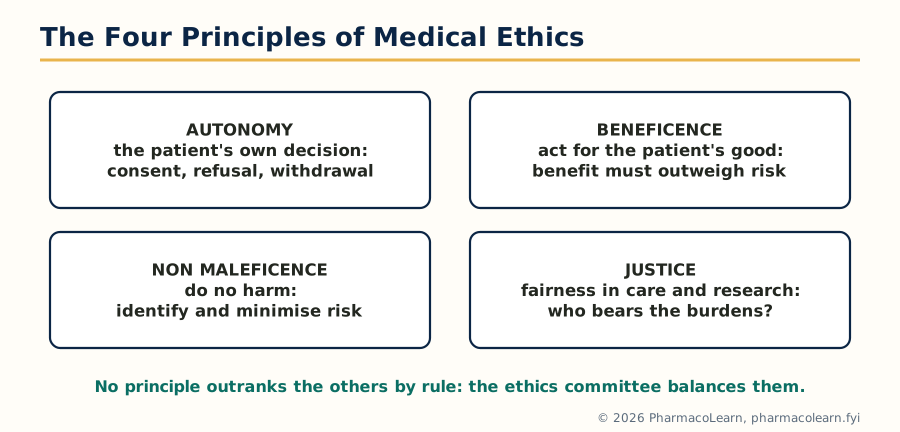 Figure: The four principles. No principle outranks the others by rule; the work of ethics is balancing them in the concrete case, which is why committees exist.
3.3 Autonomy
Autonomy is the principle that a competent person is the author of decisions about his own body and care. It requires capacity (the patient can understand, deliberate and communicate a choice), information (the material facts a reasonable person would want), and freedom from coercion and manipulation. Its operational forms are informed consent (section 3.7), the right to refuse treatment, the right to withdraw from research at any time without penalty, and respect for advance decisions. Autonomy is limited where capacity is absent (children, unconscious patients, some psychiatric illness), where surrogates and safeguards take over, and where one person's choices would gravely harm others, as in some public health emergencies. For the researcher, the practical meaning is sharp: a scientifically perfect study on unconsenting subjects is ethical failure regardless of its results, because the subjects were used as means only.
3.4 Beneficence, non maleficence, and the conflicts between them and autonomy
Beneficence obliges the clinician and researcher to act for the subject's good: to offer interventions expected to help, to design studies whose knowledge is worth having, and to rescue where rescue is possible. Non maleficence obliges them first to avoid harm: foreseeable risks must be identified, minimised and justified, and some harms may not be imposed for knowledge at any price. The two are the twin terms of the risk benefit judgement required of every protocol: expected benefit must outweigh foreseeable risk, and the ratio is judged by the ethics committee, not by the investigator with a thesis deadline.
Conflicts between autonomy and beneficence or non maleficence are the daily texture of medical ethics, and the syllabus names them deliberately. A competent patient refuses a transfusion that would save his life: beneficence says transfuse, autonomy says the body is his; the settled answer in modern practice is that the competent refusal governs, however it grieves the team. In research the conflict reverses direction: the investigator's wish to complete a valuable study (a beneficent end) cannot override a subject's autonomous wish to withdraw. Where the patient lacks capacity, surrogates decide in his best interests, the beneficence standard. The principles do not dissolve these conflicts; they name the values at stake so the decision is reasoned rather than improvised, and hard cases go to the ethics committee (section 3.11), not to individual conscience alone.
3.5 Double effect
The doctrine of double effect governs actions that foreseeably produce both a good and a harmful effect. An act with a bad side effect is permissible, on the classic conditions, when the act itself is good or neutral, the good effect is intended and the bad merely foreseen (not intended, and not the means to the good), and the good is proportionate to the harm risked. The stock medical example is adequate pain relief with opioids in a dying patient: relief is intended; a possible hastening of death through respiratory depression is foreseen and accepted, not sought; and the relief is proportionate. Double effect is the line orthodox ethics draws between palliative care and euthanasia (the next section), and students should be able to state both the doctrine and its critics' objection, that intention is too private a thing to bear so much moral weight.
3.6 Euthanasia
Euthanasia, literally a good death, is the deliberate ending of a patient's life to relieve suffering. The distinctions that structure the debate: active euthanasia (a lethal act, such as an injection given to end life) against passive (withholding or withdrawing life sustaining treatment and letting the disease take its course); voluntary (at the competent patient's request), non voluntary (the patient cannot request, as in permanent coma) and involuntary (against the patient's wishes, condemned by all sides). Orthodox medical ethics and Indian law prohibit active euthanasia; the Indian position, settled by the Supreme Court, permits passive euthanasia under strict safeguards (Aruna Shanbaug, 2011) and recognises advance directives or living wills refusing life sustaining treatment, with a laid down procedure (Common Cause, 2018). The research relevance is indirect but real: end of life studies, palliative research and withdrawal of futile treatment all work inside this framework, and an ethics committee will require the protocol to state which side of the line it stays on.
3.7 Informed consent
Informed consent is the process by which autonomy is exercised in treatment and research: a competent person, given the material information in understandable language, freely agrees. Its elements are constant across the codes (and are stated as principles in Unit 5): the nature and purpose of the procedure or study, what participation involves, the foreseeable risks and discomforts, the expected benefits (stated honestly, including that a trial may offer the subject none), the alternatives, the safeguards of confidentiality, compensation and treatment for research related injury where applicable, the voluntary character of participation, and the right to withdraw at any time without affecting care. Consent for research is written and documented, obtained before any study procedure, and treated as a continuing process rather than a signature: new information (a safety signal, a protocol change) renews it. Special rules protect those who cannot consent for themselves: children (parental consent plus the child's assent where capable), unconscious patients (legally authorised representative), and vulnerable populations, where committees add safeguards against inducement and coercion. A consent obtained by pressure, by incomplete disclosure or from a person who could not understand it is not consent, and research resting on it is unethical whatever its data show.
3.8 Confidentiality
Confidentiality is the duty to guard the patient's and the subject's information: identity, records, samples and data. It rests on autonomy (the information is the person's own) and on trust (patients who fear disclosure conceal facts their doctors need). In research it is engineered into the study: coded identifiers instead of names on analysis files, restricted access, secure storage, publication in aggregate so that no individual can be recognised, and special care with genetic and stigmatising information. Breaches are justified only narrowly: the patient's own consent, a legal duty, or a serious and identifiable risk to others that disclosure can avert, and even then the minimum necessary information goes to the minimum necessary audience. The modern setting adds digital duties: databases and online practices (section 3.13) must be secured, and a confidentiality failure online is a failure at scale.
3.9 Criticisms of orthodox medical ethics
The syllabus asks for the criticisms of orthodox medical ethics, the four principle, rule bound tradition itself. The standard criticisms are these. That principlism is a checklist: it names values but gives no rule for ranking them when they conflict, so decisions can be rationalised after the fact. That it is culturally narrow: built on individual autonomy, it fits awkwardly in societies where decisions are made by families and communities (section 3.12). That it is cold: real care involves emotion, virtue and relationship (the ethics of care and virtue ethics are rival accounts). That its rules bend under institutional pressure: hospitals and sponsors have interests, and ethics language can decorate decisions made for money or reputation. And the feminist and communitarian critiques add that the tradition long ignored who actually bears medicine's burdens. The student need not abandon the framework, it remains the working language of committees and courts, but should hold it as a tool with known limits, not as a machine that outputs right answers.
3.10 Communication and conflict resolution
Communication is named in the syllabus because most ethical failures in practice are communication failures first: consent taken without understanding, bad news broken brutally or withheld, families and teams working from different facts. Its skills are concrete: listening before informing, plain language without jargon, checking understanding, honesty about uncertainty, time for questions, and documented discussion. Where values collide (within a family, between team members, between patient and institution), conflict resolution follows a discipline of its own: establish the facts, name the values in conflict, hear every party including the patient, seek the option that honours the most principles, use the ethics committee as mediator and forum, and document the decision and its reasons. The phrases of the syllabus print "control resolution"; it is read and taught here as conflict resolution, the standard topic between communication and guidelines (see the verification record).
3.11 Guidelines and ethics committees
Ethical rules reach the bedside through guidelines and ethics committees. The guideline stack for an Indian researcher runs from the international codes (Nuremberg, the Declaration of Helsinki of Unit 5, the CIOMS guidelines) through national instruments (the ICMR National Ethical Guidelines for Biomedical and Health Research Involving Human Participants, 2017; the New Drugs and Clinical Trials Rules, 2019 for drug trials) to institutional standard operating procedures. The ethics committee (Institutional Ethics Committee for human research; Institutional Animal Ethics Committee under CPCSEA for animal work, Unit 4) is the body that applies them: an independent, multidisciplinary committee, including lay and legal members, that reviews the protocol before the study starts, judges the risk benefit ratio, the consent process and the protection of vulnerable subjects, and continues oversight through progress reports and safety information. Approval is prospective; a study begun without it cannot be cured retrospectively, and journals and universities refuse its fruits. For the M.Pharm student the committee is not a hurdle but the institution that makes the research defensible.
3.12 Cultural concerns and truth telling
Cultural concerns arise because ethical practice is enacted inside cultures. Family centred decision making, religious convictions about the body, death, blood, diet and gender of the treating clinician, and differing understandings of illness can all pull against the individualist defaults of the codes. The working position is respect without surrender: learn the patient's framework, involve the family as the patient wishes, adapt communication and logistics where possible, and hold the floor of the principles themselves (a competent refusal stands even when the family disagrees; harmful practices are not performed because they are customary). Truth telling is the sharpest cultural case. Orthodox ethics requires honest disclosure of diagnosis and prognosis to the patient; some families, from protective motives, ask that a grave diagnosis be withheld from the patient. The orthodox answer respects the patient's own wish as the controlling one: ask the patient how much he wants to know and who should be told, and follow that. Lying to a competent patient at others' request treats him as a child in his own illness; blunt disclosure against his stated wish is its own cruelty. The skill is finding, with the patient, the truth he wants at the pace he wants it.
3.13 Conflicts of interest, referral, vendor relationships and online practice
The last items of the syllabus unit are the professional practice problems. A conflict of interest exists whenever a secondary interest (money, publication, promotion, a sponsor's favour) risks distorting a primary duty (the patient's good, the integrity of the research). The management is disclosure first, then recusal or independent oversight where disclosure is not enough; undisclosed conflicts, not conflicts themselves, are the scandal. Referral must be governed by the patient's interest: referring to the best appropriate provider, never split fees or referral commissions, which convert clinical judgement into trade. Vendor relationships (with pharmaceutical and device companies: gifts, hospitality, sponsored travel, consultancy) are regulated by professional codes precisely because marketing works; the researcher declares industry ties in every publication and presentation. Online business practices extend the same duties to the digital front: honest advertising without exaggerated claims, teleconsultation within competence and law, protection of patient data online (section 3.8), and professional conduct on public platforms. The principles are old; only the shopfront is new.
3.14 Treatment of family members, sexual relationships and fatality
Three boundary problems close the unit. Treating family members and oneself is discouraged by professional guidance except in minor or emergency situations: objectivity is compromised, intimate history is under taken, the relative may conceal or the doctor may over investigate, and records and consent become informal. Sexual relationships with patients are prohibited absolutely: the power imbalance between doctor and patient vitiates consent, and the prohibition extends, with graded rules, to former patients and to patients' close relatives; the same boundary logic binds researchers and the subjects in their power. Fatality, the death of a patient, carries duties of its own: honest and prompt communication with the family, accurate certification and documentation, respect for the body and for the family's religious and cultural practices, disclosure of error where error occurred (with the institution's process, not private improvisation), and care for the team's own moral residue. A researcher analysing mortality data should remember that every row of the outcome table was one of these events.
Unit 4: CPCSEA Guidelines for Laboratory Animal Facility
4.1 CPCSEA: the statutory framework
The Committee for the Purpose of Control and Supervision of Experiments on Animals (CPCSEA) is the statutory body constituted under the Prevention of Cruelty to Animals Act, 1960, working under the Ministry of Fisheries, Animal Husbandry and Dairying, Government of India. It exists to ensure that animals used in experiments are not subjected to avoidable pain or suffering, before, during or after the experiment. Its instruments are the Breeding of and Experiments on Animals (Control and Supervision) Rules framed under the Act, and its guidelines for laboratory animal facilities, which this unit follows. The working machinery has two tiers. Every establishment that breeds or uses animals must be registered with CPCSEA and must constitute an Institutional Animal Ethics Committee (IAEC), which includes a CPCSEA nominee, to approve and oversee animal experiments. Experiments on small animals are approved by the IAEC; experiments on large animals are referred to CPCSEA itself. For the M.Pharm student, this unit together with the ethics of Unit 3 completes the regulatory frame of pharmacology research: human work answers to the ethics committee and the Declaration of Helsinki, animal work to the IAEC and CPCSEA.
4.2 Getting approval: the IAEC route
No animal experiment in a registered establishment begins without prospective approval, on this path:
Investigator writes the protocol: species, numbers, procedures,
anaesthesia, endpoints, euthanasia method, justification
        |
        v
IAEC reviews: scientific need, the 3Rs, animal numbers,
housing and care arrangements, investigator competence
        |
        v
Small animals: IAEC approval is final, experiment may begin
Large animals: protocol referred to CPCSEA for approval
        |
        v
During the work: IAEC oversight, records open to inspection,
CPCSEA inspection of the facility at any time
The protocol must justify the species and the number of animals (the sample size logic of Unit 2 applies to animal work with full force: an underpowered animal study wastes lives), state the humane endpoints at which suffering ends the animal's participation, and name the anaesthesia and euthanasia arrangements of sections 4.9 and 4.10.
4.3 Veterinary care
Veterinary care is the professional core of the facility. A qualified veterinarian, experienced in laboratory animal medicine, must be available to the establishment, with authority over animal health decisions. The duties run from advising investigators on species choice, anaesthesia and endpoints, through routine health monitoring of colonies, diagnosis and treatment of disease, supervision of quarantine and acclimatisation, to certifying animals fit for experiment and ensuring euthanasia is performed humanely. Veterinary oversight is what converts the guidelines from paper into practice: an establishment whose veterinarian is nominal has a paper facility, whatever its buildings contain.
4.4 Quarantine, stabilisation and separation
Newly arrived animals are quarantined: housed separately from established colonies for a defined period, observed for signs of illness, and examined before release, so that an infected shipment cannot seed the whole facility. Stabilisation (acclimatisation) is the companion rule for experiments: animals need a settling period after transport before any procedure, because transport stress distorts physiology and therefore data; readings taken on a transported, unsettled animal measure the journey as much as the drug. Separation continues inside the facility: animals of different species are housed apart, sick animals are isolated from healthy ones, and animals undergoing different experiments are kept identifiable and distinct. The three rules together protect both the animals and the validity of the research, a pairing that recurs in every section of this unit.
4.5 Surveillance, diagnosis, treatment and control of laboratory animal diseases
The facility runs a continuous surveillance programme for laboratory animal diseases: routine observation of every animal, sentinel animals and periodic health screening where the programme requires it, post mortem examination of unexplained deaths, and records that make an outbreak traceable. Diagnosis follows the ordinary veterinary path of clinical examination supported by microbiological, parasitological and pathological investigation. Treatment is given where compatible with the animal's experimental status, and an animal whose treatment would compromise either its welfare or the study is removed and, where necessary, humanely killed rather than left to suffer for data. Control combines the quarantine of section 4.4 with sanitation, pest control, controlled access and, where the species programme uses it, vaccination. The scientific stake is direct: an undiagnosed infection sweeping a colony alters baselines, inflates variability (the sigma of Unit 2), and can invalidate months of experiments, besides being a welfare failure in itself.
4.6 Location of the animal facility, and animal housing systems
Location. The animal facility should be located away from public ways, noise, vibration and pollution, and separated from general institutional traffic, while remaining connected to the laboratories it serves. It is planned with barrier and corridor systems that separate clean and dirty flows: animals, feed and bedding move one way, waste and soiled material another, and personnel movement is controlled so that hands and clothing do not carry contamination between rooms. The building is designed for washdown, drainage and pest proofing, with service areas (feed and bedding stores, cage washing, waste holding, post mortem) distinct from animal rooms. The layout also protects the neighbourhood: noise, odour and waste from the facility are contained by design, not by apology.
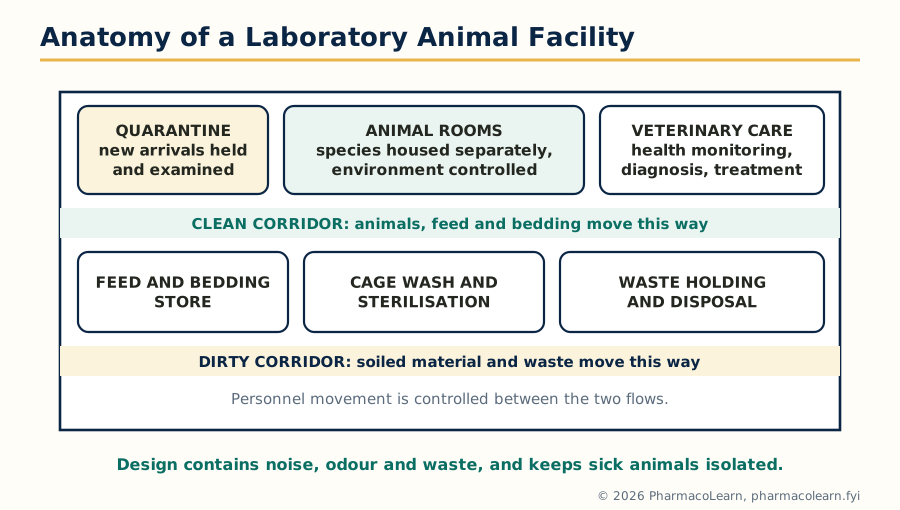 Figure: The facility in plan. Separate clean and dirty corridors, species separation, quarantine at the receiving end and service areas at the working end are the design facts CPCSEA inspection looks for.
Environment. Animal rooms are held within the comfort range of the species, with temperature, humidity, ventilation, light and noise controlled and monitored: for common rodent rooms, temperatures near 22 degrees Celsius, relative humidity roughly 30 to 70 percent, ventilation of the order of 10 to 15 air changes per hour, and a regular light cycle, typically 12 hours light and 12 dark, are the usual working values. Alarms and backup for power and ventilation failures are welfare equipment, because a failed ventilator in a closed room kills quietly and quickly.
Animal housing systems. Animals are housed in systems suited to the species: ventilated or conventional cages for rodents (with solid floors and bedding, or grid floors only where justified), pens and runs for larger animals, and tanks or racks for aquatic species, each with space, bedding, nesting material and environmental enrichment appropriate to natural behaviour. Stocking density follows the guideline space allowances per animal by species and weight; overcrowding is a welfare breach and a data breach together, since stressed animals are physiologically abnormal animals. Cages and housing are identified by cards recording strain, sex, number, experiment and investigator, the paper trail that links every animal to its protocol.
4.7 Maintenance and husbandry
Husbandry is the daily routine of care: feeding with nutritionally adequate, uncontaminated diet of known composition (the diet is itself an experimental variable and is standardised and recorded), clean water always available, bedding changed at intervals that keep cages dry and ammonia low, cages and rooms cleaned and sanitised on schedule, and every animal observed daily, with the observation recorded. Feeding and cleaning routines are timed so they do not collide with experiments, and weekend and holiday care is rostered like any other day: animals do not observe the academic calendar. Enrichment (nesting material, shelters, gnawing material, social housing for social species) is part of husbandry, not decoration, because barren housing produces abnormal behaviour and abnormal physiology.
4.8 Personal hygiene
Personal hygiene protects staff, animals and experiments in one system. Personnel wear facility clothing (changed or covered before entering animal rooms), gloves, masks and head covers as the barrier level requires; hands are washed on entry, between species and rooms, and on exit. Eating, drinking and cosmetics are barred from animal areas. Health of personnel is monitored, because staff can carry infections to animals (and, with zoonoses, receive them); injuries and bites follow a written first aid and reporting procedure, and shower and change facilities separate the animal areas from the outside. Hygiene discipline is also a data discipline: most colony contamination arrives on people.
4.9 Anaesthesia
Anaesthesia is required wherever a procedure would cause pain beyond the momentary: the governing principle is that an animal must not be allowed to experience pain the investigator would not accept untreated in a patient. The choice of agent and regimen follows the species and the procedure, under veterinary guidance: inhalant agents such as isoflurane for controllable depth and recovery, injectable combinations such as ketamine with xylazine for rodents where inhalation is impractical, chosen and dosed by trained persons. Anaesthetic depth is monitored throughout (reflexes, respiration, heart rate), the animal is kept warm, and recovery is supervised until the animal is conscious and stable; analgesia continues into the post operative period, because anaesthesia ending does not end pain. Neuromuscular blocking agents are never used alone: they paralyse without removing sensation, and their use without adequate anaesthesia is among the gravest welfare breaches in experimental work.
4.10 Euthanasia
Euthanasia, the humane killing of an animal, is required at the end of experiments whose design needs tissue or terminal measurements, at humane endpoints where suffering cannot be relieved, and for animals surplus to breeding or suffering incurable disease. The method must produce rapid unconsciousness and death without pain or distress, be reliable and irreversible, suit the species and the scientific needs (some methods contaminate tissues or distort measurements), and be performed by trained persons, out of the sight and smell of other animals where possible. Physical and chemical methods each have their accepted place by species in the CPCSEA framework (an overdose of an anaesthetic agent is the standard chemical route for most laboratory species); death is confirmed before disposal, carcasses are disposed of hygienically, and the record of every euthanasia closes the animal's file. The investigator's duty is to design the experiment so that the endpoint, and the manner of meeting it, was decided in the protocol, not improvised at the cage side.
4.11 Record keeping and SOPs
The facility runs on its records. Record keeping covers the registers of animals received, bred, issued, experimented on and disposed of; IAEC approvals and minutes; veterinary and health monitoring records; environmental monitoring; training records; and incident reports. Every animal must be traceable from arrival to end point against a protocol number. Standard operating procedures (SOPs) are the written, version controlled instructions for every routine activity: receiving and quarantine, cleaning schedules, feeding, cage changing, anaesthesia, euthanasia, waste disposal, emergency response. New personnel work from the SOPs, audits check practice against them, and deviations are recorded and explained. In CPCSEA inspection, the records and SOPs are the evidence that the guidelines are a living system rather than a framed certificate.
4.12 Personnel, training and transport of laboratory animals
Personnel. The facility is staffed by people competent for their roles: a veterinarian (section 4.3), trained animal care staff, technicians and supervisory personnel, in numbers sufficient that no duty of this unit depends on goodwill and overtime. Training is mandatory and continuing: animal handlers are trained in handling, restraint, recognition of pain and illness, and the procedures they perform; investigators in the ethics, regulations and techniques of their protocols; and training is recorded, because CPCSEA inspection asks for the record, not the assurance. Handling technique is itself a welfare and data issue: a frightened animal roughly handled arrives at the experiment stressed, and its readings say so.
Transport of laboratory animals follows the same care logic outside the building. Animals travel in suitable, labelled containers with adequate ventilation, space, bedding, and food and water for the journey's length, protected from extremes of temperature, noise and public exposure, by the shortest reasonable route, with the consignment documented (species, number, sender, receiver, health status). Transport between institutions moves animals through the quarantine of section 4.4 at the receiving end. The rules complete the circle of the unit: the animal is protected at arrival, in housing, in experiment and in transit, which is the whole content of the CPCSEA approach.
Unit 5: Declaration of Helsinki
5.1 History
The Declaration of Helsinki is the World Medical Association's statement of ethical principles for medical research involving human subjects, and it is the document the whole of Unit 3 leans on. The World Medical Association (WMA) was founded in 1947, in the shadow of the medical crimes tried at Nuremberg, and charged itself with the ethics of the profession internationally. The Nuremberg Code of 1947 had set absolute rules but was widely treated by ordinary researchers as a code for barbarians rather than for themselves; the WMA's answer was a code written by physicians for the research physicians actually did, adopted at its 18th General Assembly in Helsinki, Finland, in June 1964. It has been revised by later assemblies, among them Tokyo (1975), Venice (1983), Hong Kong (1989), Somerset West (1996), Edinburgh (2000), Seoul (2008) and Fortaleza (2013), with notes of clarification added in 2002 and 2004, and a further revision was adopted at Helsinki in 2024, sixty years after the original. Each revision tracks a new pressure: the 1975 revision introduced independent committee review, now universal; later revisions fought over placebo use and post trial access, the subjects of sections 5.4 and 5.5.
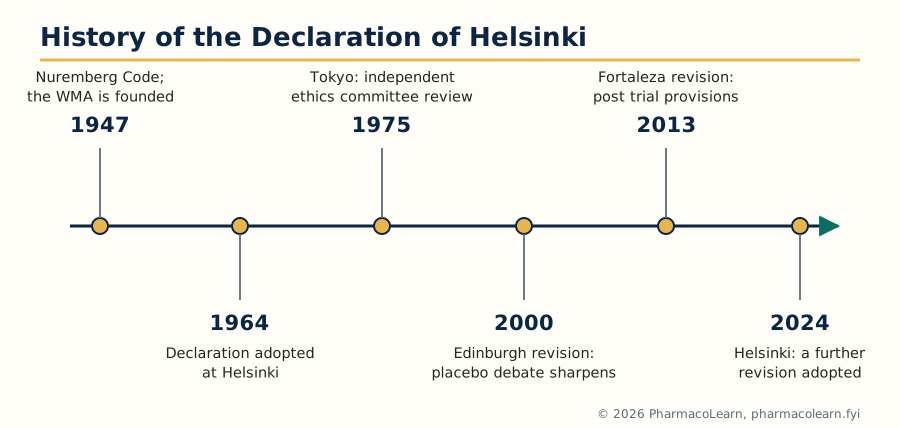 Figure: The Declaration and its revisions. The document is deliberately kept alive: each generation of the profession re argues it against the research of its own time.
5.2 Introduction: what the Declaration is
The Declaration is a statement of ethical principles, addressed primarily to physicians, with the World Medical Association encouraging all others who conduct or participate in medical research, students and pharmacologists included, to adopt the same principles. It binds through professional conscience and through adoption: regulators, ethics committees, universities and journal editors require compliance, so that in practice no legitimate research proceeds outside it. Its scope is medical research involving human subjects and research on identifiable human material and data, which brings biobanks and record based research inside the frame. Two structural features matter for study. First, the Declaration states the physician's dual duty in its foundation: the health and rights of the patient or subject come first, a duty the Geneva oath tradition carries and research may never invert. Second, it divides its operative principles into two sets, exactly as the syllabus divides this unit: the basic principles for all medical research (the next three sections) and additional principles for medical research combined with medical care (section 5.6), because the patient who is also a subject needs protections a healthy volunteer does not.
5.3 Basic principles for all medical research: foundations
The basic principles open with the scientific foundation: research must rest on generally accepted scientific principles, on adequate laboratory and animal work (where Unit 4's facility rules earn their place in an ethics unit) and on a thorough knowledge of the literature; a badly designed study is unethical in itself, because it exposes subjects to risk for knowledge it cannot produce. The protocol must be written, must state the ethical considerations involved, and must be submitted before the study begins to a research ethics committee for consideration, comment, guidance and approval; the committee must be independent of the researcher and sponsor and entitled to monitor the study as it runs. Research may be conducted only by appropriately trained and qualified individuals, under the supervision of a competent clinician where medical care is involved. Risk discipline runs through the set: risks must be assessed before the study and managed during it, research may proceed only where the importance of the objective outweighs the inherent risks and burdens, and it must stop where risks are found to outweigh benefits or where conclusive results are reached. The welfare clause stands over all of it: the duty to protect the life, health, dignity, integrity, self determination, privacy and confidentiality of subjects takes precedence over every other interest in the study.
5.4 Basic principles: consent, vulnerability and protection
The consent principles of the Declaration are the fullest statement of the doctrine of section 3.7. Participation must be voluntary and informed: each potential subject must be told the aims, methods, funding, conflicts of interest, expected benefits, risks, discomforts, the right to refuse or withdraw without reprisal, and all other relevant aspects, and consent, preferably written, taken only after the subject has understood. Where the subject cannot consent (a child, an unconscious or mentally incapable patient), consent is sought from the legally authorised representative, the subject's own assent is sought where he can give any, and his dissent is respected; research on those who cannot consent is permitted only for their condition, at minimal risk and burden beyond narrow exceptions, and only where it cannot be done in persons able to consent. Vulnerable groups and individuals receive specially considered protection, and research with them must respond to their health needs and be likely to benefit them. Privacy and confidentiality of subjects' information must be protected (section 3.8). Identifiable samples and data carry their own consent principle, with a committee governed exception for cases where consent is impossible or impracticable. Physicians must not take part in research that does not conform to these principles, and editors must not publish it: the Declaration arms its principles with the publication gate.
5.5 Basic principles: placebo, post trial duties and reporting
Three principles of the basic set are examined constantly and so are stated separately. Placebo: where a proven intervention exists, a new intervention is tested against it; placebo or no treatment controls are acceptable only where no proven intervention exists, or where compelling and scientifically sound methodological reasons require placebo and the patients receiving it face no additional risk of serious or irreversible harm; extreme care is required to avoid abuse of the option. Post trial access: in advance of the trial, sponsors, researchers and host country authorities must make provisions for post trial access, for all participants who still need it, to interventions identified as beneficial in the trial; the provision is disclosed during consent. Participants are also entitled, at the study's conclusion, to be informed of its outcome and to share in its benefits. Registration and publication: every research study involving human subjects must be registered in a publicly accessible database before the first subject is recruited, and researchers have a duty to make results publicly available, negative and inconclusive as well as positive, with reports that are complete and accurate; authorship and funding are disclosed. These three, taken together, are the Declaration's answer to the abuses of selective knowledge: trials hidden, results buried and subjects used and abandoned.
5.6 Additional principles for medical research combined with medical care
When research is combined with medical care, the same physician owes the patient two loyalties, and the additional principles police the join. A physician may combine research with care only to the extent that the research is justified by its potential preventive, diagnostic or therapeutic value and there is good reason to believe participation will not adversely affect the patients' health. The patient's refusal to participate, or withdrawal, must never adversely affect the patient physician relationship or the care he receives. Where medical research is combined with care, the patient must be fully informed which aspects of his care are related to the research, and the therapeutic misconception, the patient's natural belief that everything done to him is chosen for his personal benefit, must be actively countered in the consent conversation. If a patient is under the care of one physician and enrolled by another, the roles must be clear. The principles close with a rule of restitution and candour for the combined setting: patients who are harmed as a result of participation are entitled to treatment and compensation, and unproven interventions used in the care of an individual patient, where proven ones do not exist or have failed, are permissible only with expert advice, informed consent, and a duty to record and share the experience so that improvisation hardens, where it can, into knowledge.
5.7 The Declaration among the ethics codes
| Instrument | Year and source | Character | Distinctive note |
|---|---|---|---|
| Nuremberg Code | 1947, war crimes tribunal judgement | Absolute rules for permissible experiments | Voluntary consent stated without exception; no provision for those who cannot consent |
| Declaration of Helsinki | 1964, World Medical Association, revised since | Ethical principles for medical research | Committee review, proxy consent under safeguards, placebo and post trial rules, research combined with care |
| Belmont Report | 1979, United States national commission | Principles for federally funded research | Respect for persons, beneficence, justice: the American statement of the four values of Unit 3 |
| CIOMS Guidelines | 1982 onwards, Council for International Organizations of Medical Sciences with WHO | Detailed international ethical guidelines | Applies Helsinki principles to settings and topics in depth, including low resource settings |
| ICMR National Ethical Guidelines | 2017 edition, Indian Council of Medical Research | India's national framework | The operative guidelines for Indian ethics committees, with the NDCT Rules 2019 for drug trials |
Read together, the codes are one tradition at different working depths. Helsinki is the one a pharmacy student must be able to expound: its history, its two sets of principles, and its three most examined doctrines, committee review, informed consent with protection for those who cannot give it, and the placebo and post trial rules. With it, the subject closes where it began: Unit 1's machinery makes research true, Unit 2's tests make its conclusions measured, and Units 3 to 5 make it right.
Frequently Asked Questions
Q: Randomization and blinding both fight bias. Why does a good study need both? They fight different biases at different points. Randomization works at allocation: it stops selection bias and balances known and unknown confounders between groups before treatment starts. Blinding works during the study: it stops the expectations of subjects and assessors from distorting treatment, measurement and reporting. A randomized but unblinded trial can still be bent by an assessor who knows the groups; a blinded but unrandomized study starts with unequal groups that blinding cannot repair.
Q: A study reports P = 0.06 and describes the drug as almost effective. What is wrong with that? At the conventional alpha of 0.05 the result is not statistically significant, and the data do not justify rejecting the null hypothesis. P = 0.06 is weak evidence against the null, not a near miss grade of effectiveness; the honest statements are the size of the observed effect with its confidence interval, and that a larger study would be needed to resolve it. Note the symmetry: P = 0.04 is not proof either, only the conventional threshold crossed.
Q: When should a researcher choose a non parametric test instead of a t test? When the parametric assumptions are not defensible: the data are ordinal (scores, grades), the distribution is strongly skewed, outliers dominate the values, or the samples are very small with no basis for assuming normality. The rank tests then compare distributions honestly at some cost in power. If the data are interval scale, roughly normal and the variances are comparable, the t test is the more powerful and the correct choice.
Q: Why do paired designs, the paired t test and the crossover, manage with fewer subjects? Because they remove between subject variation from the error term. In a parallel design the treatment difference must be seen through the full spread of differences between different people; in a paired design each subject is compared with himself, and only the much smaller variation of within person change remains as noise. The price is the design's conditions: stable conditions, reversible effects and adequate washout.
Q: Which belongs in a results table, the standard deviation or the standard error? The standard deviation, because it describes the data: how widely the observations themselves spread. The standard error describes the precision of the estimated mean, and quoting SE where SD is expected makes the data look deceptively tight. SE has its proper place in stating confidence intervals for estimates; the two must always be named, never interchanged silently.
Q: A competent patient refuses a treatment his doctors believe would save his life. Which principle governs? Autonomy. Beneficence and non maleficence argue for treatment, but a competent, informed refusal is decisive in modern medical ethics and law. The team's duties are to ensure the refusal is truly informed and uncoerced, to document it, to offer every acceptable alternative, and to continue all other care without penalty. The answer reverses only where capacity is absent, when surrogates decide on the best interests standard.
Q: Why is the planned sample size inflated for expected dropouts, instead of simply recruiting replacements as subjects leave? Because the inflation is calculated before the study, from the dropout rate the setting is known to produce, keeping the study's power as designed. Replacing leavers ad hoc breaks the recruitment frame (replacements are recruited later, often differently, and in a trial they cannot restore the original randomization balance). Dropouts also bias if their reasons relate to treatment, which is why analysis by intention to treat and honest reporting of dropout numbers matter as much as the head count.
Q: What does the ethics committee actually examine before approving a protocol? The scientific soundness and social value of the question (a study that cannot answer its question is unethical exposure), the risk benefit balance, the fairness of subject selection, the consent process and documents, protections for vulnerable subjects, privacy and confidentiality arrangements, compensation and treatment provisions for research related harm, and the qualifications of the team. Approval is prospective and continuing: amendments, safety reports and progress reports return to the same committee.
Q: Who approves an animal experiment in an Indian institution, the IAEC or CPCSEA? Both, at different levels. The institution must be registered with CPCSEA, and its Institutional Animal Ethics Committee, which includes a CPCSEA nominee, approves experiments on small laboratory animals after reviewing necessity, numbers, pain relief and competence. Proposals involving large animals go beyond the institution to CPCSEA itself for approval. No approval, no experiment; the approval number follows the work into its records and publications.
Q: What does the Declaration of Helsinki cover that the Nuremberg Code did not? Research combined with medical care, and the machinery of ordinary ethical research. Nuremberg stated absolute conditions for experiments, above all voluntary consent without exception, which left no lawful room for research on children or unconscious patients. Helsinki, written by physicians for ongoing practice, added independent committee review, consent through legally authorised representatives under strict safeguards, the placebo and post trial rules, and a whole set of additional principles for the patient who is also a research subject.
Complete MRM301T notes, all 5 units in one PDF, free to keep.
Other M.Pharm subjects: MPH101T · MPC101T · MPL101T · MPH102T · MPH103T · MPH104T · MPL102T · MPL103T · MPL104T · MPC102T · MPC103T · MPC104T · MPH201T · MPH202T · MPH203T · MPH204T · MPC201T · MPC202T · MPC203T · MPC204T · MPL201T · MPL202T · MPL203T · MPL204T · MRA101T · MRA102T · MRA103T · MRA104T · MRM301T · MPG101T · MPG102T · MPG103T · MPG201T · MPG202T · MPG203T · MPG104T · MPG204T · MRA201T · MRA202T · MRA203T · MRA204T · M.Pharm