
Daily Pharma News - 26 November 2026
Today's round-up brings seven important stories for pharmacy students — from Alembic Pharma's US FDA approval for generic bosutinib and Maharashtra FDA's crackdown on spurious drugs to the shortlist for India's next DCGI, President Murmu's call for evidence-based homoeopathy research, a UK-India life sciences roundtable in Bengaluru, circular RNA progress in China, and the European Parliament's landmark pharma reform.
Alembic Pharma Receives US FDA Final Approval for Bosutinib 400 mg Tablets
Alembic Pharmaceuticals Limited has received final approval from the U.S. Food and Drug Administration (FDA) for its Supplemental Abbreviated New Drug Application (sANDA) for bosutinib tablets, 400 mg. The product is therapeutically equivalent to PF Prism C.V.'s reference listed drug, Bosulif tablets, 400 mg.
Bosutinib is a kinase inhibitor indicated for adult patients with chronic phase Philadelphia chromosome-positive (Ph+) chronic myelogenous leukaemia (CML), either newly diagnosed or resistant/intolerant to prior therapy, as well as accelerated or blast phase Ph+ CML resistant or intolerant to prior therapy. Alembic had previously received US FDA final approval for the 100 mg and 500 mg strengths and launched both.
With this decision, Alembic reaches a cumulative total of 248 US FDA ANDA approvals, comprising 230 final approvals and 18 tentative approvals. According to IQVIA data for the twelve-month period ended September 2026, bosutinib 400 mg tablets had an estimated US market size of USD 246 million.
Maharashtra FDA Cancels Inducare Pharma's Manufacturing Licences Over Spurious and Substandard Drugs

The Maharashtra Food and Drug Administration (FDA) has cancelled the Form 25 and Form 28 drug manufacturing licences of Pune-based Inducare Pharmaceutical and Research Foundation with immediate effect. The action followed findings that the firm manufactured and sold nine drugs without obtaining separate mandatory product permissions, all of which were declared Not of Standard Quality (NSQ), misbranded, or spurious by government analysts.
Two products were declared spurious after zero active ingredients were detected: Ibucare Plus (labelled as Ibuprofen 400 mg + Paracetamol 325 mg) lacked Ibuprofen entirely, while Carevita-M lacked all listed vitamins and minerals. Other formulations, including Carepanta D2 and Carezinc, failed potency tests, and earlier inspections at the Purandar unit uncovered 25 serious Good Manufacturing Practice (GMP) deficiencies, missing batch records, and mismatched expiry and manufacturing dates.
Several NSQ samples were traced to the Central Medical Store of YCM Hospital in Pimpri-Chinchwad, where the FDA seized stock worth approximately Rs 1.72 crore on 4 November 2026. For pharmacy students, this case illustrates how Section 18(c) of the Drugs and Cosmetics Act, 1940 and Schedule M documentation controls protect public drug supply chains.
Union Health Ministry Shortlists 11 Candidates for Next Drugs Controller General of India
The Union Health Ministry has shortlisted 11 candidates from 28 applicants to lead India's Central Drugs Standard Control Organisation (CDSCO) as the next Drugs Controller General of India (DCGI). A three-member screening panel prepared the shortlist, which now moves to the Union Public Service Commission (UPSC) for interviews before final approval by the Appointments Committee of the Cabinet.
The recruitment follows revised eligibility rules notified in April 2026 that widened postgraduate qualification criteria beyond pharmacy, chemistry, life sciences, and medicine to include engineering disciplines such as biomedical, computer science, and mechanical engineering, while raising the upper age limit from 56 to 58 years and counting medical device and clinical trial experience toward the 15-year requirement. The selected official will succeed Dr Rajeev Singh Raghuvanshi, whose current extension runs until 1 March 2027 or until a regular appointment is made.
Key priorities awaiting the next DCGI include enforcing revised Schedule M quality systems, overseeing joint risk-based inspections with state regulators, and implementing CDSCO's unified digital regulatory platform and expanded QR-code traceability rules.
President Droupadi Murmu Calls for Stronger Evidence-Based Research in Homoeopathy
Addressing the National Scientific Convention on Homoeopathy in Bhubaneswar, Odisha, on 25 November 2026, President Droupadi Murmu emphasised that the future credibility of homoeopathy depends on scientific integrity and high-quality clinical evidence. She noted that while homoeopathy has built an extensive institutional network across India, its standing requires rigorous scientific validation.
President Murmu urged medical colleges, universities, and research institutions to conduct adequately designed multicentric clinical studies, systematic reviews, evidence synthesis, and pharmacological research, alongside building reliable clinical databases. She stressed that researchers must practise intellectual honesty by acknowledging study limitations and transparently reporting unfavourable findings.
Speaking to young practitioners and students, she highlighted that healthcare demands lifelong learning, scientific temper, and empathy alongside academic credentials, linking accessible and scientifically responsible healthcare to India's Viksit Bharat 2047 goals.
University of Liverpool Bengaluru and Biocon Academy Explore UK-India Life Sciences Collaboration

On 25 November 2026, the University of Liverpool Bengaluru and Biocon Academy jointly hosted a leadership roundtable in Bengaluru to expand UK-India partnerships across biotechnology, pharmaceuticals, clinical research, and workforce development. Senior representatives from Syngene, Teva Pharmaceuticals India, SRM Institutions, and the Royal College of Obstetricians and Gynaecologists participated alongside academic leaders.
Discussions centred on combining the University of Liverpool's expertise in drug discovery, women's health, artificial intelligence, and clinical trials with India's strengths in biomanufacturing and pharmaceutical sciences. Ahead of the roundtable, the University of Liverpool delegation also held a strategic leadership meeting with Biocon Group Executive Chairperson Kiran Mazumdar-Shaw.
Following the roundtable, delegates interacted with over 60 students from the inaugural BSc Biomedical Sciences cohort at the University of Liverpool Bengaluru Campus, focusing on industry-ready skills in AI-enabled life sciences, clinical research training, and global career pathways.
CirCode Biomed Closes Series A+ Financing to Advance Circular RNA Therapeutics in China
Shanghai-based clinical-stage biotechnology firm CirCode Biomed announced on 25 November 2026 that it has closed a Series A+ financing round in the tens of millions of dollars, led by Fosun Health Capital with participation from existing investors. The company develops circular RNA (circRNA) therapeutics using an AI-enabled sequence design and targeted lipid nanoparticle (LNP) platform.
Proceeds will support clinical development of lead candidate HM2002 (VEGF-A), currently in Phase I trials for ischemic heart disease. HM2002 has received three Investigational New Drug (IND) clearances from China's National Medical Products Administration (NMPA)—covering ischemic heart disease, refractory angina, and chronic coronary syndromes—in addition to US FDA IND clearance and Fast Track designation.
Funds will also advance HM2003 for ischemic limb disease and preclinical circRNA-based in vivo CAR-T and in vivo CAR-M programs, underscoring growing investment in next-generation nucleic acid therapeutics in China.
European Parliament Gives Final Approval to Landmark EU Pharmaceutical Reform
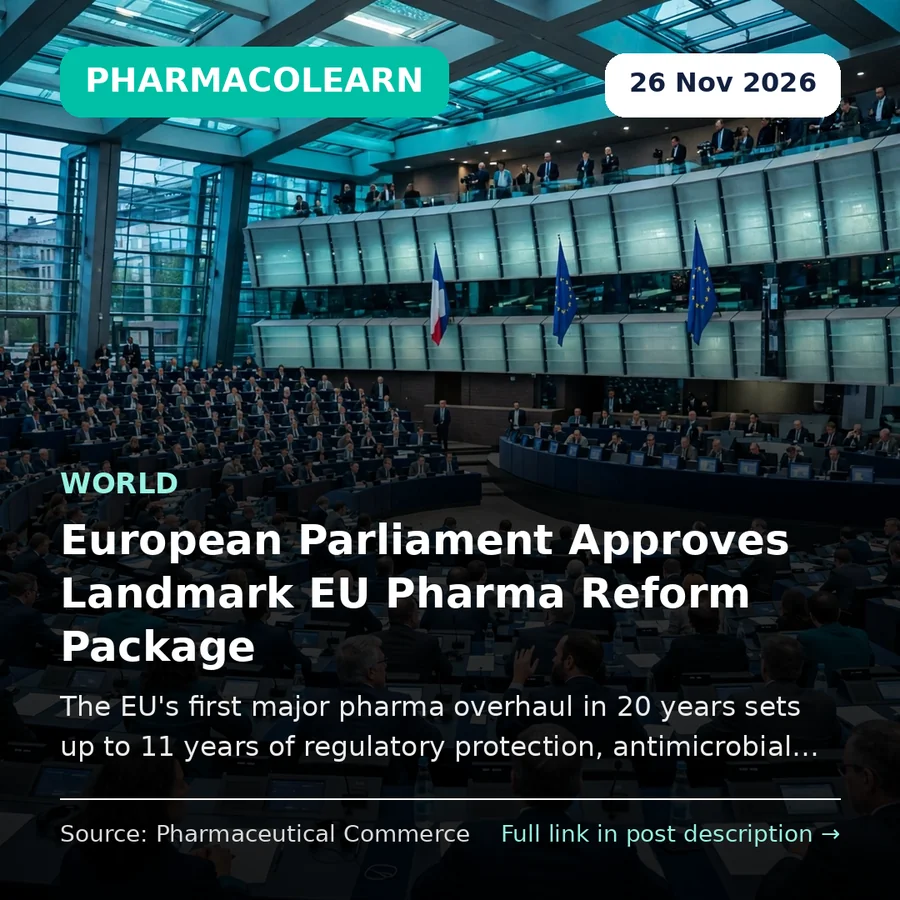
On 25 November 2026, the European Parliament granted final approval to the European Union's pharmaceutical reform package—revising the bloc's general pharmaceutical legislation for the first time in 20 years—alongside the Critical Medicines Act. Most provisions of the pharma package will apply two years after entering into force following publication in the EU's Official Journal.
Under the new framework, newly authorised medicines receive up to 11 years of combined regulatory protection: eight years of data protection, one year of market protection, and potential conditional market-protection extensions. To support timely generic entry, generic manufacturers will be permitted to carry out certain preparatory activities during the originator's market-protection window, while developers of priority antimicrobials can earn an extra year of data protection via a transferable exclusivity voucher.
To curb drug shortages, EU member states will gain authority to require sufficient supply from companies, while the Critical Medicines Act establishes strategic EU manufacturing projects with public-funding supply obligations and procurement incentives tied to European production of medicines and active substances.
Conclusion
Today's developments span regulatory enforcement, workforce development, and major legislative reform. In India, Alembic Pharma's US FDA approval for bosutinib 400 mg, the Health Ministry's shortlist of 11 DCGI candidates, Maharashtra FDA's decisive action against Inducare Pharma, and President Murmu's call for rigorous research reflect heightened focus on both global competitiveness and domestic quality standards. Regionally and globally, Bengaluru's UK-India life sciences dialogue, CirCode Biomed's circular RNA progress in China, and the European Parliament's landmark pharmaceutical reform illustrate how regulatory frameworks and next-generation modalities are evolving worldwide.
References
- Pharmabiz https://www.pharmabiz.com/NewsDetails.aspx?aid=192135&sid=2
- PSU Watch https://psuwatch.com/newsupdates/maharashtra-fda-cancels-manufacturing-licenses-of-pune-based-pharma-company
- Medical Buyer https://medicalbuyer.co.in/expanded-eligibility-rules-shape-race-to-lead-indias-drug-regulator/
- DD India https://ddindia.co.in/2026/11/president-murmu-calls-for-scientific-integrity-and-stronger-research-in-homoeopathy/
- India Education Diary https://indiaeducationdiary.in/university-of-liverpool-bengaluru-and-biocon-academy-explore-new-partnerships-to-strengthen-uk-india-life-sciences-collaboration-2/
- ACROFAN https://us.acrofan.com/detail.php?number=1027328
- Pharmaceutical Commerce https://www.pharmaceuticalcommerce.com/view/pharma-pulse-eu-adopts-pharma-reform-cms-sets-2028-negotiated-prices