
Daily Pharma News - 24 November 2026
Today's round-up brings seven important stories for pharmacy students — from India's largest anaemia survey and a new biopharma manufacturing push to landmark US FDA approvals for breast cancer and a rare muscle disease.
ICMR SAMPADA Survey Shows Lower Anaemia Prevalence and Severe Cases Below Two Percent
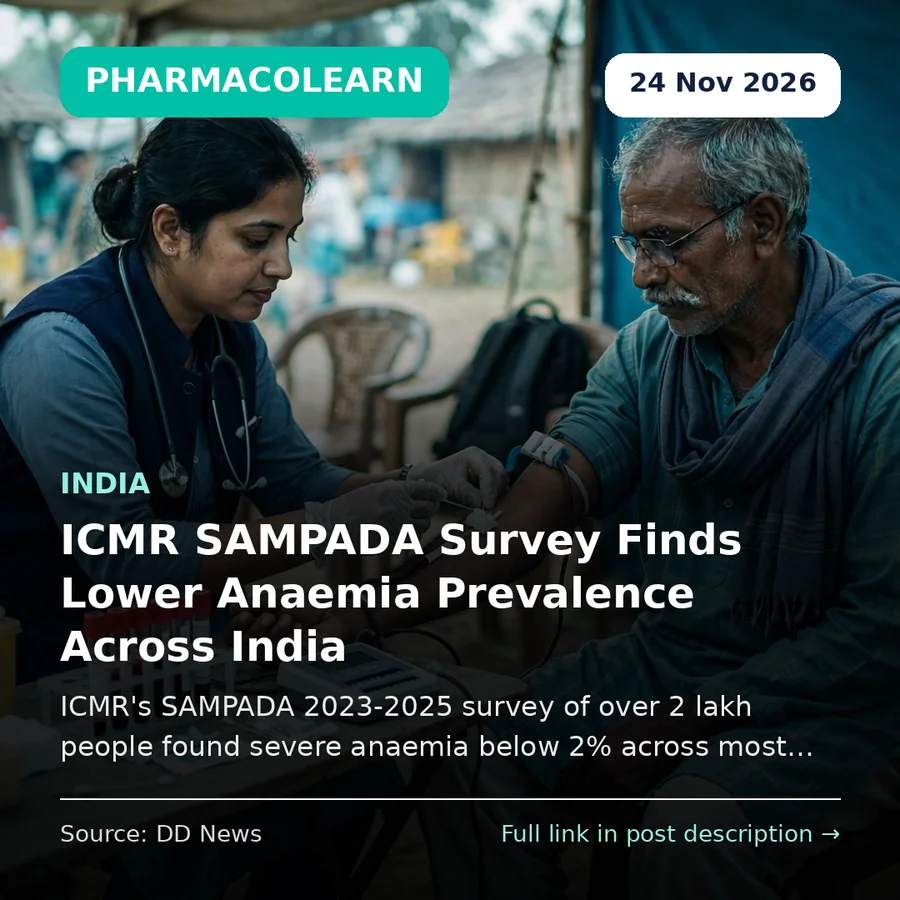
The Indian Council of Medical Research (ICMR) released findings from its nationwide Survey for Assessment of Markers of Population Health, Activity, Diet and Anthropometry (SAMPADA) 2023-2025 on 23 November 2026. Covering more than two lakh individuals from over 81,000 households across 183 districts in 35 States and Union Territories, SAMPADA analysed over 1.7 lakh venous blood samples using automated analysers to generate nationally representative haemoglobin and micronutrient estimates.
Results indicate an overall decline in anaemia prevalence compared with earlier national surveys, with severe anaemia accounting for less than 2% of cases across most age groups. Prevalence was reported at 42% among children aged 12-59 months, 46% among adolescent girls aged 10-19 years, 22-23% among adolescent boys and adult men aged 20-59 years, and 56% among women of reproductive age. Mild anaemia represented roughly half of cases in women and children and nearly three-quarters among adolescent boys and men.
For pharmacy and public health students, the micronutrient data offer an important takeaway for Anaemia Mukt Bharat 2.0: iron deficiency accounted for roughly half of the overall anaemia burden, while vitamin B12 and folate deficiencies appeared at comparable levels in both anaemic and non-anaemic groups. ICMR officials noted that addressing non-iron causes — such as infections, haemoglobin disorders, and chronic inflammation — will be essential alongside targeted iron supplementation.
India Prepares January 2027 Launch for Proposed Biopharma SHAKTI Scheme
India's Department of Pharmaceuticals is finalising the policy framework for the Biopharma SHAKTI (Strategy for Healthcare Advancement through Knowledge, Technology and Innovation) programme, targeting a January 2027 rollout subject to Union Cabinet approval. Joint Secretary Satyaprakash T L confirmed on 23 November 2026 that the final policy is being prepared for Cabinet submission. The scheme carries a proposed five-year outlay of Rs 10,000 crore from 2026-27 to 2030-31.
First announced in the Union Budget 2026-27, Biopharma SHAKTI aims to shift India's pharmaceutical sector beyond conventional small-molecule generics toward complex biologics and biosimilars. The programme is designed to support contract research, development and manufacturing organisations (CRDMOs), expand domestic clinical research infrastructure, and build end-to-end capabilities from early research to commercial-scale biomanufacturing.
Priority therapeutic areas under the proposed framework include non-communicable diseases such as cancer, diabetes, and autoimmune disorders, where biologics and targeted antibodies play a growing clinical role. Year-wise fund allocations and project eligibility criteria are expected to be announced once the Cabinet clears the final policy.
FSSAI Suspends Licences of Five Nutraceutical Manufacturers Over Hygiene and Compliance Failures

The Food Safety and Standards Authority of India (FSSAI) announced on 23 November 2026 the immediate suspension of licences for five nutraceutical and health product manufacturers following regulatory inspections. The companies named are Vedant Remedies, Lucid Healthcare Private Limited, Ambico Ayurvedic Healthcare, Vitamedic Health Nutraceuticals, and Adorreal Healthcare.
Inspection findings varied across the units: Vedant Remedies scored 12% on compliance due to poor hygiene, pest-control lapses, expired flavouring substances, and inadequate segregation of AYUSH-licensed and FSSAI-licensed ingredients, while Lucid Healthcare scored 27% and lacked mandatory hygiene training for food handlers. Ambico Ayurvedic Healthcare scored 46% amid unsanitary premises, expired materials, and missing safety records, whereas Vitamedic Health Nutraceuticals and Adorreal Healthcare were found to be non-operational at their licensed addresses.
The enforcement drive highlights growing regulatory scrutiny over India's rapidly expanding nutraceutical sector. For pharmacy students studying quality assurance and Good Manufacturing Practices, the action underscores the importance of strict separation between AYUSH and food-grade nutraceutical lines, valid licensing records, and documented pest and hygiene controls.
USFDA Issues Seven Form 483 Observations to NATCO Pharma's Hyderabad Formulation Plant
Hyderabad-based NATCO Pharma Limited received seven observations on Form 483 from the U.S. Food and Drug Administration (USFDA) following an inspection of its formulation manufacturing facility in Kothur, Hyderabad. The inspection took place between 12 November and 20 November 2026, and the company disclosed the outcome in a regulatory filing.
A Form 483 is issued at the close of an inspection when USFDA investigators observe conditions that may constitute violations of regulatory standards. NATCO Pharma stated that it believes the seven observations are procedural in nature and expressed confidence in addressing them comprehensively within the stipulated regulatory timelines without disrupting core operations.
South India's Hyderabad cluster remains one of the country's primary hubs for US-regulated generic and specialty formulations. Routine cGMP inspections and timely Form 483 responses remain critical for maintaining export continuity to regulated markets.
HUTCHMED Launches Phase III RANOVA Trial of Ranosidenib in China

On 23 November 2026, HUTCHMED (China) Limited announced the initiation of RANOVA, a registrational Phase III clinical trial evaluating ranosidenib (HMPL-306) in patients with isocitrate dehydrogenase (IDH)-mutated glioma in China. The trial marks a key late-stage milestone for the targeted small-molecule candidate.
IDH mutations are a well-characterised genetic driver in certain adult diffuse gliomas, leading to abnormal cellular metabolism that promotes tumour growth. Developing selective inhibitors capable of crossing the blood-brain barrier has been a major focus in neuro-oncology research.
Initiating a registrational Phase III study positions ranosidenib for potential future regulatory submission in China if the trial meets its clinical endpoints, reflecting continued momentum in China's domestic oncology drug development pipeline.
US FDA Approves Wilserdly (Giredestrant) for Early-Stage Breast Cancer

The U.S. Food and Drug Administration (FDA) on 23 November 2026 approved Wilserdly (giredestrant), an oral estrogen receptor antagonist developed by Genentech, a member of the Roche Group, for adults with estrogen receptor (ER)-positive, HER2-negative, Stage I, II, or III breast cancer at intermediate to high risk of recurrence after surgery. It is the first new hormone therapy approved for early-stage breast cancer in more than 20 years.
Approval was supported by the Phase III lidERA Breast Cancer trial (NCT04961996) involving 4,170 patients randomised to receive Wilserdly or standard hormone therapy (tamoxifen or an aromatase inhibitor) for up to five years. Wilserdly reduced the risk of invasive breast cancer recurrence or death by 30% compared with standard therapy, with 92.4% of patients alive and free of invasive disease at three years versus 89.6% in the control arm.
Wilserdly had previously received FDA approval on 16 November 2026 in combination with everolimus for ESR1-mutated advanced or metastatic breast cancer. Common adverse reactions (10% or more) include muscle and joint pain, hot flashes, fatigue, headache, nausea, bradycardia, dizziness, and peripheral numbness or tingling, alongside embryo-fetal toxicity warnings.
US FDA Approves Welgemda (Ribitol) as First Therapy for Limb-Girdle Muscular Dystrophy 2I/R9

On 23 November 2026, the U.S. Food and Drug Administration approved Welgemda (ribitol) oral solution for adults and paediatric patients weighing at least 30 kg with limb-girdle muscular dystrophy type 2I/R9 (LGMD2I/R9). Manufactured by ML Bio Solutions and distributed by BridgeBio Pharma, Welgemda is the first therapy ever approved for any form of limb-girdle muscular dystrophy.
LGMD2I/R9 is caused by mutations in the FKRP gene, which impair the glycosylation of alpha-dystroglycan, a protein that anchors muscle cells to surrounding tissue. Without proper anchoring, muscle fibres become fragile and degenerate, causing progressive weakness, walking difficulty, and respiratory impairment.
In a 112-patient randomised, double-blind, placebo-controlled trial (NCT05775848), a 12-month interim analysis showed significant improvements in walking speed (100-meter timed test) and lung function (forced vital capacity), alongside increased glycosylated alpha-dystroglycan levels. The most common adverse reactions were gastrointestinal effects (diarrhoea, stomach pain) and joint pain.
Conclusion
Today's developments highlight strong regulatory and clinical momentum across both domestic and global pharmaceutical landscapes. In India, large-scale epidemiological data from ICMR's SAMPADA survey and the planned January 2027 rollout of Biopharma SHAKTI point to a dual focus on evidence-based public health and advanced biomanufacturing, while FSSAI's suspensions and USFDA's Form 483 observations at NATCO Pharma underscore strict quality and compliance expectations. Globally, landmark US FDA approvals for Wilserdly and Welgemda alongside HUTCHMED's Phase III glioma trial reflect rapid progress in targeted oncology and rare genetic diseases.
References
- DD News https://ddnews.gov.in/en/icmrs-sampada-survey-finds-lower-anaemia-prevalence-across-age-groups-severe-cases-below-2/
- Chemical Industry Digest https://chemindigest.com/government-planning-january-2027-launch-of-biopharma-shakti-scheme/
- NDTV https://www.ndtv.com/health/indian-food-regulator-suspends-licences-of-5-nutraceutical-companies-over-food-safety-violations-12364818
- Voice of Healthcare https://vohnetwork.com/news/pharma/natco-pharma-usfda-form-483-observations-hyderabad
- GlobeNewswire https://www.morningstar.com/news/globe-newswire/9882848/hutchmed-initiates-ranova-phase-iii-trial-of-ranosidenib-hmpl-306-in-patients-with-idh-mutated-glioma-in-china
- U.S. Food and Drug Administration https://www.fda.gov/news-events/press-announcements/fda-approves-first-new-hormone-therapy-early-stage-breast-cancer-more-20-years
- U.S. Food and Drug Administration https://www.fda.gov/news-events/press-announcements/fda-approves-first-treatment-limb-girdle-muscular-dystrophy-type-2ir9