
Daily Pharma News - 21 November 2026
India's HPV vaccination programme, cheaper generic semaglutide, proposed drug storage rules, a US FDA inspection in Hyderabad, and new vaccines for cancer, chemotherapy nausea and Ebola all feature in today's daily pharma news. Here are the seven stories pharmacy students and pharmacists should know, with the background that makes each one matter for practice and examinations.
## 1. India HPV Vaccination Programme Crosses 1 Crore Doses with Nearly 87% Coverage
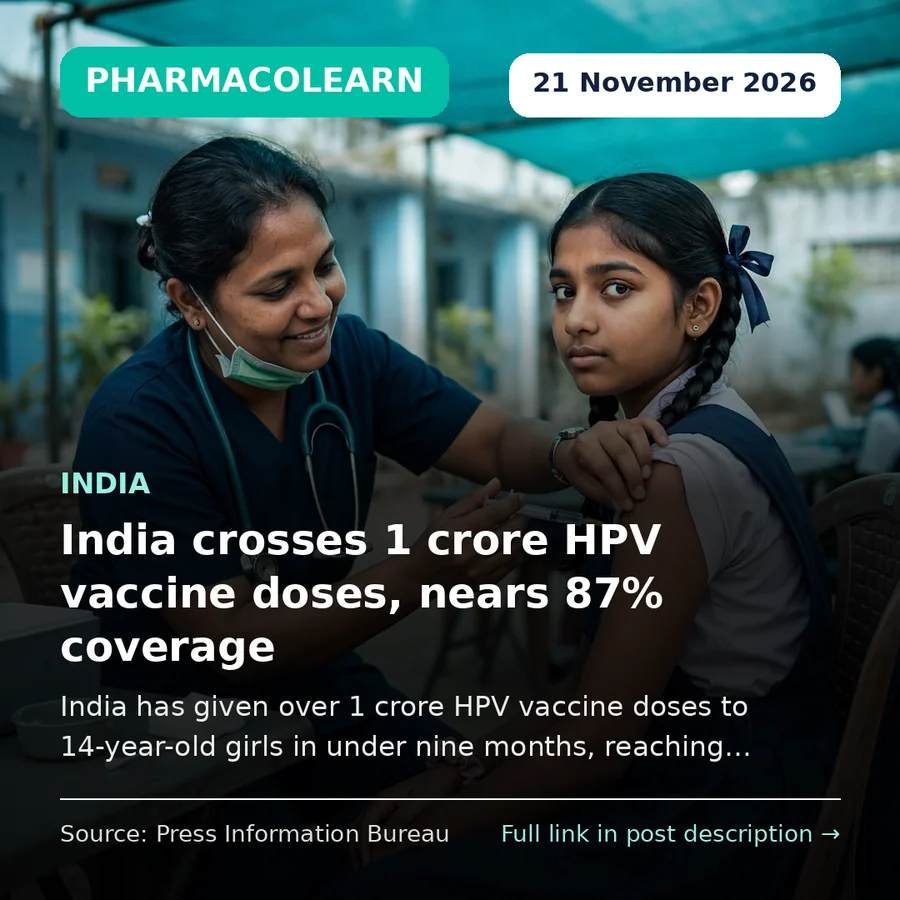
India has administered more than 1 crore doses of human papillomavirus (HPV) vaccine to 14-year-old girls in under nine months, reaching nearly 87% of the annual target cohort. Six states have already achieved 100% coverage, according to the Press Information Bureau. The pace of the rollout is a notable public health achievement, because HPV vaccination in adolescence protects against cervical cancer later in life, and high coverage in the target age group is what turns a vaccination programme into lasting population protection.
For pharmacy students, this story connects immunisation, cold chain management and public health pharmacy. HPV vaccines must be stored and handled correctly through the supply chain, and pharmacists in hospitals, clinics and community settings are often the professionals who counsel families, answer questions about safety and schedules, and support vaccination drives. The coverage figures also show how national programmes are monitored against annual targets, a useful example of how programme indicators work in practice.
## 2. Generic Semaglutide Price Falls in India After Patent Expiry, but Heart and Kidney Evidence Is Still Limited
Generic semaglutide has become cheaper in India after Novo Nordisk's patent expired on 20 March, improving access to a glucagon-like peptide-1 (GLP-1) receptor agonist widely used in type 2 diabetes and weight management. Experts caution, however, that the short Indian trials conducted so far demonstrate benefits in blood glucose control and weight reduction, not proven protection against heart and kidney disease.
This distinction matters. The cardiovascular and renal benefits associated with semaglutide come from long-term outcome trials of the originator product, and those findings cannot automatically be assumed for every generic preparation without adequate comparative evidence. For pharmacists, the message is practical: counsel patients on the established benefits and adverse effects of GLP-1 receptor agonists, including gastrointestinal effects, and explain that cheaper access does not by itself prove the same long-term organ protection. The story is also a good revision case on patents, generic medicines and the difference between surrogate outcomes, such as blood glucose and body weight, and hard clinical outcomes.
## 3. India Proposes Mandatory Good Storage and Distribution Practices (GSDP) Under the Drugs Rules, 1945
The Union Health Ministry has proposed adding the Central Drugs Standard Control Organisation (CDSCO) Good Storage and Distribution Practices (GSDP) to the Drugs Rules, 1945, making them mandatory for drug storage and distribution in India. The aim is to protect drug quality during storage and transport and to curb falsification and diversion of medicines.
Storage conditions are a core part of pharmaceutical quality: temperature, humidity, light and handling can all affect whether a medicine remains safe and effective by the time it reaches a patient. GSDP sits alongside Good Manufacturing Practices as part of the quality system that runs from factory to pharmacy shelf, and it is directly relevant to wholesale distributors, hospital pharmacies and retail pharmacists who receive, store and dispense medicines. Students should note this proposal for examinations on drug regulatory affairs and the Drugs and Cosmetics Act framework, and watch for the final notification and its timelines.
## 4. US FDA Form 483: Seven Observations Issued to NATCO Pharma Hyderabad Plant After November Inspection
The United States Food and Drug Administration (US FDA) inspected NATCO Pharma's formulation plant at Kothur, Hyderabad, on 12-20 November and issued seven observations in a Form 483. The company has described the observations as procedural and said it will address them within the stipulated time.
A Form 483 lists observations made during an inspection; it is not a warning letter and does not by itself stop a company from operating, but the firm must respond with corrective and preventive action, and unresolved observations can affect future approvals. For Indian pharmaceutical manufacturers, which supply a large share of the world's generic medicines, inspection outcomes are closely watched by regulators, investors and customers alike. Pharmacy students should understand the language of regulatory inspections: Form 483, current Good Manufacturing Practice (cGMP), corrective and preventive action (CAPA), and the difference between procedural and data-integrity observations.
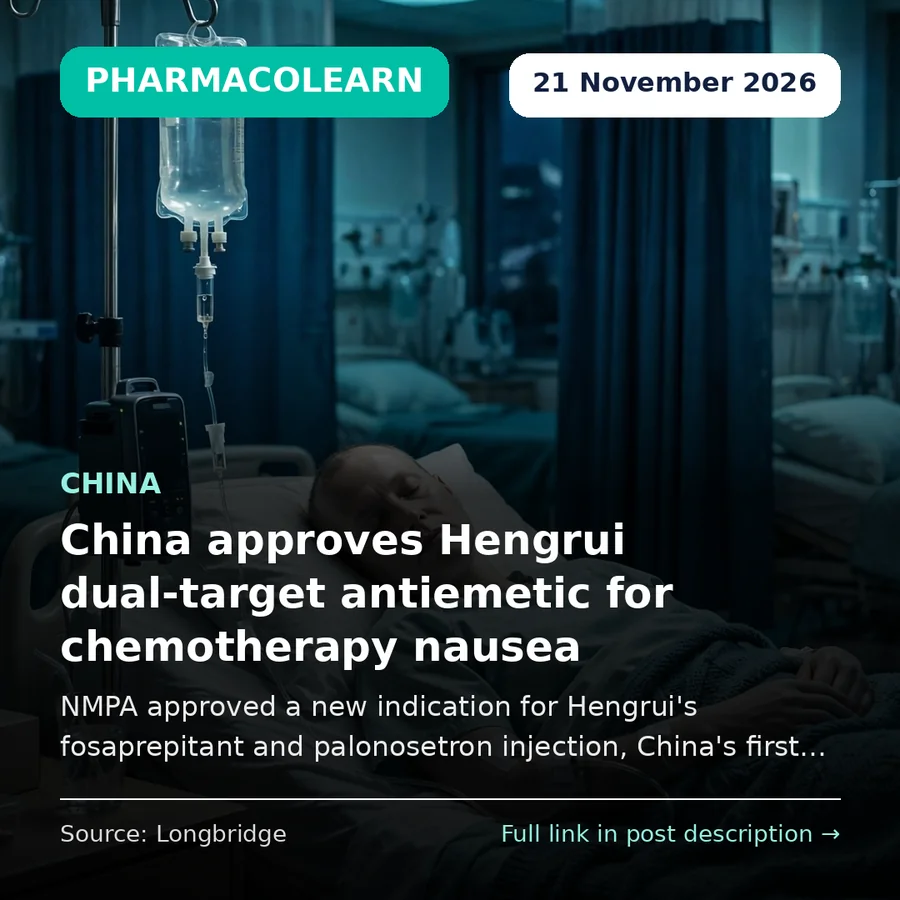
## 5. China NMPA Approves Hengrui Dual-Target Antiemetic Fosaprepitant and Palonosetron Injection for Chemotherapy-Induced Nausea
China's National Medical Products Administration (NMPA) has approved a new indication for Hengrui's fosaprepitant and palonosetron injection, described as China's first ultra-long-acting dual-target antiemetic, for acute and delayed nausea and vomiting caused by moderately emetogenic chemotherapy.
The combination pairs two complementary mechanisms: fosaprepitant, a neurokinin-1 (NK1) receptor antagonist, and palonosetron, a long-acting 5-HT3 receptor antagonist. Chemotherapy-induced nausea and vomiting remains one of the most distressing adverse effects of cancer treatment, and delayed nausea, which appears a day or more after chemotherapy, is often harder to control than the acute phase. A fixed combination that covers both phases with a single injection is therefore clinically interesting, and the approval is a useful case study in antiemetic pharmacology, combination products and how regulators in different countries assess new indications.
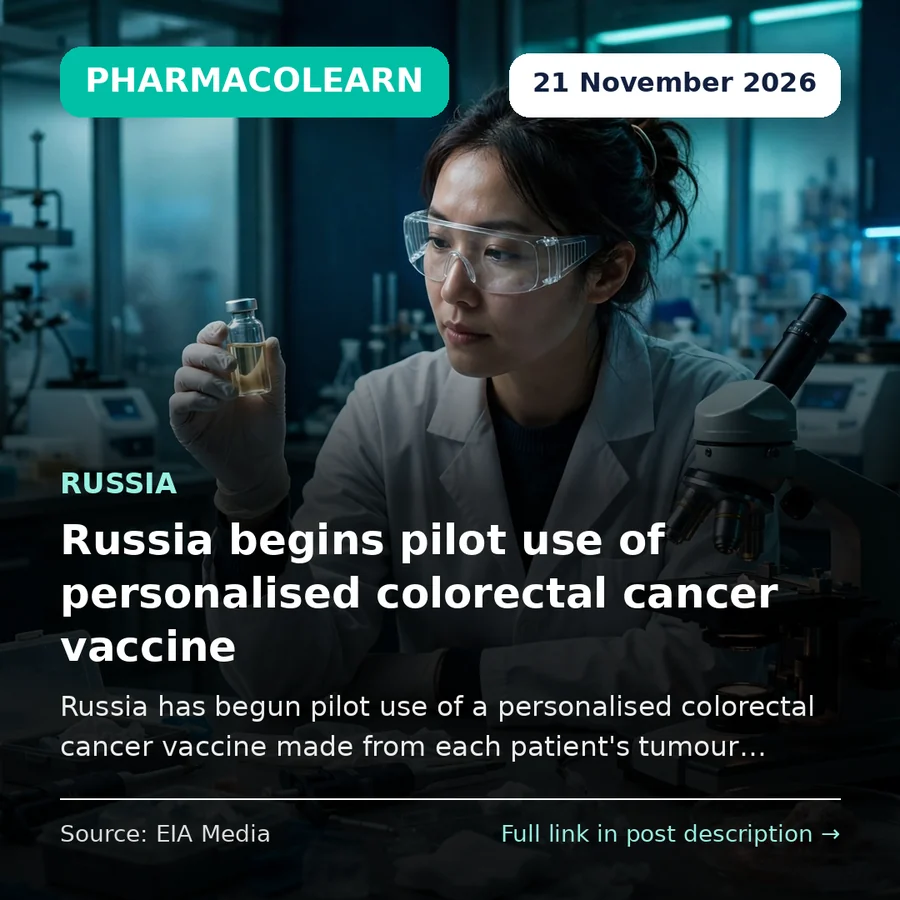
## 6. Russia Begins Pilot Use of Personalised Colorectal Cancer Vaccine Based on Tumour Neoantigens
Russia has begun pilot use of a personalised colorectal cancer vaccine made from each patient's own tumour neoantigens, for adults after surgery and at least two courses of chemotherapy. Early data are reported to show good tolerability.
Personalised cancer vaccines are built around neoantigens, the abnormal proteins produced by mutations in a patient's own tumour, so each vaccine is individual to the person receiving it. The approach aims to train the immune system to recognise and attack remaining cancer cells after surgery and chemotherapy, when the risk of recurrence is highest. The programme is still at the pilot stage, and questions about efficacy, manufacturing scale and cost remain open, but it illustrates a direction of travel in oncology: from medicines made for everyone to treatments designed around a single patient's tumour. Students should follow this alongside the wider field of cancer immunotherapy and therapeutic vaccines.
## 7. WHO to Begin Phase 2 Trials of Two Bundibugyo Ebola Vaccines in DR Congo
The World Health Organization (WHO) has said that two Bundibugyo-specific Ebola vaccines, Oxford's ChAdOx1 and Moderna's mRNA-1469, will enter Phase 2 trials on 26-27 November in Bunia, in the Democratic Republic of the Congo (DRC), amid 11,376 cases and 5,568 deaths reported in the outbreak.
Most existing Ebola vaccines target Zaire ebolavirus, the species behind the largest outbreaks, whereas the current outbreak is caused by Bundibugyo ebolavirus, which is why strain-specific vaccines are needed. A Phase 2 trial tests safety and immune response in a larger group than Phase 1, and running such a trial during an active outbreak raises demanding questions of ethics, logistics, cold chain and community trust. For pharmacy students, the story links virology, vaccine platforms — a viral-vector vaccine and an mRNA vaccine — and the role of WHO in coordinating research during public health emergencies.
## Conclusion
Today's news spans prevention, access, quality and innovation. India is showing what a large immunisation programme can achieve, while also tightening the rules that keep medicines safe in storage and distribution. Cheaper generic semaglutide improves access but reminds pharmacists to separate proven benefits from assumed ones, and the NATCO inspection shows why manufacturing quality is never a finished task. Beyond India, new medicines and vaccines for chemotherapy nausea, colorectal cancer and Ebola show how pharmacology keeps moving from the laboratory into the clinic. For pharmacy students, the lesson is to read each headline twice: once for the news itself, and once for the pharmacology, regulation and patient care underneath it.
## References
Press Information Bureau: https://www.pib.gov.in/PressReleasePage.aspx?PRID=2339423®=48&lang=2
Firstpost: https://www.firstpost.com/health/cheaper-semaglutide-india-experts-heart-kidney-14061677.html
Press Information Bureau: https://www.pib.gov.in/PressReleasePage.aspx?PRID=2338316®=48&lang=2
Business Standard: https://www.business-standard.com/amp/industry/news/usfda-issues-7-observations-to-natco-pharma-s-hyderabad-facility-126112100402_1.html
Longbridge: https://longbridge.com/en/news/306236351
EIA Media: https://eia.media/en/article/society/v-rossii-nachali-primenyat-novuyu-vakcinu-protiv-raka-tolstoy-kishki
The Hindu: https://www.thehindu.com/sci-tech/health/strain-specific-ebola-jab-trials-to-start-in-dr-congo-next-week-who/article71728070.ece