Daily Pharma News - 20 November 2026
India proposes separate licences for bulk drug wholesalers under draft Drugs Rules amendment

India's Health Ministry has proposed dedicated licences for the wholesale sale of bulk drugs, through a draft Gazette notification G.S.R. 987(E). The proposal introduces new licence forms, Form 19-BC and Form 20-BC, specifically for wholesalers dealing in active pharmaceutical ingredients (APIs), separating bulk drug trade from the existing licensing framework for finished formulations.
The move aims to tighten oversight of the bulk drug supply chain and curb the diversion of APIs into unauthorised channels, a long-standing concern for regulators and the pharmaceutical industry alike. Because India is one of the world's largest producers and exporters of APIs, clearer traceability at the wholesale stage matters for both domestic drug safety and export credibility. The draft has been placed in the public domain for comments for 30 days, giving industry bodies, state drug controllers and pharmacy professionals a window to respond before the amendment is finalised.
For pharmacy students, this is a live example of how the Drugs and Cosmetics Act, 1940 and the Drugs Rules, 1945 evolve: new licence categories are created when regulators identify a gap in the existing framework. Students preparing for GPAT, the Drug Inspector examination and pharmacist licensing exams should note the form numbers, the 30-day objection window, and the underlying principle that bulk drugs and finished formulations are regulated differently.
India moves antimicrobials under central drug approval in draft NDCT Rules amendment
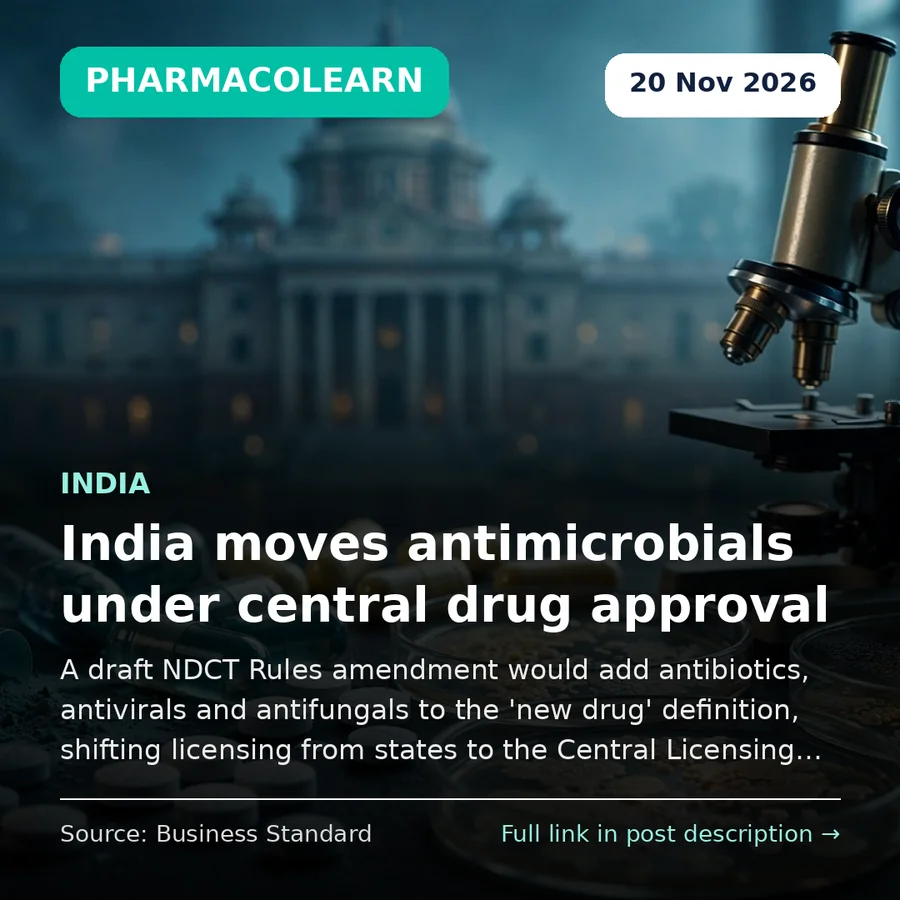
A draft amendment to the New Drugs and Clinical Trials (NDCT) Rules, 2019 would bring antibiotics, antivirals and antifungals within the legal definition of a "new drug", shifting their licensing from state drug controllers to the Central Licensing Authority. The proposal, reported on 19 November, also requires bioavailability and stability data as part of the approval dossier for these products.
The change is a significant step in India's fight against antimicrobial resistance (AMR). Centralised approval is expected to bring uniform standards to antimicrobial licensing across states, reduce the approval of irrational fixed-dose combinations, and strengthen the evidence base for new antimicrobial products entering the Indian market. For a country with one of the highest burdens of antimicrobial resistance, harmonising how these drugs are approved is both a regulatory and a public health priority.
Pharmacy students should connect this development with the concept of the "new drug" definition under the NDCT Rules, the role of the Central Drugs Standard Control Organisation (CDSCO), and the difference between state and central licensing. The requirement for bioavailability and stability data also revisits core pharmaceutics and biopharmaceutics topics: how a drug is absorbed, how it remains stable over its shelf life, and why regulators demand this evidence before granting a licence.
Hyderabad enforcement drive: 90 medical shops get show-cause notices for illegal drug sales

Telangana's drug enforcement agency, TG SAFE, has issued show-cause notices to 90 medical shops in Hyderabad after a enforcement drive on 19 November found habit-forming drugs such as tramadol and codeine-based syrups, along with antibiotics, being sold without valid prescriptions. The drive targeted retail pharmacies flouting the prescription-only rules under the Drugs and Cosmetics Act.
The sale of habit-forming drugs without prescriptions is a serious violation of Schedule H and Schedule H1 provisions, which exist precisely to prevent misuse, dependence and the spread of antimicrobial resistance. Tramadol and codeine preparations carry well-known risks of abuse and dependence, while indiscriminate antibiotic sales without a prescription directly fuel resistance. The notices are the first step in a process that can lead to licence suspension or cancellation for repeat or serious offenders.
This story is a practical reminder for every future pharmacist that a licence to sell medicines carries legal and ethical duties: verifying prescriptions, maintaining proper records, and refusing sales that break the law. For students, it reinforces the importance of the Schedules to the Drugs Rules, the concept of prescription-only medicines, and the pharmacist's role as the last checkpoint between a drug and a patient.
China NMPA approves SYVIK (sovleplenib), the first novel Syk inhibitor, for two blood disorders
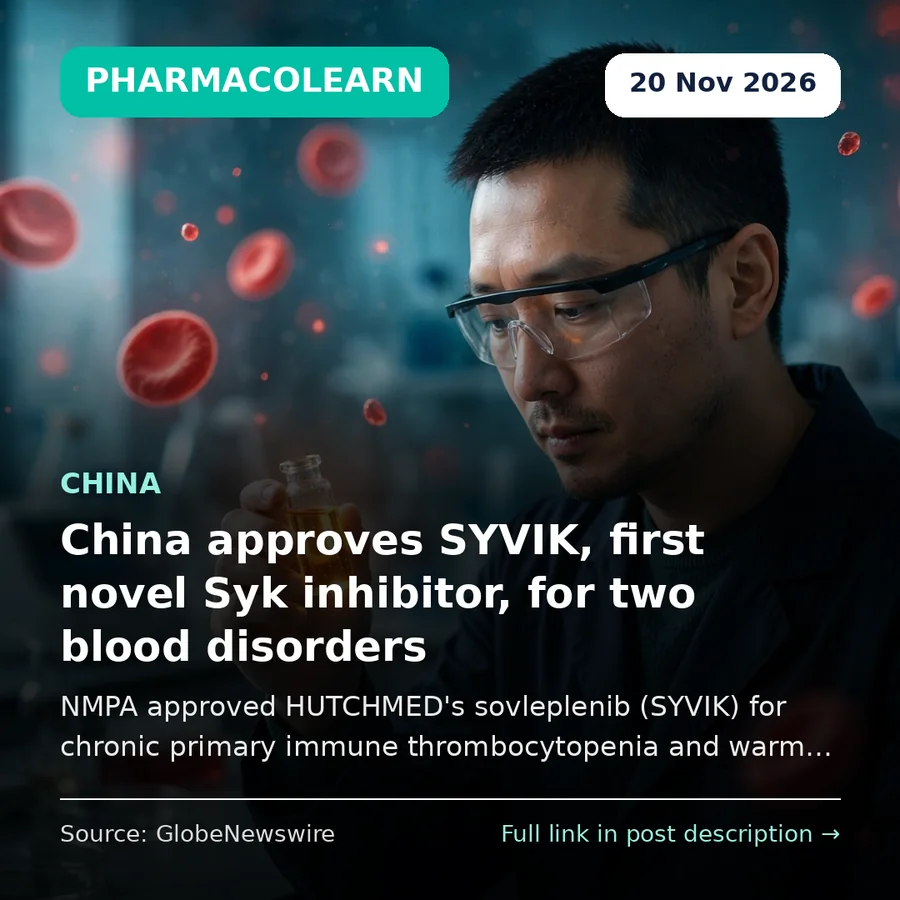
China's National Medical Products Administration (NMPA) has approved HUTCHMED's sovleplenib, marketed as SYVIK, for chronic primary immune thrombocytopenia (ITP) and warm antibody autoimmune haemolytic anaemia (wAIHA). It is China's first novel spleen tyrosine kinase (Syk) inhibitor, with approval supported by the ESLIM-01 and ESLIM-02 clinical trials.
Syk is a key signalling enzyme in B-cell and platelet pathways, and inhibiting it offers a targeted way to treat autoimmune conditions in which the body's own immune system destroys platelets or red blood cells. In ITP, patients suffer low platelet counts and bleeding risk; in warm antibody autoimmune haemolytic anaemia, antibodies destroy red blood cells and cause anaemia. Sovleplenib gives clinicians in China a new oral, mechanism-based option for both conditions, which have historically relied on corticosteroids, immunosuppressants and splenectomy.
For pharmacy students, SYVIK is a useful case study in targeted drug design: a small-molecule kinase inhibitor developed for a defined molecular target, validated in named phase 3 trials, and approved for two related but distinct indications. It also illustrates how China's NMPA is increasingly approving first-in-class innovative medicines from domestic developers such as HUTCHMED, a trend worth following for anyone tracking global pharmaceutical innovation.
FDA clears Infilbray (venglustat), the first drug for brain symptoms of Gaucher disease type 3

The US Food and Drug Administration (FDA) has approved Sanofi's venglustat, marketed as Infilbray, as the first therapy for the neurological symptoms of Gaucher disease type 3. The once-daily oral medicine works by crossing the blood-brain barrier and reducing the build-up of glycosphingolipids in the brain, with approval based on the phase 3 LEAP2MONO trial.
Gaucher disease is a lysosomal storage disorder caused by deficiency of the enzyme glucocerebrosidase, leading to accumulation of glucosylceramide in organs including the spleen, liver and bone marrow. While enzyme replacement therapy treats the systemic features of the disease, it cannot cross the blood-brain barrier, so the neurological symptoms of type 3 Gaucher disease — which include eye movement abnormalities, seizures and cognitive decline — have had no approved treatment until now. Venglustat is a glucosylceramide synthase inhibitor that reduces the production of the accumulating substrate, and its ability to reach the brain is what makes this approval a first.
This approval is a milestone for rare disease pharmacology and for the concept of substrate reduction therapy. Pharmacy students should note the mechanism — inhibiting glucosylceramide synthesis rather than replacing the missing enzyme — and the pharmacokinetic challenge the drug overcomes: crossing the blood-brain barrier. It is also a reminder that orphan drugs for rare diseases can transform care for small patient populations, and that clinical trial evidence from studies such as LEAP2MONO is what converts a promising molecule into an approved medicine.
FDA approves Livsayis (cemdisiran), the first siRNA therapy for generalised myasthenia gravis
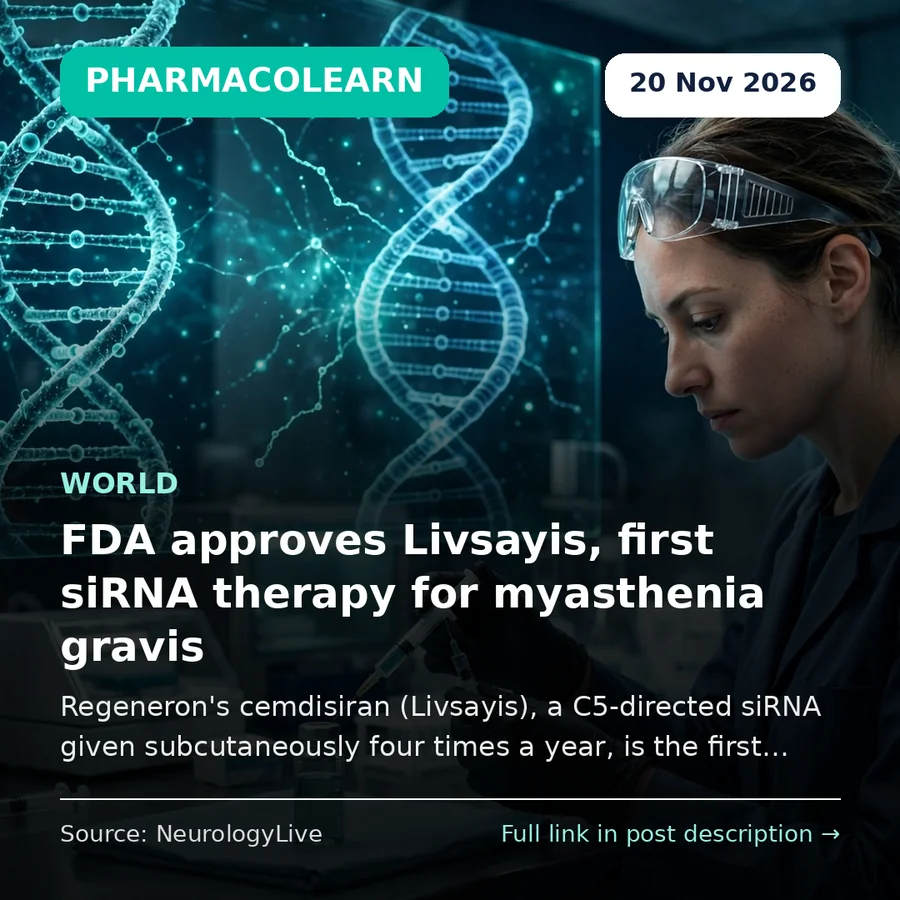
The FDA has approved Regeneron's cemdisiran, marketed as Livsayis, for adults with acetylcholine receptor (AChR) antibody-positive generalised myasthenia gravis. It is the first small interfering RNA (siRNA) therapy approved for this condition, given as a subcutaneous injection four times a year, with approval based on the phase 3 NIMBLE trial.
Cemdisiran works by silencing the production of complement component C5 in the liver, blocking the complement cascade that damages the neuromuscular junction in myasthenia gravis. In AChR-positive disease, autoantibodies trigger complement-mediated destruction of acetylcholine receptors, weakening the signal between nerve and muscle and causing the fluctuating muscle weakness that defines the condition. By targeting C5 at the RNA level, Livsayis offers durable complement inhibition with only quarterly dosing, a meaningful convenience advantage over existing complement inhibitors that require frequent infusions.
For pharmacy students, Livsayis is a landmark in RNA therapeutics: an siRNA medicine moving beyond rare liver diseases into autoimmune neurology. It revisits core pharmacology — the complement system, the neuromuscular junction, and the mechanism of RNA interference — and illustrates how modern biologics and nucleic acid therapies are expanding the treatment options for chronic autoimmune disease. The NIMBLE trial also shows how phase 3 evidence in a defined antibody-positive population supports a targeted approval.
Conclusion
Today's news spans the full arc of pharmacy practice, from Indian regulation to global drug innovation. Two draft proposals from New Delhi — separate licences for bulk drug wholesalers and central approval for antimicrobials — show Indian drug regulation tightening around supply-chain integrity and antimicrobial resistance, while the Hyderabad enforcement drive shows those rules being applied on the ground. Internationally, three firsts — China's first novel Syk inhibitor, the first drug for the brain symptoms of Gaucher type 3, and the first siRNA therapy for myasthenia gravis — highlight how targeted mechanisms and RNA-based medicines are opening new options for patients with rare and autoimmune diseases. For pharmacy students, the thread connecting these stories is the same: regulation, mechanism and evidence together decide which medicines reach patients, and understanding all three is what turns a student into a pharmacist.
References
- Press Information Bureau https://www.pib.gov.in/PressReleasePage.aspx?PRID=2338242®=48&lang=2
- Business Standard https://www.business-standard.com/industry/news/centre-antimicrobials-central-approval-ndct-rules-amr-antibiotics-126111900617_1.html
- The Hindu https://www.thehindu.com/news/cities/Hyderabad/show-cause-notice-issued-to-90-medical-shops-in-hyderabad-over-drug-sale-violations/article71720988.ece
- GlobeNewswire https://www.globenewswire.com/news-release/2026/11/19/3406365/0/en/hutchmed-announces-china-nmpa-approval-of-syvik-sovleplenib-for-the-treatment-of-primary-immune-thrombocytopenia-and-warm-antibody-autoimmune-hemolytic-anemia.html
- MedCity News https://medcitynews.com/2026/11/sanofi-gaucher-disease-type3-venglustat-infilbray-fda-approval-gd3-san/
- NeurologyLive https://www.neurologylive.com/view/fda-approves-cemdisiran-as-new-treatment-generalized-myasthenia-gravis