Daily Pharma News - 14 November 2026
India's TB deaths down 38% since 2015, WHO report finds
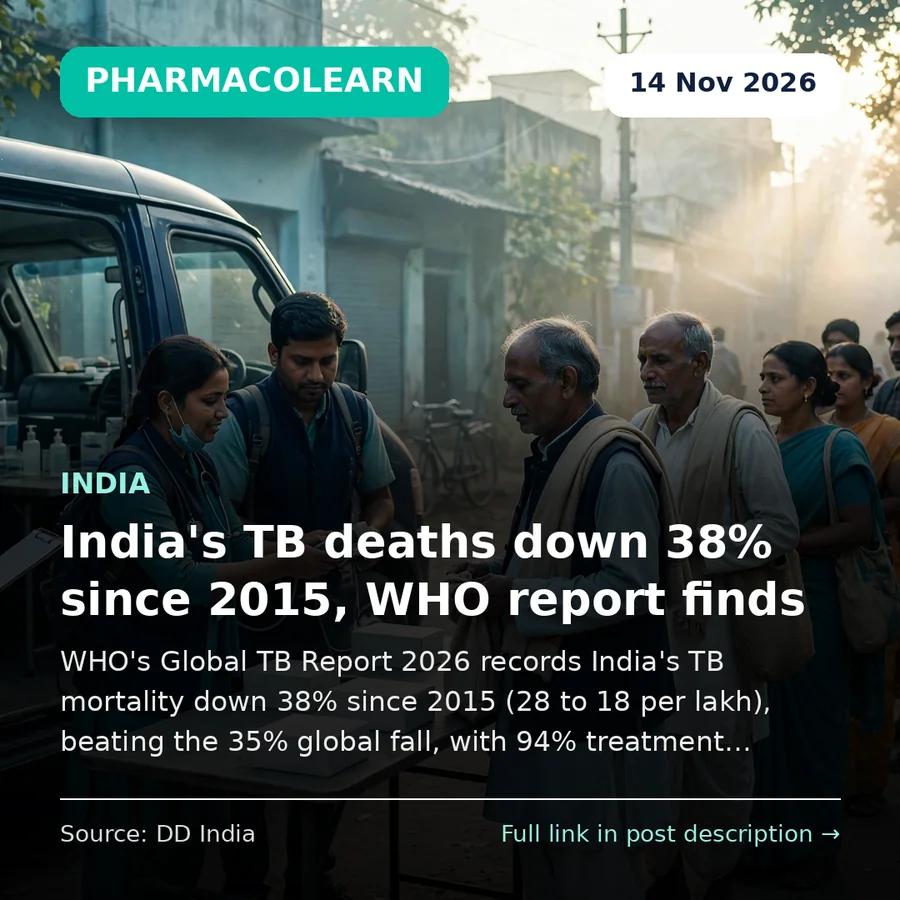
India has recorded a 38 percent decline in tuberculosis mortality since 2015, according to the World Health Organization's Global TB Report 2026, as reported by DD India on the Press Information Bureau release (PRID 2335615, 12 November 2026). TB deaths fell from 28 to 18 per lakh population, a sharper fall than the 35 percent decline seen globally over the same period. The report also records a 94 percent treatment success rate for drug-susceptible tuberculosis under the National Tuberculosis Elimination Programme (NTEP), a milestone for India's public health system.
For pharmacy students, this is a landmark example of how a national programme can move population-level outcomes. The NTEP relies on directly observed therapy, fixed-dose combinations of first-line anti-tubercular drugs such as isoniazid, rifampicin, pyrazinamide and ethambutol, and the Nikshay portal for case notification and follow-up. The mortality decline reflects better case detection, wider access to molecular diagnostics such as CBNAAT, and stronger treatment adherence support, including nutritional assistance under Nikshay Poshan Yojana. Students preparing for GPAT and the Drug Inspector examination should note the 2015 baseline, the 28 to 18 per lakh figure, and the 94 percent success rate, as these numbers are likely to appear in exam questions on national health programmes.
DCGI halts obeticholic acid, orders recall over liver risk
The Drugs Controller General of India (DCGI) has halted the manufacture, sale and distribution of obeticholic acid 5 mg and 10 mg tablets used in primary biliary cholangitis, and has sought cancellation of the licences of manufacturers and importers, according to a Mint report read via its eflip.in republication. The action follows the withdrawal of the drug by the European Medicines Agency (EMA) and the United States Food and Drug Administration (FDA), after evidence of serious liver injury and unconfirmed clinical benefit in patients with this rare autoimmune liver disease.
Obeticholic acid is a farnesoid X receptor (FXR) agonist that was originally approved on the basis of a reduction in alkaline phosphatase, a surrogate marker, rather than proven improvement in liver-related survival. Regulators in Europe and the United States concluded that the risk of drug-induced liver injury, including cases progressing to liver failure, outweighed the uncertain benefit, and the drug was withdrawn from those markets. The DCGI's decision brings Indian regulation in line with these global actions and is a textbook case of pharmacovigilance in action: a drug can be removed from the market years after approval when post-marketing safety data changes the benefit-risk balance. Pharmacy students should study this alongside the concepts of conditional approval, surrogate endpoints, and the role of CDSCO in acting on international regulatory signals.
Balaxi Q2 profit jumps 450% as Jadcherla plant wins WHO-GMP

Hyderabad-based Balaxi Pharmaceuticals has reported a strong second quarter of FY27, with revenue up 45 percent and profit after tax up 450 percent year on year, alongside EBITDA growth of 338 percent. The company's new oral-dosage manufacturing plant at Jadcherla in Telangana is now operational with WHO-GMP certification, and the company reports 34 approved products in its portfolio.
The Jadcherla facility matters because WHO-GMP certification is a gateway to supplying medicines to international procurement agencies and regulated export markets, including many African and Latin American countries where Indian generic manufacturers are major suppliers. For pharmacy students in South India, Balaxi's growth illustrates how a mid-sized Hyderabad pharmaceutical company can scale through manufacturing compliance, product registrations, and export-oriented strategy rather than through research alone. The story also connects to the wider theme of Telangana as a pharmaceutical manufacturing hub, home to many formulation and active pharmaceutical ingredient (API) units that supply both the Indian market and the world.
China clears delgocitinib cream for chronic hand eczema

China's National Medical Products Administration (NMPA) has approved LEO Pharma's delgocitinib cream (Anzupgo) for adults with moderate-to-severe chronic hand eczema where topical corticosteroids are inadequate or inappropriate. The approval is backed by the DELTA China Phase 3 trial, which showed significant improvement at 16 weeks compared with vehicle cream.
Delgocitinib is a topical pan-Janus kinase (JAK) inhibitor, a newer class of dermatology therapy that blocks the JAK-STAT signalling pathway involved in skin inflammation and itch. Chronic hand eczema is a common and disabling condition, particularly for healthcare workers, cleaners and others with frequent hand washing and chemical exposure, and long-term topical steroid use on the hands carries risks of skin thinning. The NMPA approval follows earlier approvals of delgocitinib cream in Europe and other markets, and it shows how China is increasingly aligned with global regulatory timelines for innovative dermatology drugs. Pharmacy students should note the mechanism of JAK inhibition, the 16-week trial endpoint, and the positioning of the cream as a steroid-sparing option.
India warns travellers to Russia over restricted medicines

The Embassy of India in Moscow has issued an advisory, dated 11 November, warning Indian travellers to Russia not to carry medicines such as pregabalin, dextromethorphan, codeine, testosterone or clonazepam without a valid prescription and a notarised Russian translation. The advisory follows seizures of such medicines at Russian airports, where these drugs are treated as controlled substances under Russian law.
This is an important practical lesson in international drug regulation for pharmacy students. A medicine that is freely available or only loosely regulated in one country can be a controlled substance in another, and carrying it across a border without proper documentation can lead to confiscation or prosecution. Pregabalin and clonazepam are controlled in many countries because of their potential for misuse and dependence, while codeine-containing preparations and dextromethorphan are restricted in Russia for similar reasons. Pharmacists advising travellers should always check the destination country's controlled-substances list, carry medicines in original packaging with a prescription, and arrange a notarised translation where required.
FDA clears durvalumab combo for muscle-invasive bladder cancer

The United States Food and Drug Administration (FDA) has approved durvalumab (Imfinzi) in combination with enfortumab vedotin before surgery, followed by durvalumab alone after cystectomy, for adults with muscle-invasive bladder cancer who cannot take or refuse cisplatin-based chemotherapy. The approval is based on the VOLGA trial.
This approval is significant because cisplatin-based neoadjuvant chemotherapy has long been the standard before bladder removal surgery, yet many patients are ineligible due to kidney impairment, hearing loss or poor performance status. Durvalumab is a PD-L1 immune checkpoint inhibitor, while enfortumab vedotin is an antibody-drug conjugate targeting Nectin-4, a protein highly expressed on bladder cancer cells. Combining immunotherapy with a targeted cytotoxic payload before surgery, and continuing immunotherapy afterwards, represents the new direction in perioperative bladder cancer care. For pharmacy students, the VOLGA regimen is a strong example of how antibody-drug conjugates and checkpoint inhibitors are now combined across the treatment journey, and a useful case study in oncology pharmacology for GPAT and clinical pharmacy examinations.
Gazyva is first FDA-approved drug for membranous nephropathy
The United States Food and Drug Administration (FDA) has approved Gazyva (obinutuzumab) for adults with primary membranous nephropathy who are at risk of disease progression, making it the first drug ever approved specifically for this rare kidney disease. In the supporting trial, 36 percent of patients receiving Gazyva achieved complete remission at week 104, compared with 6 percent of those receiving tacrolimus.
Primary membranous nephropathy is an autoimmune kidney disorder in which antibodies, most commonly against the PLA2R antigen on podocytes, damage the kidney's filtering units and cause heavy protein loss in the urine, leading to nephrotic syndrome and progressive kidney failure. Until now, treatment relied on off-label immunosuppressants such as rituximab, cyclophosphamide or tacrolimus, with no approved therapy. Gazyva is a monoclonal antibody that depletes B cells by targeting CD20, reducing the production of the harmful autoantibodies. The approval gives nephrologists a licensed, evidence-based option for a disease that previously had none, and it is a clear example for pharmacy students of how a monoclonal antibody can move from oncology into autoimmune kidney disease through a shared mechanism of B-cell depletion.
Conclusion
Today's news spans the full range of modern pharmacy practice, from India's public health success against tuberculosis to the DCGI's decisive safety action on obeticholic acid, and from a Hyderabad manufacturer's WHO-GMP milestone to two landmark FDA approvals in oncology and nephrology. The common thread is regulation working as it should: rewarding good manufacturing and strong trial evidence, and removing or restricting medicines when safety data demands it. For pharmacy students, the lesson is to connect the dots between pharmacology, pharmacovigilance, regulatory affairs and clinical practice, because the same drug can appear in an exam question, a hospital ward, a factory audit or a travel advisory. Keep following PharmacoLearn's daily news to build this habit of linking classroom knowledge with real-world pharmacy.
References
- DD India https://ddindia.co.in/2026/11/india-records-38-decline-in-tb-mortality-since-2015-achieves-94-treatment-success-rate-who-report/
- Mint https://eflip.in/drug-regulator-halts-obeticholic-acid-production-orders-recall/
- APNA MA TV https://apnamatvchannel.com/business/balaxi-pharmaceuticals-q2-fy27-revenue-rises-45-percentage-ebitda-surges-338-percentage-and-pat-grows-450-percentage-yoy/
- The Dermatology Digest https://thedermdigest.com/delgocitinib-cream-scores-nod-for-che-in-china/
- Outlook India https://www.outlookindia.com/amp/story/national/india-warns-travellers-to-russia-over-restricted-medicines-confiscation-risk
- Oncology Nursing Society https://www.ons.org/publications-research/voice/news-views/11-2026/fda-approves-durvalumab-enfortumab-vedotin-ejfv-muscle-invasive-bladder-cancer
- FDA https://www.fda.gov/drugs/news-events-human-drugs/fda-approves-first-drug-treat-adults-primary-membranous-nephropathy