Daily Pharma News - 11 November 2026
NPPA Caps Trade Margins: 137 Anti-Cancer Drugs Cheaper in India from 9 November
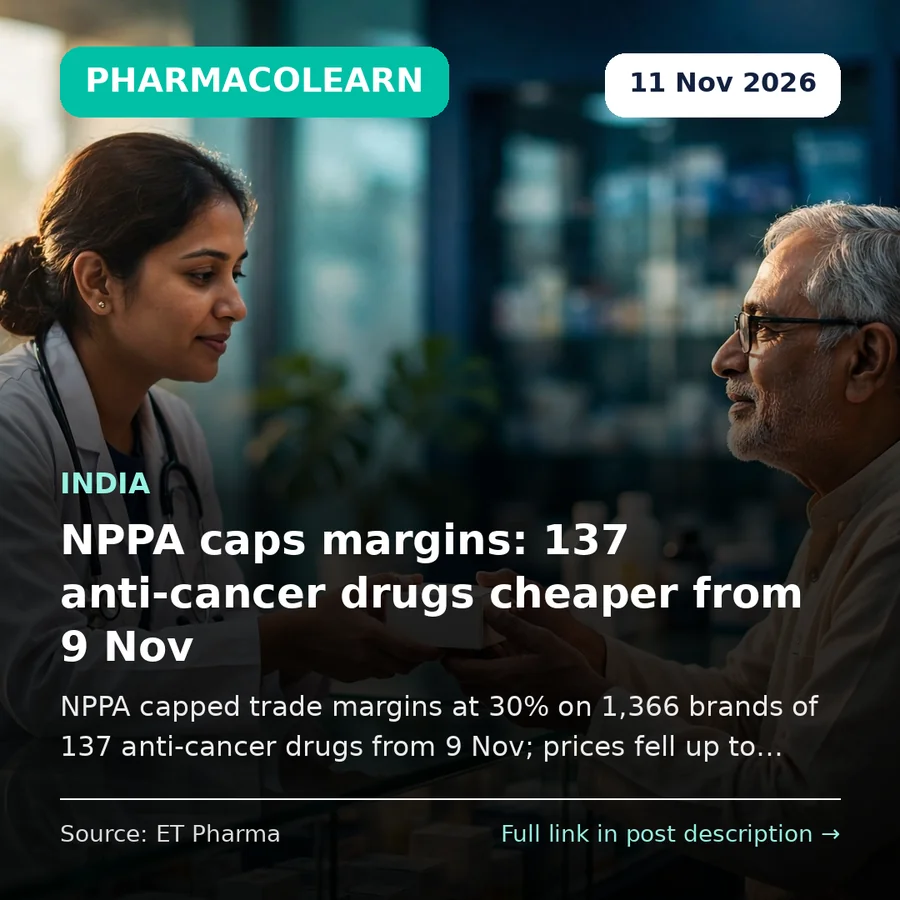
The National Pharmaceutical Pricing Authority (NPPA) has capped trade margins at 30% on 1,366 brands of 137 anti-cancer drugs, effective from 9 November. The move brings sharp price cuts across a wide range of oncology medicines, with some prices falling by as much as 96.45%. Patients are estimated to save about Rs 3,540 crore a year as a result of the cap.
Trade margin rationalisation works by limiting the gap between the price at which a drug leaves the manufacturer and the price paid by the patient, cutting out excessive mark-ups along the distribution chain. For pharmacy students, this is a textbook example of drug price control in India under the Drugs (Prices Control) Order, and of how the NPPA uses margin caps, rather than direct price fixation, to improve access to essential medicines. The scale of the saving also shows why oncology affordability remains a central policy question: cancer treatment in India is often paid for out of pocket, so a margin cap on more than a thousand brands reaches far more patients than a price cut on a handful of products.
India Must Become the 'Laboratory of the World', Says Minister Anupriya Patel at IIMA Healthcare Summit
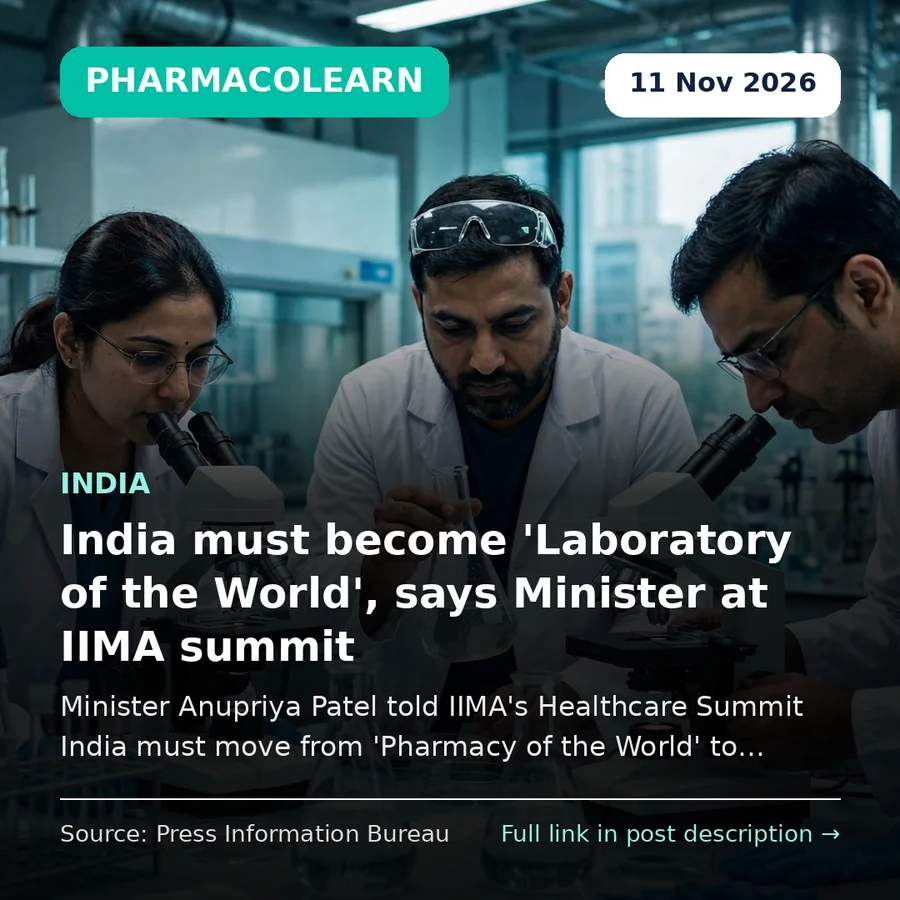
Union Minister of State for Health and Family Welfare Anupriya Patel told the Healthcare Summit at the Indian Institute of Management Ahmedabad (IIMA) that India must move from being the 'Pharmacy of the World' to becoming the 'Laboratory of the World'. The call reflects a shift in ambition: from large-scale manufacture of generic medicines towards original drug discovery and innovation led from India.
The Minister pointed to two flagship programmes backing that shift: the Promotion of Research and Innovation in Pharma MedTech sector (PRIP) scheme, worth Rs 5,000 crore, and the Biopharma SHAKTI mission, worth Rs 10,000 crore. For pharmacy students, the message matters because it signals where future careers and research funding are heading — towards medicinal chemistry, clinical research, biologics and pharmaceutical innovation, not only formulation and manufacturing. The 'Pharmacy of the World' identity was built on India's generic drug industry; the next phase depends on research capacity, skilled scientists and a stronger innovation ecosystem.
Telangana Now India's Second-Largest Pharma Producer at Rs 86,711 Crore
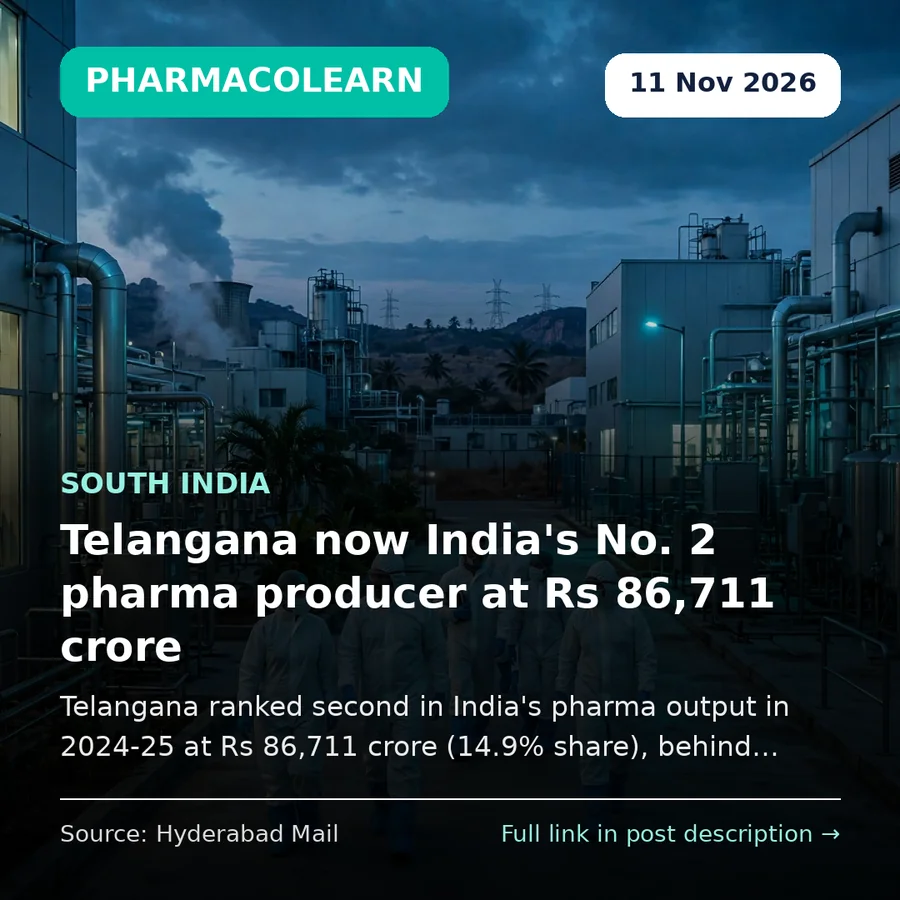
Telangana ranked second in India's pharmaceutical output in 2024-25, producing medicines worth Rs 86,711 crore and accounting for a 14.9% share of national output, behind only Maharashtra. The figures underline how concentrated India's pharma manufacturing has become in a small number of states, with Telangana's Hyderabad cluster at the centre of that growth.
Pharma generated about a third of the state's factory-sector value added, showing how deeply the industry is woven into Telangana's economy. For pharmacy students, the state-level picture is worth knowing for both exams and careers: Hyderabad's pharma corridor hosts bulk drug and formulation units, research centres and contract manufacturing, making it one of the largest employment hubs for pharmacists, quality assurance professionals and regulatory affairs specialists in South India. State-level industrial policy, infrastructure and ease of doing business all feed into these rankings.
FDA Approves Sunharbo (Asundexian), the First Factor XIa Inhibitor to Prevent Repeat Stroke

The US Food and Drug Administration (FDA) has approved Bayer's asundexian, marketed as Sunharbo, 50 mg, the first Factor XIa inhibitor, for use with antiplatelet therapy after a recent stroke or high-risk transient ischaemic attack (TIA). In the OCEANIC-STROKE trial, the drug cut repeat ischaemic stroke by 26%.
Factor XIa inhibitors represent a new approach to anticoagulation: they target a clotting factor involved in pathological thrombus formation while aiming to spare the haemostasis needed to prevent bleeding. That is the key pharmacological idea behind this class, and it is why the approval is significant for students of pharmacology — it may offer stroke prevention with a different bleeding profile from older anticoagulants. The approval also adds a new option for secondary stroke prevention, where the risk of a repeat event is highest in the weeks after the first stroke or TIA, and where antiplatelet therapy alone leaves residual risk.
FDA Approves Pimicotinib (Pimjetmi) for Symptomatic Tenosynovial Giant Cell Tumour
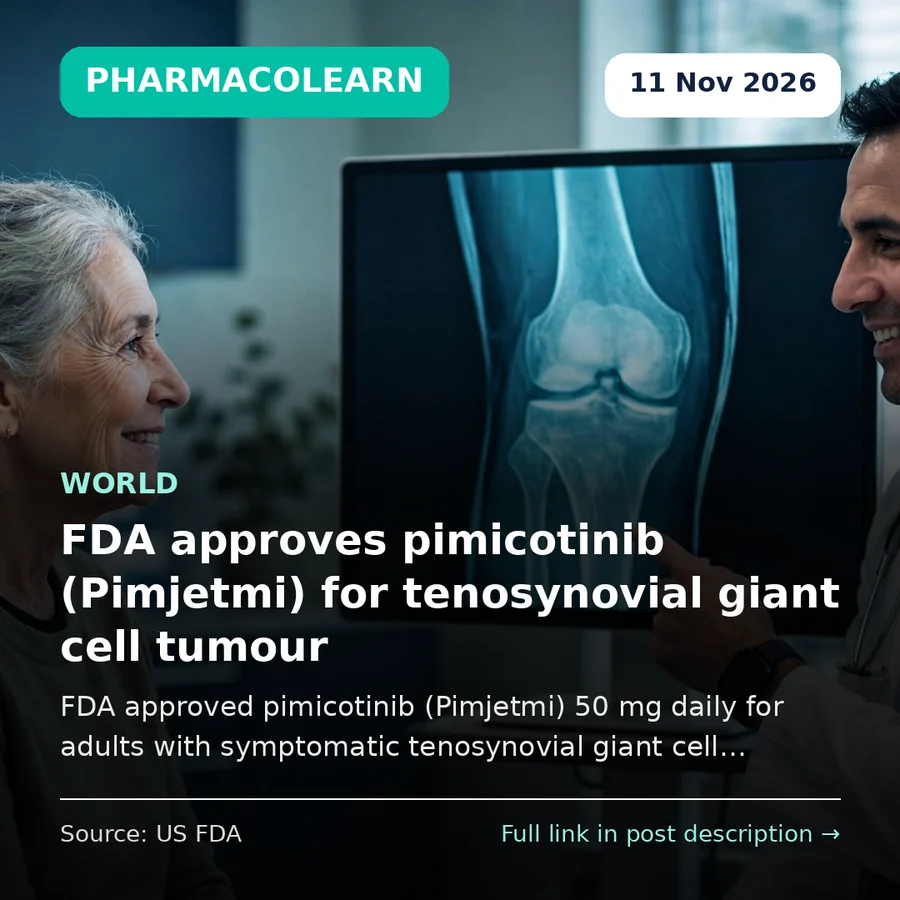
The FDA has approved pimicotinib, marketed as Pimjetmi, 50 mg daily, for adults with symptomatic tenosynovial giant cell tumour (TGCT) where surgery would risk severe harm. In the MANEUVER trial, the overall response rate was 56% with pimicotinib compared with 3.2% on placebo.
Tenosynovial giant cell tumour is a rare, locally aggressive tumour of the joints and tendon sheaths, driven in most cases by overexpression of colony-stimulating factor 1 (CSF1), which recruits macrophages into the tumour. Pimicotinib is a CSF1 receptor (CSF1R) inhibitor, so its mechanism directly targets the biology driving the disease — a clear example of targeted therapy for a rare condition. The approval matters for pharmacy students as a case study in orphan and rare-disease drug development, where surgery is often the only option and a systemic therapy can spare patients from disabling operations. Dosing, monitoring and adverse-effect counselling for a daily oral targeted therapy are also core pharmacist responsibilities here.
FDA Orders NAION Eye Warning on All GLP-1 Drugs Including Ozempic, Mounjaro, Wegovy and Zepbound
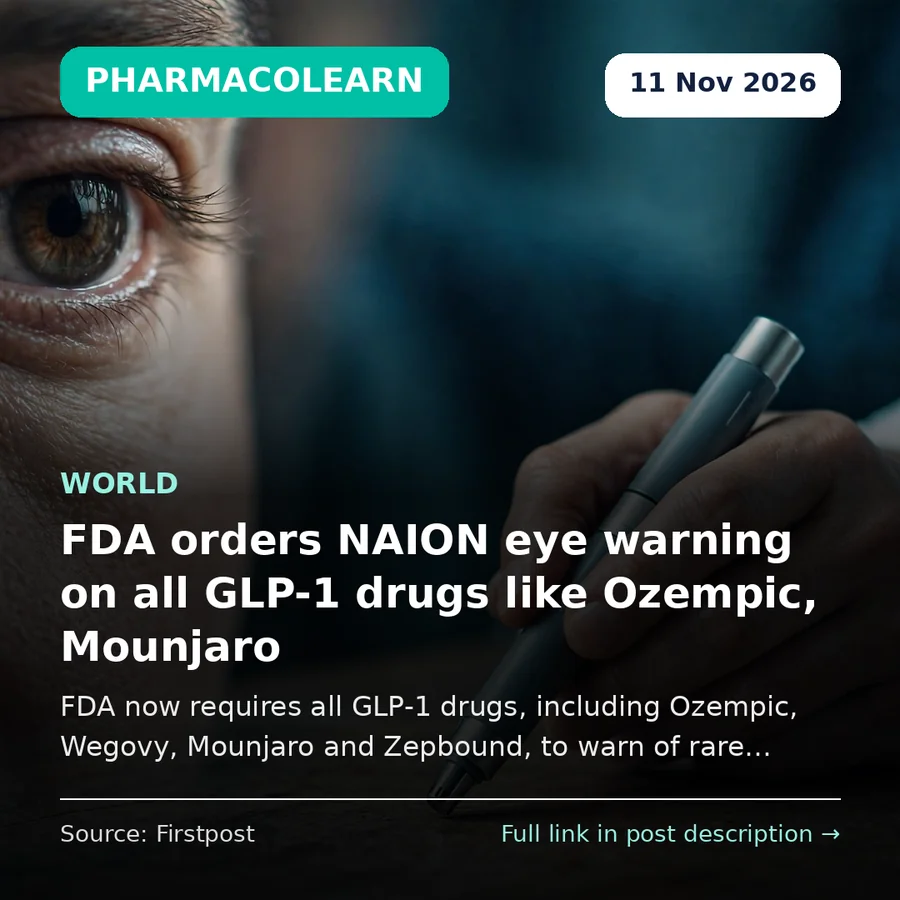
The FDA now requires all glucagon-like peptide-1 (GLP-1) receptor agonists — including semaglutide products Ozempic and Wegovy and tirzepatide products Mounjaro and Zepbound — to carry a warning about non-arteritic anterior ischaemic optic neuropathy (NAION), a rare condition causing sudden, painless vision loss in one eye. Patients should not stop their treatment on their own if they are concerned.
NAION occurs when blood flow to the optic nerve is reduced, and it has been reported rarely in people using GLP-1 medicines for diabetes and weight management. The risk remains rare, and the warning is a labelling update rather than a withdrawal, so the benefit-risk balance of these widely used drugs is unchanged for most patients. For pharmacy students, this is an important pharmacovigilance lesson: safety signals can emerge years after a drug class is in wide use, and regulators respond by strengthening warnings so that patients and prescribers can recognise symptoms early. Sudden vision loss is a red-flag symptom that always needs urgent medical attention, and pharmacists are well placed to counsel patients about it.
EU Expands Melphalan Flufenamide to Third-Line Multiple Myeloma Treatment

The European Commission has expanded the use of melphalan flufenamide (melflufen) plus dexamethasone to third-line treatment of relapsed or refractory multiple myeloma, confirming a positive opinion from the European Medicines Agency's Committee for Medicinal Products for Human Use (CHMP). The decision gives European patients another option after earlier lines of therapy have stopped working.
The expansion is notable because the same drug had its US approval withdrawn by the FDA in 2024, showing how regulatory decisions can diverge between regions as new evidence accumulates. Melphalan flufenamide is a peptide-drug conjugate that delivers an alkylating agent preferentially into myeloma cells, and its place in therapy depends on careful patient selection and monitoring. For pharmacy students, the story illustrates the lifecycle of a cancer drug: approval, expanded indications, safety review and, sometimes, withdrawal in one jurisdiction while use continues or grows in another — and why keeping up with current labelling matters more than memorising a single approval date.
Conclusion
Today's news spans the full arc of pharmacy: price regulation that makes cancer medicines affordable in India, a national ambition to lead drug discovery, the industrial strength of Telangana's pharma sector, and four major regulatory decisions from the US and Europe. The common thread is access and safety — getting effective medicines to patients at prices they can afford, while keeping a close watch on rare risks such as NAION and on how drugs perform after approval. For pharmacy students, these stories connect classroom pharmacology with the real world: NPPA margin caps and the PRIP scheme are policy in action, Sunharbo and pimicotinib are new mechanisms to learn, and the GLP-1 warning and the melphalan flufenamide divergence are reminders that a drug's story does not end at approval. Staying current with daily pharma news is one of the simplest habits that turns a good student into a well-informed pharmacist.
References
- ET Pharma https://pharma.economictimes.indiatimes.com/news/policy-and-regulations/over-1300-anti-cancer-drugs-to-get-cheaper/135696479
- Press Information Bureau https://www.pib.gov.in/PressReleasePage.aspx?PRID=2302307®=48&lang=2
- Hyderabad Mail https://hyderabadmail.com/telangana-second-largest-pharma-output-asi-2024-25/
- Medical Dialogues https://medicaldialogues.in/cardiology-ctvs/news/fda-approves-first-factor-xla-inhibitor-to-help-prevent-stroke-in-certain-adults-at-high-risk-182990
- US FDA https://www.fda.gov/drugs/cancer-approvals/fda-approves-pimicotinib-symptomatic-tenosynovial-giant-cell-tumor
- Firstpost https://www.firstpost.com/explainers/what-is-naion-the-rare-eye-condition-now-linked-to-ozempic-and-other-weight-loss-drugs-14058974.html
- OncoDaily https://oncodaily.com/not-to-miss/melphalan-flufenamide-628394