Daily Pharma News - 9 November 2026
NPPA Caps Trade Margins on 137 Anti-Cancer Drugs: Cancer Drug Prices in India Set to Fall by up to 70%
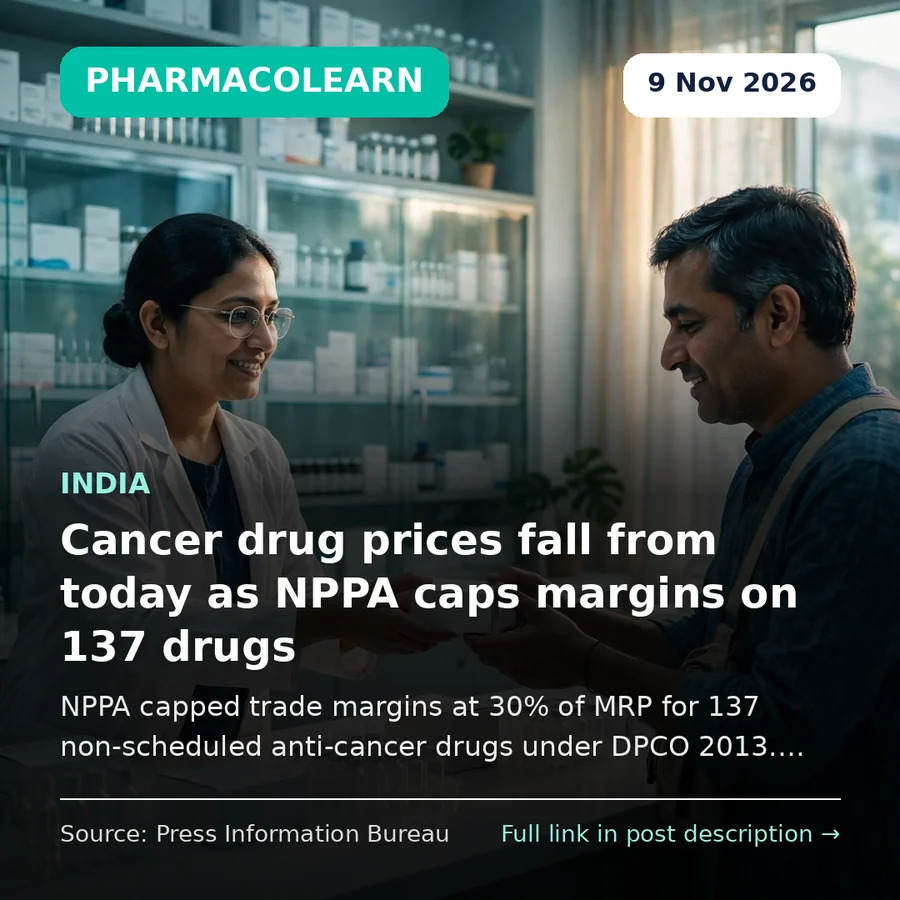
The National Pharmaceutical Pricing Authority (NPPA) has capped trade margins at 30% of the maximum retail price (MRP) for 137 non-scheduled anti-cancer drugs under the Drugs (Prices Control) Order, 2013 (DPCO 2013). The revised prices take effect from 9 November 2026, and MRPs are expected to fall by up to 70%, bringing real relief to cancer patients and their families across India.
Trade margin rationalisation works by limiting the gap between the price at which a drug leaves the manufacturer and the price the patient finally pays. For high-cost oncology medicines, where margins in the distribution chain have often been steep, a 30% cap directly targets one of the biggest drivers of out-of-pocket spending. Pharmacy students should note the distinction here: these are non-scheduled formulations, so the NPPA is using its trade margin powers under DPCO 2013 rather than a scheduled price ceiling, a mechanism that has previously been applied to other high-margin therapeutic categories.
For students preparing for GPAT, Drug Inspector and pharmacist recruitment examinations, this is a textbook example of price regulation in action. Watch how the revised MRPs appear on packs in the coming weeks, how hospitals and retail pharmacies adjust their procurement, and whether similar margin caps follow for other expensive therapeutic segments.
Fake Pfizer Antibiotics Racket Busted in Bengaluru: ED Raids Expose Relabelled Zavicefta and Emblaveo

The Enforcement Directorate (ED) has searched five premises in Bengaluru in connection with a racket allegedly relabelling cheap generic medicines as Pfizer's Zavicefta and Emblaveo, two last-line antibiotics used against resistant infections. The agency froze about Rs 9 lakh and seized devices and records during the operation.
Zavicefta (ceftazidime-avibactam) and Emblaveo (aztreonam-avibactam) are reserve antibiotics used when common treatments fail against multidrug-resistant Gram-negative bacteria. Fake versions of such medicines are especially dangerous because they reach critically ill patients, fail to treat life-threatening infections, and silently fuel antimicrobial resistance while appearing to be genuine therapy. The case is a reminder that the supply chain for high-value antibiotics needs constant vigilance, from manufacturing and distribution through to dispensing.
For pharmacy students, this story connects directly to pharmaceutical jurisprudence, drug supply chain management and pharmacovigilance. It underlines why verifying the source of medicines, checking batch and packaging details, and reporting suspected spurious drugs to the CDSCO and state drug control authorities is part of a pharmacist's professional duty.
Aurobindo Pharma Transfers Russian Subsidiary in Rs 29 Crore Internal Reorganisation

Aurobindo Pharma will transfer its entire stake in its Russian subsidiary, Auro Pharma LLC, to group company Auropharm Overseas for about Rs 29 crore. The internal reorganisation was approved on 4 November and is expected to be completed within 60 to 90 days.
The move is an intra-group restructuring rather than an exit from the Russian market, consolidating the Russian business under a different group entity. For Indian pharmaceutical companies with overseas subsidiaries, such reorganisations are commonly driven by operational efficiency, tax and compliance structuring, and clearer lines of management control across geographies.
Students tracking the Indian pharmaceutical industry should watch how large manufacturers organise their international arms, since these structures affect regulatory filings, supply continuity and financial reporting. Aurobindo is one of India's major exporters of generic medicines, and its Russian operations form part of a wider global footprint spanning regulated and emerging markets.
China NMPA Grants Priority Review to Ivonescimab for First-Line Biliary Tract Cancer
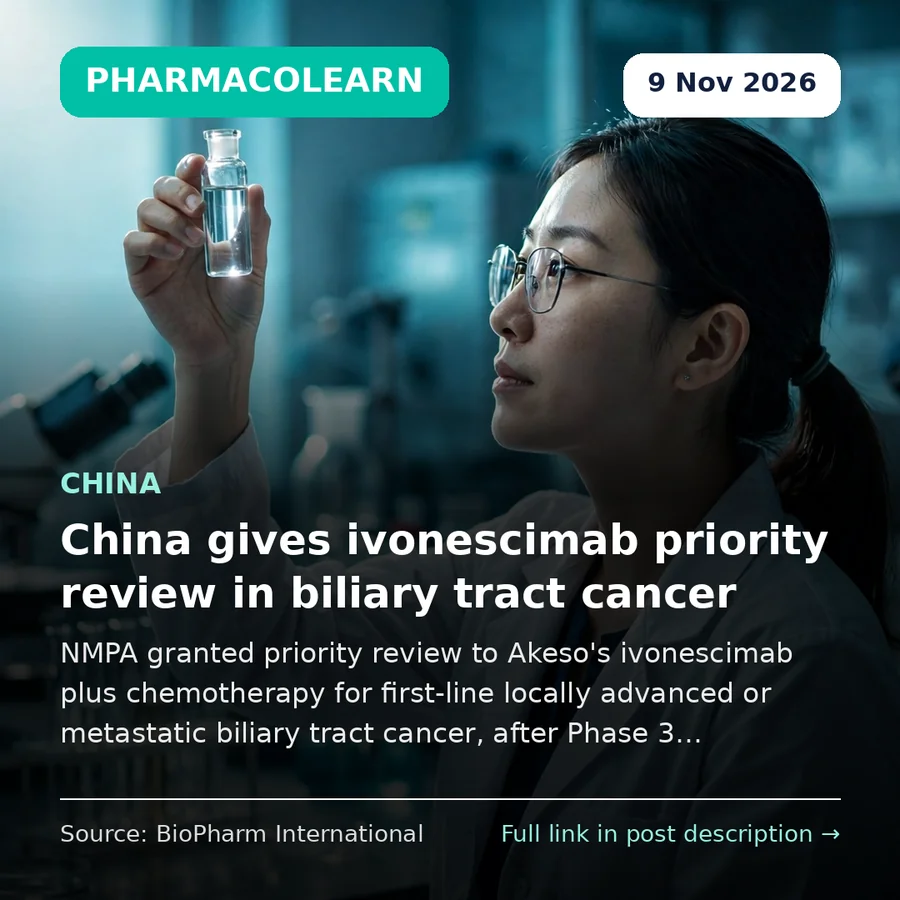
China's National Medical Products Administration (NMPA) has granted priority review to Akeso's ivonescimab in combination with chemotherapy for first-line treatment of locally advanced or metastatic biliary tract cancer. The decision follows the Phase 3 HARMONi-GI1 trial, which showed a survival benefit over durvalumab plus chemotherapy.
Ivonescimab is a bispecific antibody that targets both PD-1 and VEGF, combining immune checkpoint blockade with anti-angiogenic activity in a single molecule. Biliary tract cancers, which include cholangiocarcinoma and gallbladder cancer, are aggressive tumours with limited treatment options, and first-line therapy has long relied on chemotherapy with or without immunotherapy. A survival advantage over an established immunotherapy combination is therefore a meaningful signal for this difficult-to-treat cancer.
For pharmacy students, this is a useful case study in bispecific antibody pharmacology, oncology trial design and accelerated regulatory pathways. Priority review shortens the assessment timeline in China, and students should follow whether the NMPA converts this into a full approval and whether similar filings follow with the US FDA and the European Medicines Agency.
US FDA Grants Accelerated Approval to Rybrevant Faspro for Head and Neck Cancer
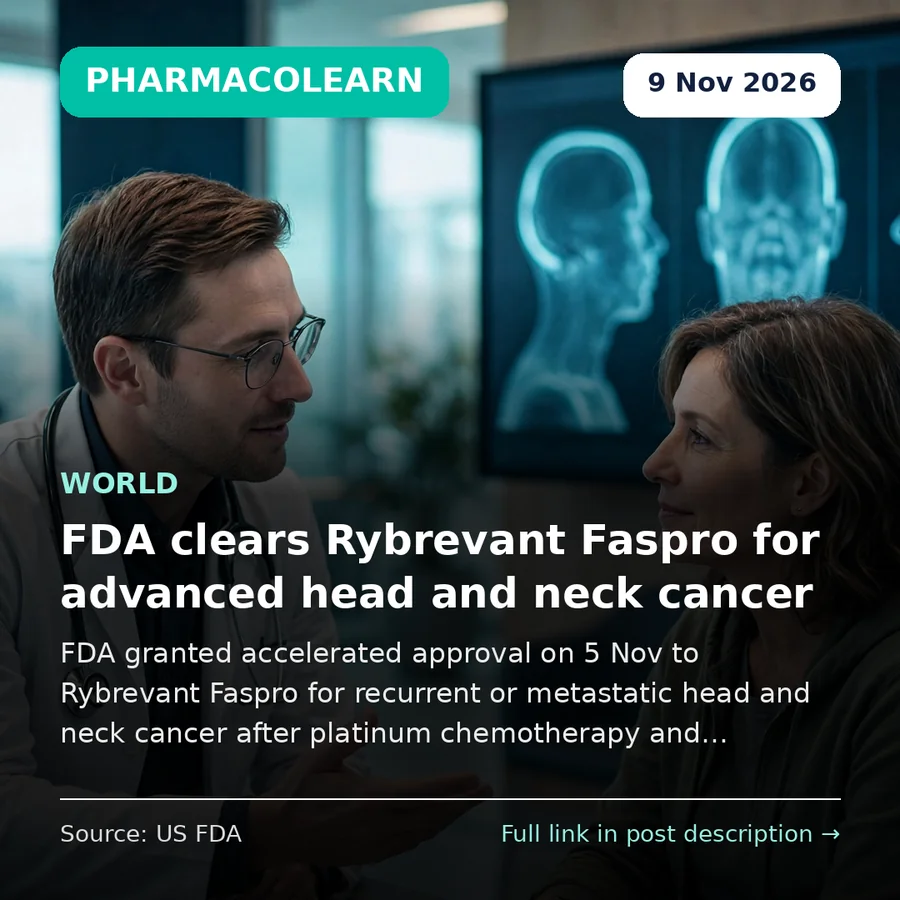
The US Food and Drug Administration (FDA) has granted accelerated approval on 5 November to Rybrevant Faspro for patients with recurrent or metastatic head and neck squamous cell carcinoma after platinum chemotherapy and immunotherapy. In a study of 102 patients, the overall response rate was 42%.
Rybrevant Faspro is the subcutaneous formulation of amivantamab, a bispecific antibody targeting EGFR and MET. The original intravenous Rybrevant is already established in non-small cell lung cancer, and this approval extends the drug into head and neck cancer, where options after platinum-based chemotherapy and PD-1 immunotherapy remain limited. The subcutaneous route is also significant for practice, as it can shorten administration time compared with intravenous infusion.
Accelerated approval is granted on the basis of a surrogate endpoint, in this case response rate, that is reasonably likely to predict clinical benefit, with confirmatory trials required to verify the benefit. Pharmacy students should understand this pathway well, since it explains why some oncology drugs reach patients quickly while further evidence is still being gathered, and why post-marketing surveillance matters.
Wegovy 2.4 mg Linked to Improved Liver Markers in Non-Obese MASH Patients: ESSENCE Post-Hoc Analysis
A post-hoc analysis of the ESSENCE trial, presented on 8 November at The Liver Meeting (AASLD 2026), found that Wegovy (semaglutide) 2.4 mg was associated with improvements in liver markers in adults with metabolic dysfunction-associated steatohepatitis (MASH) and liver scarring whose body mass index (BMI) was under 27 kg/m2. Semaglutide is already approved for MASH with moderate to advanced fibrosis.
MASH, formerly known as nonalcoholic steatohepatitis (NASH), is the progressive form of fatty liver disease in which fat accumulation is accompanied by inflammation and fibrosis, and it can advance to cirrhosis and liver failure. Most GLP-1 receptor agonist research in MASH has focused on patients with obesity, so data in non-obese patients with a BMI under 27 is notable: it suggests the liver benefits of semaglutide are not explained by weight loss alone and may involve direct effects on liver metabolism and inflammation.
This is a post-hoc analysis rather than a pre-specified primary endpoint, so students should read it as supportive evidence that needs confirmation, not as a new indication. It is a good example for pharmacology revision of how GLP-1 receptor agonists act beyond glucose control and weight reduction, and how trial subgroup analyses generate hypotheses for future studies.
Conclusion
Today's news spans the full arc of pharmacy practice, from the price a patient pays at the counter to the newest bispecific antibodies in oncology. The NPPA margin cap shows regulation working directly for affordability in India, while the Bengaluru fake antibiotics case shows why that same system needs constant enforcement. Aurobindo's Russian restructuring is a window into how Indian companies manage global operations, and the ivonescimab and Rybrevant Faspro decisions show regulators in China and the United States moving promising cancer therapies forward faster. Finally, the Wegovy analysis reminds us that familiar drugs can reveal new benefits when trial data is examined more closely.
For pharmacy students, the lesson of 9 November 2026 is to connect the dots: pricing policy, supply chain integrity, corporate strategy, clinical pharmacology and regulatory science are not separate subjects. They meet in the daily news, and the pharmacist who understands all of them is the one best placed to serve patients.
References
- Press Information Bureau https://www.pib.gov.in/PressReleasePage.aspx?PRID=2324743®=48&lang=2
- Medical Dialogues https://medicaldialogues.in/news/industry/pharma/generic-medicines-relabelled-as-pfizers-zavicefta-emblaveo-uncovered-in-bengaluru-ed-raids-182941
- Medical Dialogues https://medicaldialogues.in/news/industry/pharma/aurobindo-pharma-to-transfer-russian-subsidiary-to-another-group-entity-for-rs-29-crore-182866
- BioPharm International https://www.biopharminternational.com/view/china-nmpa-priority-review-ivonescimab-first-line-biliary-tract-cancer
- US FDA https://www.fda.gov/news-events/press-announcements/fda-grants-accelerated-approval-new-treatment-head-and-neck-squamous-cell-carcinoma
- Morningstar / PR Newswire https://www.morningstar.com/news/pr-newswire/20261108ny89636/novo-post-hoc-analysis-finds-wegovy-24-mg-was-associated-with-improvements-in-liver-markers-in-adults-with-mash-with-liver-scarring-and-a-bmi-less-than-27-kgm2-presented-at-the-liver-meeting-aasld-2026