Daily Pharma News - 6 November 2026
Today's edition brings together seven stories that matter for pharmacy students in India and beyond — a court-driven safety review of a familiar acidity drug, a proposal to open new import gateways for medicines, a major peptide manufacturing investment in Karnataka, and three important regulatory decisions from China, the United States and Indonesia, plus an early-stage report from Russia. Together they touch almost every subject a pharmacy student studies: drug safety and impurities, drug regulation and the Drugs Rules, pharmaceutical manufacturing, oncology, cardiology and vaccines.
Delhi High Court Seeks Time-Bound Safety Review of Ranitidine Over NDMA Impurity Concerns
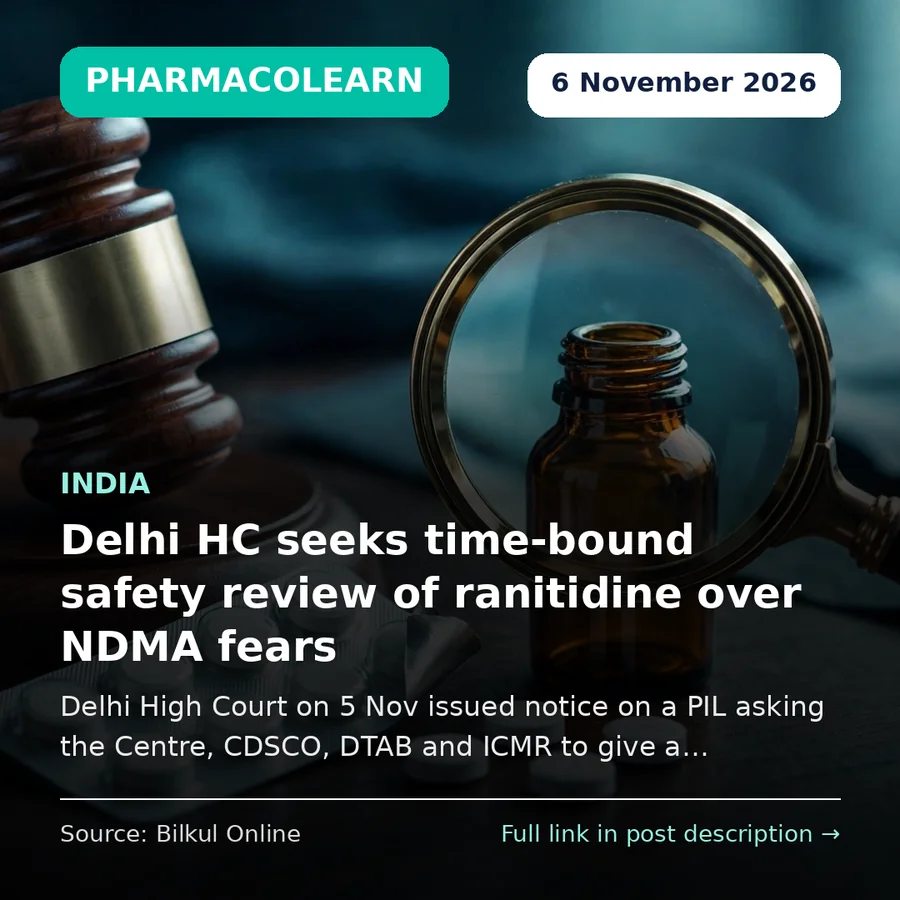
The Delhi High Court on 5 November 2026 issued notice on a public interest litigation asking the Centre, the Central Drugs Standard Control Organisation (CDSCO), the Drugs Technical Advisory Board (DTAB) and the Indian Council of Medical Research (ICMR) to take a time-bound, reasoned decision on the safety of ranitidine, the widely used H2-receptor blocker for acidity and peptic ulcer disease. The petition does not seek a ban on the drug; it asks the regulators to decide, with reasons and within a fixed timeline, whether ranitidine can continue to be sold in India given concerns about NDMA impurity.
NDMA, or N-nitrosodimethylamine, is classified as a probable human carcinogen, and it was the detection of NDMA in ranitidine products that led to withdrawals and suspensions of the drug in several countries from 2019 onwards. For pharmacy students, this case is a live lesson in how impurity profiling, nitrosamine risk assessment and regulatory decision-making interact — and a reminder that a drug's regulatory story does not end at approval. The court's demand for a reasoned decision, rather than silence, is itself significant: it pushes CDSCO and DTAB to put their scientific assessment of ranitidine on record.
India Proposes 10 New Import Gateways for Drugs, Devices and Cosmetics Under Draft Drugs Rules Amendment
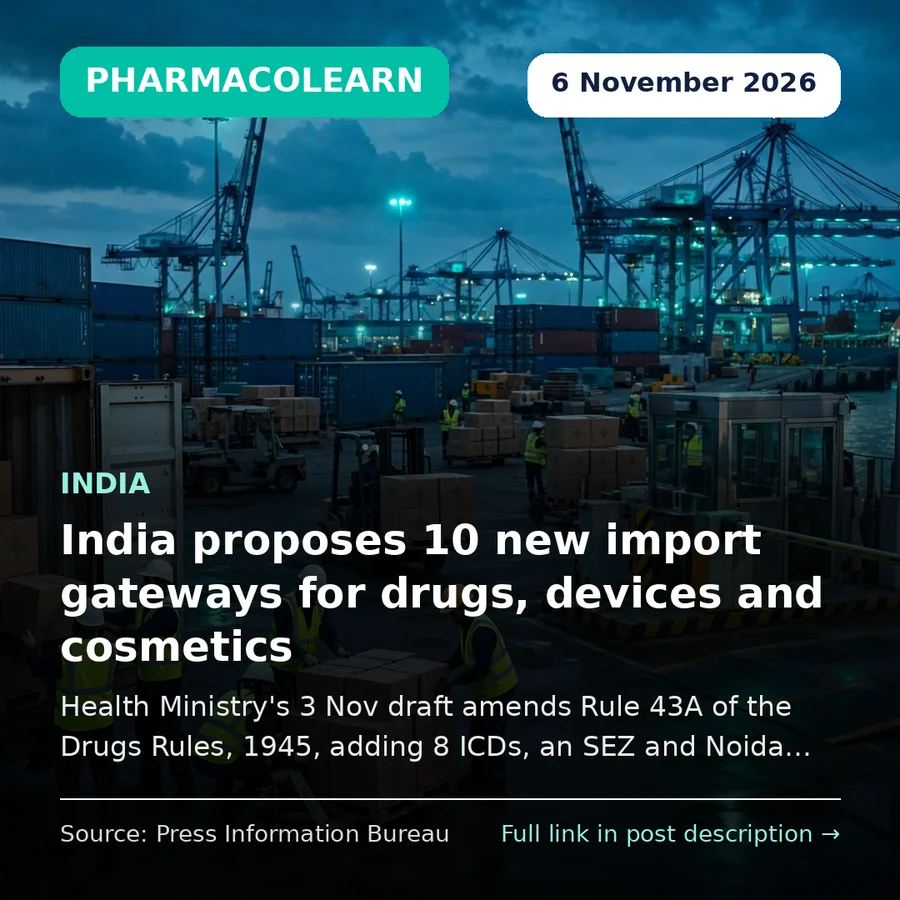
The Union Health Ministry on 3 November 2026 issued a draft amendment to Rule 43A of the Drugs Rules, 1945, proposing to add ten new authorised points of entry for imported drugs, medical devices and cosmetics — eight Inland Container Depots (ICDs), one Special Economic Zone (SEZ) and Noida airport. Comments from stakeholders have been invited on the draft, which is the standard next step before a rule change is finalised.
For students of pharmaceutical jurisprudence and regulatory affairs, Rule 43A is the provision that lists the places through which drugs may legally enter India, and every addition to that list eases the path for importers. More entry points should mean faster customs clearance and fewer supply bottlenecks for imported medicines, active pharmaceutical ingredients and medical devices — a practical benefit for patients and hospitals, and a useful example of how a small rule amendment can improve drug availability. Pharmacy students should note the process too: draft rules, public comments, then final notification is how most Indian drug regulation evolves.
Shilpa CDMO to Invest $50 Million in Peptide Manufacturing Capacity at Raichur, Karnataka
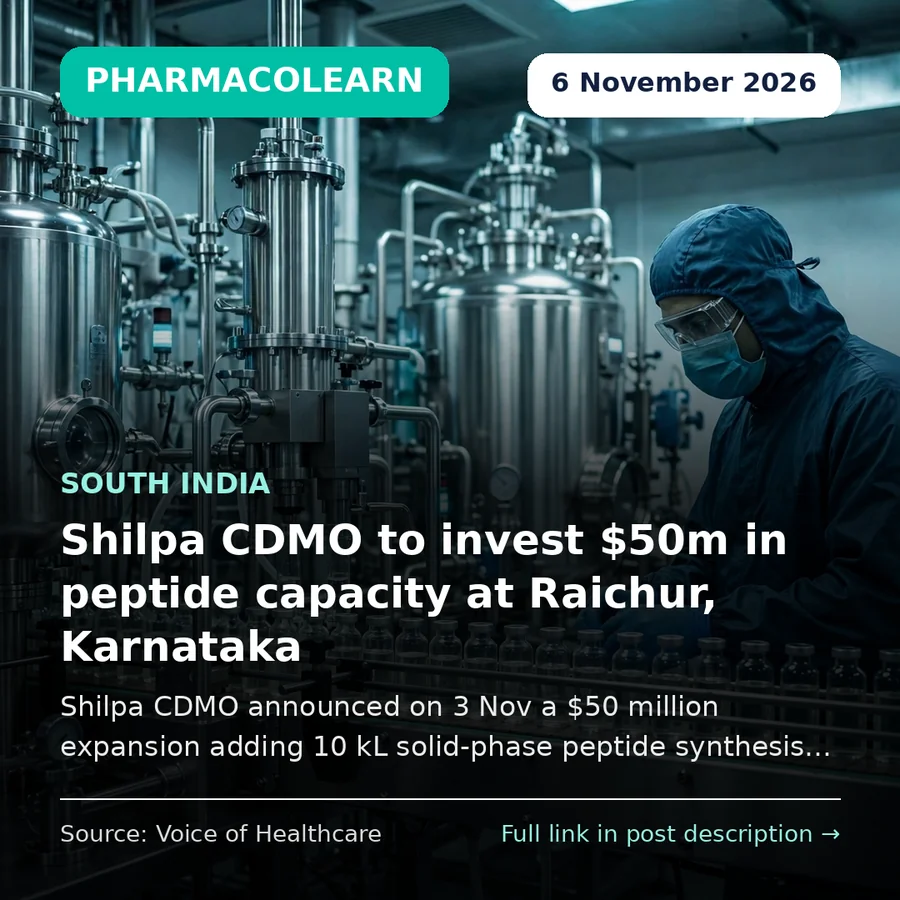
Shilpa CDMO announced on 3 November 2026 a $50 million expansion of its peptide manufacturing capacity at Raichur in Karnataka, adding 10 kL of solid-phase peptide synthesis capacity, with the first commercial production line due in December 2026. The investment is a direct response to surging global demand for peptide drugs, above all the GLP-1 receptor agonists used in diabetes and weight management.
This is a strong South India manufacturing story with national relevance. Karnataka is already a major pharmaceutical hub, and contract development and manufacturing organisations (CDMOs) such as Shilpa play a growing role in the global supply chain for complex molecules. For pharmacy students, peptides are a reminder that modern drug manufacturing goes well beyond tabletting: solid-phase peptide synthesis, purification and quality control of large molecules are specialist skills, and capacity announcements like this one signal where jobs and research opportunities in Indian pharma are heading.
China NMPA Clears Bayer's Sevabertinib (Hyrnuo) as First-Line Therapy for HER2-Mutant Lung Cancer
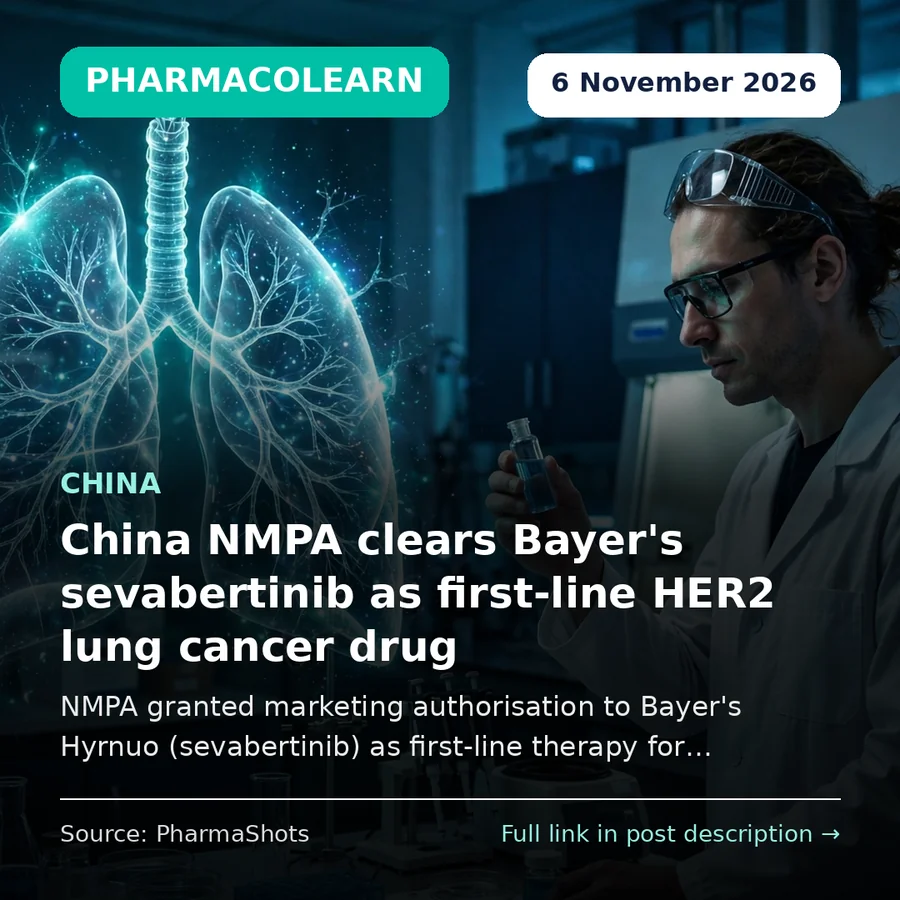
China's National Medical Products Administration (NMPA) has granted marketing authorisation to Bayer's sevabertinib, marketed as Hyrnuo, as a first-line treatment for HER2-mutant non-small cell lung cancer (NSCLC). The approval rests on the SOHO-01 trial, in which sevabertinib showed a 75 percent response rate in 73 previously untreated patients with HER2-mutant NSCLC.
HER2 mutations occur in a small but important subset of lung cancers, and targeted therapy has transformed outcomes for patients whose tumours carry driver mutations such as EGFR, ALK and HER2. A first-line approval matters because it positions sevabertinib ahead of chemotherapy for newly diagnosed patients, rather than as a later option. For Indian pharmacy students, the story is worth following for two reasons: HER2-targeted therapy is a core topic in oncology pharmacology, and NMPA approvals increasingly set the pace for cancer drug access across Asia, often preceding decisions by other regulators in the region.
Russia's New Antiplatelet Angepur Reportedly Enters Final-Phase Trials for Heart Attacks

Researchers in Volgograd, Russia, have reported that Angepur, a locally developed antiplatelet drug intended for use in myocardial infarction and after coronary stenting, has entered Phase 3 clinical trials. According to early reports, the drug may offer higher efficacy than existing antiplatelet agents, possibly with a lower risk of bleeding — but these claims should be treated as preliminary, since they come from early reports carried by a smaller aggregator rather than from a peer-reviewed publication or an official Russian regulatory announcement, and full trial data have not yet been published.
Antiplatelet drugs such as aspirin, clopidogrel and ticagrelor are the backbone of treatment after a heart attack and stent placement, and bleeding risk is their key limitation — so a new agent that is both more effective and safer would be a genuine advance if the Phase 3 data confirm it. For now, pharmacy students should note Angepur as a drug to watch, not as a proven therapy: the right question to ask of any Phase 3 candidate is what the randomised trial data show on both efficacy and bleeding endpoints, and that evidence is still awaited.
FDA Grants Accelerated Approval to Rybrevant Faspro for Advanced Head and Neck Cancer

The United States Food and Drug Administration (FDA) on 5 November 2026 granted accelerated approval to Rybrevant Faspro, the subcutaneous formulation of amivantamab with hyaluronidase, for patients with recurrent or metastatic head and neck squamous cell carcinoma who have previously received chemotherapy and immunotherapy. The overall response rate in the supporting data was 42 percent.
Amivantamab is a bispecific antibody targeting EGFR and MET, and the Faspro formulation allows it to be given as a subcutaneous injection rather than an intravenous infusion, which can shorten administration time and improve convenience for patients. Accelerated approval is the FDA pathway used when a drug shows a meaningful effect on a surrogate endpoint for a serious condition with unmet need, with confirmatory trials required afterwards — a distinction students should remember, since accelerated approval is not the same as a Fast Track designation. Head and neck cancer carries a high burden in India, so advances in this area, even from the US regulator, are directly relevant to Indian oncology practice and to GPAT and Drug Inspector exam preparation.
Indonesia Fast-Tracks M72 TB Vaccine Approval in Joint Review with the European Medicines Agency
Indonesia's drug regulator, BPOM, is building a conditional approval route for the M72/AS01E tuberculosis vaccine and will assess it jointly with the European Medicines Agency (EMA). Phase 2 data showed roughly 50 to 57 percent efficacy against tuberculosis, and the ongoing Phase 3 trial has enrolled around 20,000 participants.
Tuberculosis remains one of the world's deadliest infectious diseases, and India carries the largest share of the global TB burden, so a partially effective TB vaccine would be a landmark for public health. The M72 vaccine, developed from a Mycobacterium tuberculosis protein combined with the AS01E adjuvant system, is the most advanced TB vaccine candidate in decades. The joint BPOM-EMA review is also notable as a regulatory model: two agencies assessing the same dossier together can speed access in high-burden countries. Pharmacy students should watch the Phase 3 results closely, since efficacy, duration of protection and use alongside existing TB treatment will decide how widely the vaccine is adopted.
Conclusion
Today's news shows how connected the world of pharmacy has become. A court in Delhi is pressing Indian regulators for a clear, reasoned answer on ranitidine safety; the Health Ministry is widening the doors through which medicines enter India; a Karnataka manufacturer is investing in the peptide capacity the world now needs; and regulators in China, the United States, Indonesia and Europe are moving on cancer drugs and a long-awaited TB vaccine. For pharmacy students, the lesson is that drug safety, regulation, manufacturing and therapeutics are not separate chapters in a textbook — they are one story, unfolding every day. Keep following the primary sources linked below, practise reading trial endpoints such as response rates critically, and remember that early reports, like the one on Angepur, deserve curiosity and caution in equal measure.
References
- Bilkul Online https://bilkulonline.com/2026/11/05/delhi-hc-issues-notice-on-plea-seeking-time-bound-safety-review-of-acidity-drug-ranitidine/
- Press Information Bureau https://www.pib.gov.in/PressReleasePage.aspx?PRID=2331879®=48&lang=1
- Voice of Healthcare https://vohnetwork.com/news/finance/shilpa-cdmo-invests-50-million-to-expand-peptide-manufacturing-capacity-in-india
- PharmaShots https://pharmashots.com/37169/bayer-sevabertinib-nmpa-approval-1l-her2-nsclc/
- NabaMart https://www.nabamart.com/2026/11/russia-develops-drug-to-treat-blood.html
- FDA https://www.fda.gov/drugs/resources-information-approved-drugs/fda-grants-accelerated-approval-amivantamab-and-hyaluronidase-lpuj-recurrent-or-metastatic-head-and
- Tech Times https://www.techtimes.com/articles/330102/20261105/indonesias-bpom-fast-tracks-m72-tb-vaccine-approval-joint-ema-review.htm