
Daily Pharma News - 5 November 2026
Today's daily pharma news brings together tighter drug quality regulation in India, wider access to diabetes and HIV medicines, a step forward for personalised cancer vaccines from Hyderabad, a first biosimilar approval in China, and new Ebola vaccine trials in the Democratic Republic of the Congo. For pharmacy students, it is a useful snapshot of how regulation, manufacturing quality, and clinical innovation connect in everyday practice.
India Proposes Instant Licence Suspension for Substandard Drugs Under Draft Drugs Rules Amendment
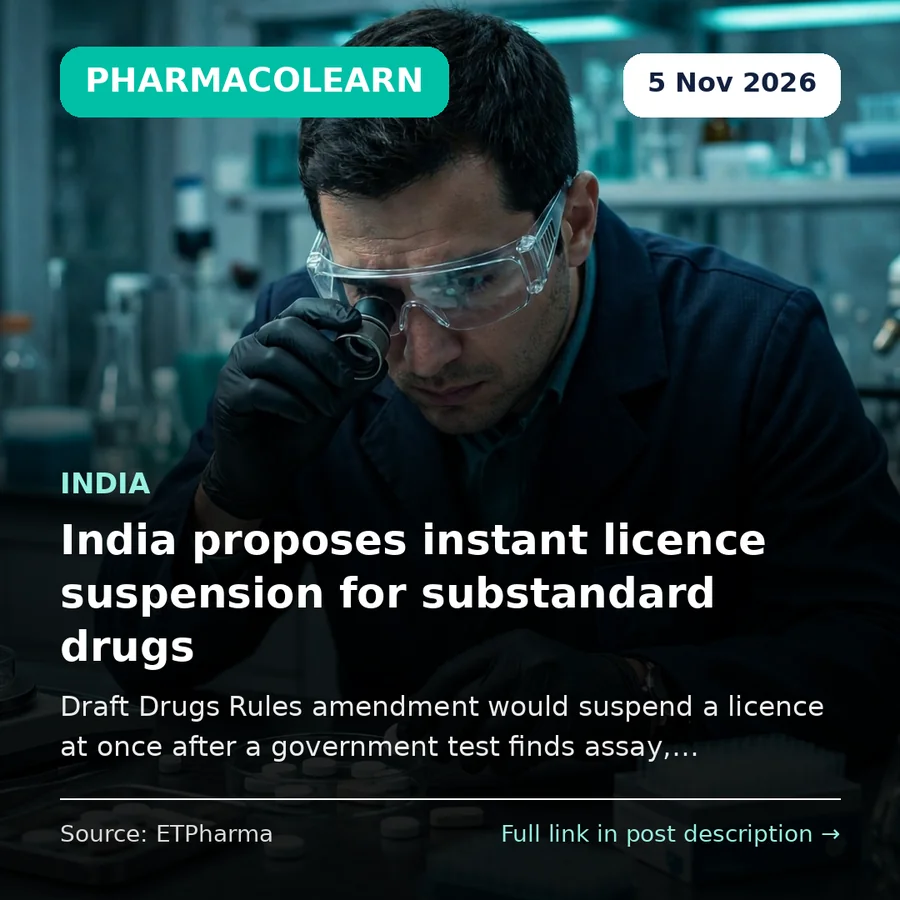
India is considering a draft amendment to the Drugs Rules that would allow a manufacturing licence to be suspended at once after a government test finds a drug to be substandard. The trigger would be a failure on parameters such as assay, dissolution, impurity or sterility, and the licence would be restored only after verified corrective and preventive action, known as CAPA. This is a significant shift from slower enforcement routes, because it links a laboratory finding directly and immediately to market action.
For students of pharmaceutical regulation and quality assurance, this proposal is a clear example of how not-of-standard-quality (NSQ) drug findings are handled in India. It underlines why assay, dissolution testing, impurity profiling and sterility testing matter beyond the textbook: a single failed parameter can now, under the proposal, halt production and supply. It also makes CAPA documentation, root-cause analysis and good manufacturing practice central skills for anyone entering industry or regulatory affairs.
India Plans WHO-Aligned No Growth Rule for Sterile Grade A Manufacturing Areas

The Health Ministry has proposed replacing Schedule M Table 3 so that Grade A clean areas in sterile drug manufacturing follow microbial limits aligned with the World Health Organization, with any detected microbial growth triggering an investigation. Comments on the proposal are invited for 30 days. Grade A areas are the most critical zones in aseptic manufacturing, where sterile products are exposed, so the microbial standard applied there directly affects patient safety.
This story pairs naturally with the first item of the day, since both concern quality systems in Indian pharmaceutical manufacturing. For pharmacy students studying sterile products, environmental monitoring and cleanroom classification, the proposal shows how Schedule M, the Indian good manufacturing practice standard, evolves alongside global guidance. A no-growth expectation for Grade A areas raises the bar for monitoring, gowning, aseptic technique and investigation of any excursion, and it is exactly the kind of regulatory update that appears in regulatory affairs and industrial pharmacy discussions.
Sun Pharma Wins CDSCO Nod for Generic Oral Semaglutide Tablets in India

The Central Drugs Standard Control Organisation (CDSCO) has cleared Sun Pharma to manufacture and market once-daily oral semaglutide tablets in 3 mg, 7 mg and 14 mg strengths for type 2 diabetes. Semaglutide is a GLP-1 receptor agonist, a class of medicines widely studied in diabetes care, and an oral tablet formulation widens access to oral GLP-1 therapy in India following expiry of the molecule patent. Generic competition of this kind is often what brings an advanced therapy within reach of far more patients.
For pharmacy students, this approval connects pharmacology, formulation science and the Indian generics industry in one story. Oral semaglutide is a formulation challenge because peptides are normally broken down in the gut, so the development of a stable, effective tablet is itself a pharmaceutical technology achievement. The CDSCO approval also illustrates the generic drug approval pathway in India and why patent expiry is such an important moment for access to medicines, pricing, and the domestic industry.
Hyderabad Startup PopVax Builds AI-Designed Personalised Cancer Vaccines at New RNA Foundry

Hyderabad startup PopVax has launched the city's RNA Foundry with Stochastic Sciences to develop mRNA vaccines tailored to the genetics of a patient's tumour. The aim is named-patient access by the end of 2026, subject to regulatory approvals. Unlike traditional vaccines that prevent infectious disease, personalised cancer vaccines are designed around the unique mutations of an individual's tumour, with artificial intelligence helping to select the targets most likely to trigger an immune response.
This is an exciting development for students interested in biotechnology, immunology and the growing Hyderabad life sciences ecosystem. Personalised mRNA vaccines sit at the intersection of genomics, bioinformatics, formulation and clinical translation, and they show why modern pharmacy curricula increasingly include genomics and biopharmaceuticals. Because the programme is still subject to approvals, it is also a reminder that promising early-stage innovation must pass rigorous safety and efficacy evaluation before reaching patients.
China Approves First Secukinumab Biosimilar BAT2306 for Psoriasis and Related Conditions

China's National Medical Products Administration (NMPA) has approved Bio-Thera's BAT2306, marketed as YOUZHUOMEI, the first secukinumab biosimilar in China, for psoriasis, ankylosing spondylitis and psoriatic arthritis. Secukinumab is a monoclonal antibody that targets interleukin-17A, a driver of inflammation in these chronic immune-mediated conditions. In parallel, Biocon expanded its licensing rights for the ustekinumab biosimilar YESINTEK to nine markets, showing how biosimilar competition is spreading across regions and companies.
Biosimilars are a core topic for pharmacy students because they are not identical copies of small-molecule generics but highly similar versions of complex biological medicines, requiring extensive comparability, immunogenicity and clinical evidence. This approval matters for India too: Indian biosimilar makers compete in the same global market, and every first biosimilar approval for a major biologic reshapes pricing, access and treatment options for chronic conditions such as psoriasis and inflammatory arthritis.
FDA Tentatively Approves Dr Reddy's Generic Twice-Yearly HIV Prevention Shot Under PEPFAR
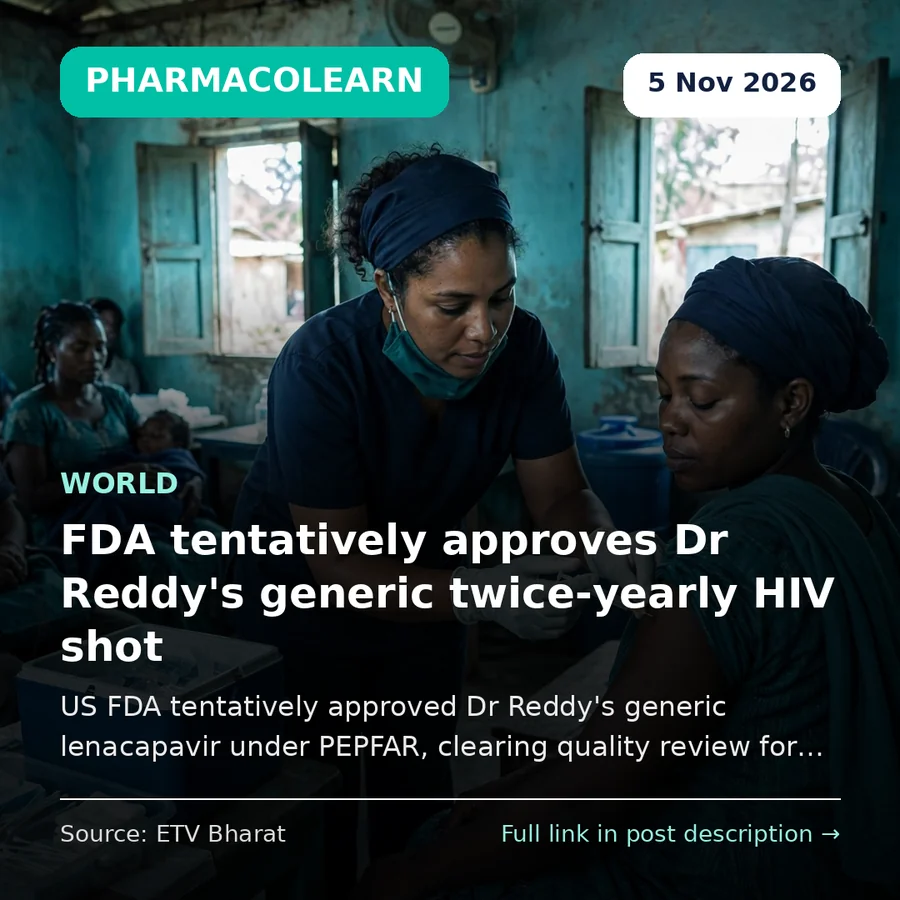
The United States Food and Drug Administration (FDA) has tentatively approved Dr Reddy's generic version of lenacapavir, a twice-yearly HIV prevention injection, under the PEPFAR programme. Tentative approval means the product has cleared quality review and can be supplied to 120 low- and middle-income countries at a reported cost of $40 a year, although it cannot yet be sold in the United States. Long-acting HIV prevention is a major advance because adherence to daily tablets is one of the biggest challenges in prevention programmes.
For Indian pharmacy students, this story highlights India's role as the pharmacy of the developing world, with Indian generic manufacturers supplying affordable HIV medicines globally for decades. Lenacapavir's twice-yearly dosing schedule also raises important clinical pharmacy questions about counselling, follow-up, supply planning and programme delivery in resource-limited settings. It is a strong example of how tentative FDA approval, PEPFAR procurement and generic manufacturing combine to expand access to essential medicines.
WHO Adds Two New Ebola Vaccines to DRC Bundibugyo Trial

World Health Organization experts have recommended two new Ebola vaccines, Oxford-Serum Institute's ChAdOx1 BDBV and Moderna's mRNA-1469, for trial in the Democratic Republic of the Congo, where Bundibugyo Ebola has killed more than 5,300 people. Results from the trial are expected in early 2027. Bundibugyo is one of the Ebola virus species, distinct from the better-known Zaire strain, and it has historically had fewer vaccine options, making dedicated trials especially important.
This story brings vaccine trial design, outbreak response and global health equity into focus for pharmacy students. Testing two different vaccine platforms, a viral-vector vaccine and an mRNA vaccine, in the same outbreak setting allows direct comparison of approaches that students study in biopharmaceutics and immunology. It also shows the WHO's role in coordinating research during outbreaks, and why clinical trial pharmacy, cold-chain logistics and ethical trial conduct matter when research happens under emergency conditions.
Conclusion
Taken together, today's news tells a single coherent story about modern pharmacy: regulation is tightening where quality fails, access is widening where patents expire or generics scale up, and innovation is moving toward personalised and long-acting therapies. India features on both sides of that story, as a regulator strengthening Schedule M and Drugs Rules enforcement, and as a manufacturer bringing oral semaglutide and generic lenacapavir to patients at home and abroad. For pharmacy students, the lesson is practical: a strong grounding in quality assurance, regulatory affairs, pharmacology and clinical pharmacy is not just exam material, it is the daily work behind every headline here. Keep following these threads, because today's proposals and tentative approvals are tomorrow's marketed products, inspection findings and counselling points.
References
- ETPharma https://pharma.economictimes.indiatimes.com/news/policy-and-regulations/centre-weighs-immediate-suspension-of-license-for-drugs-flagged-as-nsq/135555656
- The Hindu BusinessLine https://www.thehindubusinessline.com/news/health-ministry-proposes-changes-to-microbial-contamination-limits-for-sterile-drug-manufacturing/article71665970.ece
- India Pharma Outlook https://www.indiapharmaoutlook.com/news/sun-pharma-gains-cdsco-nod-for-oral-semaglutide-push-nwid-6044.html
- The New Indian Express https://www.newindianexpress.com/amp/story/cities/hyderabad/2026/Nov/02/hyderabad-startup-developing-personalised-cancer-vaccine
- Legal 500 https://www.legal500.com/intelligence/global/food-drugs-healthcare-life-sciences/global-biosimilar-market-update-secukinumab-biosimilar-approval-in-china-and-expanded-ustekinumab-licensing-rights
- ETV Bharat https://www.etvbharat.com/en/international/approval-of-a-cheap-version-of-hiv-prevention-shot-lenacapavir-raises-hopes-in-low-income-countries-enn26110206542
- MedicalXpress https://medicalxpress.com/news/2026-11-clinical-trials-ebola-vaccines.html